Software
Houzz Logo Print
mjnoah_gw

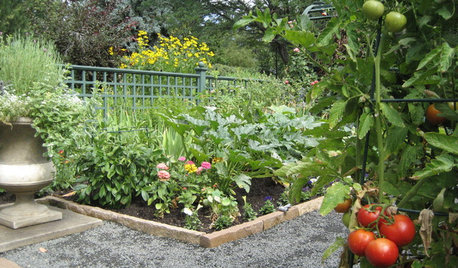
Raised Beds for Vegetable Garden

17 years ago

Our club is considering planting a vegetable garden and donating the food to the local food pantry. I was going to use raised beds but no more than 6 inches high as it gets very hot and dry in our area in the middle of the summer and so it might be too hard to keep them from drying out. It has been years since I did vegetables and just started growing them again last year in my own garden.

I have a few questions. How big a garden would be sufficient to donate, initially, a few hundred pounds of produce. I didn't want to start too big. We will be doing tomatoes, pepper, cukes, beans, onions to start. I want to be sure we get sufficient help in the summer to maintain the garden. We can always add on next year.

Secondly, does anyone find it easier to build the beds first and then dig and amend the soil inside the box, or till the whole area first and then place the boxes, adding more amendments on top of the tilled soil. We have heavy clay.

Lastly, how easy is it to use a raised bed without borders, just mounded soil. Does the bed decrease in size over the summer with soil running off?

Thanks.

Comments (5)

  • 17 years ago

    Our club is considering planting a vegetable garden and donating the food to the local food pantry.

    Very cool. I was going to use raised beds but no more than 6 inches high as it gets very hot and dry in our area in the middle of the summer and so it might be too hard to keep them from drying out.

    The deeper the beds are the less often they need to be watered. Water in the top 2-3 inches will dry from evaporation, but below that it won't so it only goes dry as plants use it unless there is an extreme drought in which case it may dry down further. How big a garden would be sufficient to donate, initially, a few hundred pounds of produce.

    Yikes, I dunno as I never have weighed things. A few hundred pounds sounds like a a lot, but a tomato will weigh much more than a pepper. Rather than worry about how much you have to donate, why not focus instead on the area you and your club can actually handle attending to? Secondly, does anyone find it easier to build the beds first and then dig and amend the soil inside the box, or till the whole area first and then place the boxes, adding more amendments on top of the tilled soil. We have heavy clay.

    Save yourself a lot of work and don't dig the ground at all. 6" of good growing depth is enough for all the plants you mentioned. They will grow deeper if they wish. You really don't need to do anything at all to the ground under the beds.

    I have heavy clay and my beds are 8" framed with around 6" of growing depth over the clay. Clay is actually really good for growing things provided it doesn't get compacted or dry out to the point it becomes brick like. Under 6" of growing beds that aren't walked on this won't happen. Lastly, how easy is it to use a raised bed without borders, just mounded soil. Does the bed decrease in size over the summer with soil running off

    This depends entirely on the rain run off. If the garden is in an area with significant run off you want to frame the beds to prevent run off. If run off isn't a major issue you can just mound the soil and have no frames.

  • 17 years ago

    From what I read a few minutes on another forum, you may not want to dig down into the clay, you may cause the "bathtub effect". Check out the linked thread.

    Here is a link that might be useful: RB drainage

  • 17 years ago

    One of my gardens is on top of several feet of hardpan and clay, so I have raised beds. In my neck of the woods, raised beds without sides would wash away in less than 2 weeks. I use old boards for the sides of the beds, usually 4-6 inches tall. When building the bed, I lay 4 layers of newspaper on top of the ground. I don't bother to kill the weeds or grass first; the newspaper will kill them. I do, however set the lawnmower to the lowest height and mow the area first. I then put the raised bed box on top of the newspaper and shovel dirt on the outside of the box to fill any gaps. I put half an inch of sand in the bottom of the raised bed to cover the newspaper, and with a garden fork, puncture the newspaper for drainage. On top of that, I put a nice layer of slow release 10-10-10 since the plants aren't going to get many nutrients from the soil. Over that I put a mixture compost and pine needles and I fill it up to the top. This works great for me. In succeeding years, every spring I mix in more 10-10-10 and then fill to the top with more compost mixed with pine needles.

    Not sure about other vegetables in raised beds since we usually only grow cucurbits and garlic in this particular garden, but cucumbers grown in this type of raised bed, and watered with fish emulsion added to the water every other day yields well over 100 lbs per growing season per 2x20 ft. Squash can give a higher yield with the proper variety. With the feeding every other day, the plants can be grown in very high density and thrive. For example, we plant cucumbers in 2 ft wide beds with 4 rows 7-8 inches apart. The seeds in the rows are planted 2-3 inches apart and we let nature thin them out, but that still leaves us with very high density. And the cucumbers just love it. The only bad thing is that it is very easy to overlook some of the cucumbers, so we usually grow yellow varieties, such as lemon or Boothby's Blonde.

    Good luck.

  • 17 years ago

    "mjnoah mentioned,
    it gets very hot and dry in our area in the middle of the summer and so it might be too hard to keep them from drying out."

    not necessarily the case with the use of a good layer of mulch hay, we mulch to around 6" or 8"s.our plant grow on available rainwater or a water about once a week.

    len

    Here is a link that might be useful: lens garden page

  • 17 years ago

    Hi, in my very first veg garden I did raised beds but didn't use the box, I just mounded the soil into rows 6"-8" deep and put my grass clippings in between the rows to help w/weeds. At the time I lived in a small town that had water restrictions, (I came from a house that had a well so it was difficult to adjust) and I lived right across the street from the city water dept. so I thought I was doomed.

    I bought the resin soaker hoses and burried them under the raised beds, leaving one end out so I could connect to it when I wanted to water. Let me tell you, I had the best veg garden, everythihng grew so nicely. I think it was b/c the water went right to the roots instead of the foliage. And there is no fear of watering in the hot sun and risk burning the vegs, or wasting water. And I never got caught sneaking water