Software
Houzz Logo Print
anney_gw

Plants that repel insect pests

19 years ago

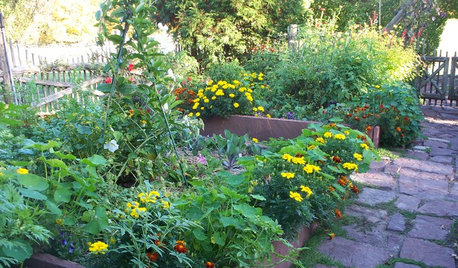
Though I haven't had many insect pests so far, probably because of this drought, I'm thinking about interplanting plants considered to be pest repellents in my garden next year.

I found this list at the link below. It also lists companion plants and plants that don't grow well together. Maybe it will be useful to someone else as well.

Insect Repellents

Basil -- Flies, Mosquitoes, Asparagus Beetle

Borage -- Tomato Worm

Calendula -- Asparagus Beetles, Tomato Worms

Catnip -- Ants, Aphids, Cockroaches, Flea Beetle, Japanese Beetles

Chrysanthemum -- Mexican Bean Beetle

Cosmos -- Mexican Bean Beetle

Coriander -- Aphids

Dandelion -- Colorado Potato Beetle

Dead Nettle -- Potato Beetle

Fennel -- Fleas

Flax -- Potato Beetle

Garlic -- Aphids, Apple Scab, Borers, Japanese Beetles, Peach Leaf Curl Disease, Spider Mites

Geranium -- Cabbage Worm, Red Spider Mite

Henbit -- General insect repellant

Horseradish -- Potato Beetle

Hyssop -- Cabbage Moth

Lavender -- Mice, Ticks, Moths

Marigold -- Mexican Bean Beetle, Nematodes

Mint -- Ants, Aphids, Cabbage Moth, Fleas, Mice

Mole Plant -- Mice, Moles

Nasturnium -- White Flies, Squash Bugs, Striped Pumpkin Beetle, Wooly Aphid (apple)

Oregano -- Cabbage Butterfly, Cucumber Beetle

Parsley -- Beetles

Pennyroyal -- Fleas, Flies, Mosquitoes

Pot Marigold -- Asparagus Beetle, Tomato Worm

Radish -- Cucumber Beetle

Rosemary -- Bean Beetles, Cabbage Moth, Carrot Fly

Rue -- Flies, Japanese Beetle, Cats, Dogs

Sage -- Bean beetle, Cabbage Moth, Carrot Fly, Slugs

Southernwood -- Cabbage Moth

Sunflower -- Armyworm

Tansy -- Ants, Fleas, Flies, Japanese Beetle, Moths, Striped Cucumber Beetles, Squash Bugs

Thyme -- Cabbage Worm

Wormwood -- Animals

Here is a link that might be useful: Companion-Insect Repellent Plants

Comments (10)

  • 19 years ago
    last modified: 11 years ago

    I have had particularly good luck with Basil repelling all kinds of insects. Unfortunately, I've also had poor luck with Borage--the white flies moved in and now call it home-sweet-home.

  • 19 years ago
    last modified: 11 years ago

    celestial

    That's good to know. Whiteflies are deadly spreaders of the tomato yellow leaf curl virus (TYLCV) in southern states, and if they're attracted to borage, people should know that.

  • 19 years ago
    last modified: 11 years ago

    very good link, thanks anney. Rodger

  • 19 years ago
    last modified: 11 years ago

    I can attest to using fern-leaf tansy with cucumbers with great success. Mine are thriving, with no sign of the nasty squash bugs that plagued my early squash.

  • 19 years ago
    last modified: 11 years ago

    Rosebush

    In that list, tansy is also said to repel cucumber beetles. They and squashbugs were a torment to me last summer, so I'll certainly be on the lookout for tansy.

    Rodger

    Didn't you have cuke beetle trouble last summer, too? Are you the Rodger who participated in that discussion about using clove oil as a bait for them?

  • 19 years ago
    last modified: 11 years ago

    Great topic. Is there anything to repel whitefly? I'm a newbie so I didn't know exactly what it was that was killing my tomatoes, but that had to be it -- that and the tomato yellow leaf curl virus, which is the best, most descriptive name of a disease I've ever seen. Does the virus live on in the soil? (The tomatoes were in containers, so it's not too terrible a problem, but I'd like to be able to use that soil to amend other areas of the garden later, unless it's diseased...)

  • 19 years ago
    last modified: 11 years ago

    mgpaquin

    According to this site, the tomato yellow leaf curl virus does not survive in soil. I'd do some more research to make sure that's what all the research says.

    I also found the site linked below that describes an odiferous "invention" to repel whiteflies using fermented eggshells and eggwhites as the ingredients. It sounds pretty smelly, if you know what rotten eggs smell like! Here's the process described in the link. I don't know if it could be reproduced by home gardeners or not, since the information given appears to comprise some sort of formula that someone wants to take commercial. I'm also not sure if you're supposed to spray the plants with the resulting smelly mess or water the soil with it. The author says the plants themselves begin to smell of sulfur and thereby whiteflies are repelled, so I concluded the soil around the plants should be watered with it. Yet, in another place the author mentions "placing" it on leaf surfaces. If the plants smell like sulfur, I suppose any fruit would taste like sulfur, and nobody wants tomatoes to taste like that, but who knows? Maybe one tomato plant in a container could be sacrificed as a test!

    =====

    There are many parts of an egg including the albumen or egg white. Typically, the albumen accounts for about sixty-seven percent of an egg's weight. The albumen contains more than half of the egg's total protein, minerals and vitamins. The albumen contains protein, niacin, riboflavin, chlorine, magnesium, potassium, sodium and sulfur.

    The pest repellant is produced by fermenting eggshells with a portion of the albumen attached thereto. Fermentation is the chemical process that breaks down organic materials. The process is carried out by bacteria, molds and yeasts that are present in the air. It is believed that the fermentation process liberates sulfur from sulfates and sulfides present in the amino acids of the eggshells and albumen.

    A chemical analysis of chicken eggs was undertaken and the following results were yielded. One-hundred grams of fresh chicken eggs contains approximately 70.83 g of water, 12.14 g of protein and 11.15 g of lipids. Minerals present in the eggs were as follows: 56 mg of C, 2.09 mg of Fe, 12 mg of Mg, 180 mg of P, 130 mg of K, 138 mg of Na and 1.44 mg of Zn. Vitamins included in the fresh eggs were as follows 0.087 mg of Thiamin, 0.301 mg of Riboflavin, 0.062 mg of Niacin, 0.120 mg of B6, 1.547 mg of B12 and 520 IU of A. The chicken eggs also included amino acids in the approximate quantities: 0.820 g of Lysine, 0.392 g of Methionine, 0.289 g of Cystine, 0.596 g of Threonine, 0.759 g of Isoleucine and 0.686 g of Phenylalanine.

    Methionine and Cystine both include sulfur. Methionine is represented by the following structural formula. ##STR2##

    Cystine is represented by the following structural formula. ##STR3##

    Since the eggshells and albumen contain amino acids that comprise sulfur, sulfur dioxide is created during the fermentation process. Sulfur dioxide is a colorless gas with a distinctive odor. The sulfur dioxide contributes to repelling the pests as it is placed on the leaf surfaces of the plant. The plants also absorb the sulfur present in the mixture of eggshells and albumen and give off a sulfur smell that repels pests.

    Another important element in the pest repellent is sulfide. Sulfide is a chemical compound that contains sulfur and another element. All sulfides contain the sulfide ion, a single sulfur atom with an electrical charge of -2. Sulfide ions are present in some proteins which make up living things. Since eggs are high in proteins, sulfide is present in them. During the manufacturing process of the pest repellent sulfur from the sulfide is liberated by the fermentation process.

    The best contemplated process for producing the pest repellant, involves collecting eggshells with part of the albumen attached thereto. The eggshells are placed into a metal or plastic container with warm or hot water. Over a period of time, the water coupled with bacteria and other fermenting agents dissolve the eggshells and cause them to decompose and liquefy. The mixture of water, eggshells and albumen are allowed to ferment for a period of time. Typically, the mixture ferments for at least twelve days. Heat may be introduced into the curing time to increase the fermentation process and cause chemical bonds to be broken thereby more quickly liberating sulfur. Likewise, the mixture may be stirred occasionally to increase the fermentation process. Typically, the mixture is tested using a hydrogen sulfide test kit to determine whether it is ready to be applied to plants. The mixture is ready for use as a pest repellant when the hydrogen sulfide is present in at least an amount of 0.424 mg/I.

    The mixture is then strained to remove visible or non-liquid particles. Silt sized particles may remain in the mixture due to the calcium in the shells. Typically, the calcium carbonate of the egg shells does not breakdown entirely leaving silt sized particles which may be filtered from the mixture. In the preferred embodiment, the silt sized particles are left in the mixture and are applied at the base of the plant adding nutritional value to the mixture. The preferable ratios of chemical compounds in the mixture are 250 ml of H2 O to 24.3 g of CaCO3 to 1.060-5 g of H2 S. The following is the structural formula for the pest repellant. ##STR4##

    The following are examples of the effectiveness of the pest repellant mixture.

    EXAMPLE 1

    A mixture of hydrogen sulfide and calcium suspended in water, as mentioned above, was applied to a poinsettia plant. The poinsettia plant was placed near a gardenia bush that was infested with white flies. The poinsettia plant was monitored and visually inspected bi-weekly for approximately five months during warm weather. Visual inspections of the poinsettia plant revealed no white flies, larvae or white fly eggs present on the leaves of the poinsettia plant. The plant remained healthy and productive with blossoms and leaves of deep color.

    EXAMPLE 2

    A gardenia bush that was infested with white flies operated as a control. White flies were visibly present on the leave surface of the gardenia bush. A second gardenia bush was placed within approximately a foot of the control. The second gardenia bush was treated twice a month with a mixture containing 0.424 mg/l of H2 S as mentioned above. Visual inspections of the gardenia bushes were conducted over a four-month period of time. While the control remained infested with white flies, no white flies were present during the visual inspections on the second gardenia bush. Further, neither larvae nor white fly eggs were found on the underside surface of the leaf. The second gardenia bush remained healthy and did not become infested with the white flies.

    It is to be understood that the invention is not limited to the exact construction illustrated and described above, but that various changes and modifications may be made without departing from the spirit and the scope of the invention as defined in the following claims.

    Here is a link that might be useful: Patent application

  • 19 years ago
    last modified: 11 years ago

    Hi Anney,

    Interesting subject!

    I grow many of the plants on that list to attract beneficial insects. This year my garden is buzzing with insect activity as many of the herbs are flowering. Sunflowers and coneflowers are glorious right now. This year I added a couple of birdbaths w/pebbles on or near the ground. Plants like fennel, dill, angelica, carrot and coriander produce large amounts of nectar over a short period of time. Fennel blooms from July-Sept and attracts around 500 different species of insect, 195 of these are predatory and 105 are parasitic.
    Also, flat open daisy-like flowers composed of many tiny florets such as; calendula, sunflowers and asters. They produce smaller amounts of nectar than the aforementioned group, but over a longer period of time. Last year I tried to create "havens" for good bugs to overwinter. Like a pile of leaves, straw, flat rocks or boards.

    I love borage and I've never had a problem with whitefly. The borage self seeds lightly around the garden. The bees love it and it is VERY attractive. When it outgrows it's space, I yank it and toss it to the compost pile. OTOH, I learned the hard way that catnip actually ATTRACTS flea beetles. The trick, I believe, is to plant the catnip AWAY from plants you're trying to protect. In my case, eggplant.

    I've been afraid to say anything...but I'm not seeing bean beetles this year. :) I did find 2 sitting on the same leaf last week and swished em! I'm growing a lot of beans this year and I'm REALLY surprised that I haven't seen more bean beetles. Not so many cuke beetles either. In fact, even J beetles are not as bad this year. Rain has not been plentiful here. It can rain in the next town and never a drop here...or the other way around.

    One plant I'm growing 1st time is lovage. What a monster! Fortunately I planted it by the garden fence so I was able to stake it when it reached 7'! The flowers attract an abundance of beneficials as well as swallowtail cats. It's one of the "busiest" plants in the garden along with the liatris (blazing star) and earlier a chard plant that overwintered and went to seed. OMG, it was covered in bene's long before other herbs were even flowering. Carrots are excellent to overwinter for flowers in the spring.

    Ps... I would take pics but I can't get my camera to focus or zoom...???

    Here is a link that might be useful: Beneficial insects

  • 19 years ago
    last modified: 11 years ago

    aka_peggy

    You're fortunate that probably the whitefly that's a vector for TYLCV isn't reported in your area yet, so you can grow borage and not think your tomato plants might be at risk. It's in the deep south and has spread to California and a couple of other states along the Southern border of the US. I don't dare grow borage at all!

    Of course, I immediately began to think of using chopped-up borage leaves and flowers as whitefly bait in a cup with Sevin liquid. If you can't repel 'em, then attract them and poison them!

  • 19 years ago
    last modified: 11 years ago

    Anney, thanks for your wonderful reply! Now I feel much safer about re-using my container soil in my garden. Thanks again -- your reply was much appreciated.