Software
Houzz Logo Print
gregbaker_gw

saving corn seed- how many plants, etc.

18 years ago

Hi everyone,

I've been saving my own seed for most of the items in my garden, but not corn. Would like to start (open-pollinated, of course), but not sure I can grow enough plants to avoid inbreeding depression. While the written information I've found consistently stresses the need for many plants, I do find some inconsistency in the exact number- (all paraphrased)

"...at least 200 plants, save seed from at least 10%..."

"...at least 200 plants, save seed from every plant..."

"...at least 100 plants, save seed from at least 1/2..."

"...200 will work for awhile, but 300+ is necessary for the long term..."

Have been doing some early planning for next year's garden, and here's the deal: assuming 12" spacing, 24" between rows, I can do ~120 plants without cutting into space for other vegetables & while maintaining my 3-year rotation scheme.

Haven't settled on a variety, though it will be "multi-purpose"; a few ears here & there for fresh eating, the rest for cornnuts & cornmeal. Black Aztec is a leading candidate, though I'm still scouring the web for others.

I would appreciate any advice or experiences from those of you who save your own corn seed, especially if your plant population is similar to what mine will be.

Comments (8)

  • 18 years ago

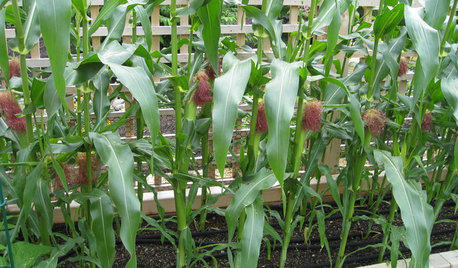
    The rule is 200 ears of corn from 200 different plants. And the more the better. I am not sure of what varieties you plan on saving and what types, but lots of the older corns are quite tall especially the dent types, well over 10ft. Older sweet corns 6-8ft and popcorns around 6ft. I mention this because 12in apart in rows and 24inches between rows is way to close, only the outside edges will make anything the corn in the center will be so overcrowded that it will not produce any ears or only inferior ears. Corn needs minimum 3ft between rows even for modern hybrids and older taller corns need 2ft between plants minimum. Rodger

  • 18 years ago

    Maybe I am missing something one corn. I know its different from field corn (feed corn) but when you look at a field of feed corn the rows are little more then a foot aparta dnt he plants are maybe 6 inches apart. Why does sweet corn need soooo much more space???

    Right now Im growing mine (peaches and cream)staggered double row 8 inches between plants and 18 inches between rows. Side dress with fert, heavily mulched and irrigated. 6 feet tall and throwing ears. Someone shoudl tell my corn its not supposed to be growing like that.

  • 18 years ago

    Interesting, I'm following intensive corn planting at 3 inches between stalks and 8 inch rows. I've just started to get tassels and silks on my first plantings. I may not get 2 or 3 ears on every stalk, but I couldn't expect that anyway. And I'd be darned if I were to plant 20 stalks in my 44 SF bed. It's an experiment for me, but so far so good!

    Here is a link that might be useful: Sinfonian's garden adventure!

  • 18 years ago

    Sweet corn can be planted like sinfonain is doing. I have done it several times where space is limited for gardens. The number of ears per stalk depends a lot on the variety.

    As far as your question of how many ears, on 8 inch ears, you save only the center 3 or 4 inches.

  • 18 years ago

    I would take as much seed as possible and store it up for the long term. Even freeze some for the real long term. That way you avoid any problems with depression over many generations.

    I do not see a reason to save only the center 3 or 4 inches of corn. They are pollenated from the tassels and the location in the ear does not seem to matter.

    the book SEED to Seed is going to help if you save all kinds of seeds. It is suggested that you can slightly increase diversity by not taking pollen from a plant onto the ears of the same plant. It is suggested you take 100 plants for the tassels and 100 plants for the ears. Mix the pollen together and put onto the ears. You would bag the tassels and bag the ears.

    It is also suggested that you must pull out the bad corn stalks and not allow them to be used. It also says that much bigger fields are needed for long term maintenance of the full diversity of genes. So with 200 plants you will only be partially successful no matter how hard you work at it.

  • 18 years ago

    I guess I need to clarify, the question was how many ears to save seed on corn. 200 is an acceptable standard in most publications. As Dangould stated Susan Ashworths book seed to seed is the best resource for home gardeners for saving seed. The statement on using pollen from 100 stalks and silk from another 100 is 200 different plants and this is for hand pollinating. So 200 plants wind pollinated is acceptable if no other corn within a mile tassling. On the distances I stated that for older varieties larger distances were needed. Even on hybrids which are smaller plants 2ft-3ft between rows and 1-2ft between plants is need to produce a good crop.When growing a seed crop more distance is better than when growing for home cunsumption. The intent is to provide maximum light and nutrients to each corn stalk to produce the best seed. I know because I grow heirloom corns for seed both commercially and for preservation.Bill in PA it may look as if the corn in the rows is only a 8iches apart and that is true but if you measured it is probably closer to 24inches between rows vice the 18inches. This works for modern field corns which are smaller plants have less leaf spread and produce smaller ears. For the others I am not talking about growing sweet corn in a small home garden for eating. A couple of rows of intensly planted corn will probably produce a few ears satisfactory for a home grower. I answered the question as a grower and a preservationist for someone who maybe interested in growing a corn variety for seed and preserving the genetic diversity of the corn with out having any significant affect from inbreeding. Corn and other outcrossing crops can quickly develope inbreeding problems in just a couple of generations if sufficent seed from sufficient plants are not saved. For the home gardener do as you please but if you grow and pass on to someone else grow for a seed company or are intently passionate about preserving the variety get some good reference books such as Seed to Seed. Corn is a crop that takes a lot of room to produce a good crop. And it is a fun crop to grow in a small intensive plot and can produce satisfactory ears for eating. But it cannot produce seed good enough to preserve the genetic diversity unless the 200 plant minimum population size is used and adequte spacing and nutrients are used to allow each plant to produce full size ears that are well pollinated and full. Rodger Winn

  • 18 years ago

    As for using only the center of the ear is because most all the kernals on each end are not fully developed. You will deffinetly have problems with germination. When open pollinated corn was used by farmers many years ago, they would go to their crib and select only the longest and biggest ears they could find. They never used either end except to feed their animals.

    They needed 11 to 12 pounds of seed to plant 1 acre in 36 inch rows.

  • 18 years ago

    Thanks for all the replies. I knew at best I'd be on the ragged edge of acceptable diversity. Think I'll keep buying seed until I get enough beds to grow at least 300.

    Have been saving seed from tomatoes, cucumbers, pole beans, squash, lettuce, & watermelons. Have some carrots in the seedling stage that I plan to overwinter for seed production next year. Only corn & potatoes remain. With corn it's just a matter of getting enough space for an adequate population. Potatoes... not sure what to make of them. Everything I read says it's not worth it to save seed potatoes because yield will suffer dramatically after several years, and that seed potatoes on the market are regenerated by tissue culture every five years. Makes me wonder how older varieties ever survived the times before that technology was available, since potatoes don't come true to type from seed. Somebody obviously knew how to keep those varieties productive & disease-free for more than five years.