Software
Houzz Logo Print
patrad_gw

Pruning Espailer Apple Tree

12 years ago
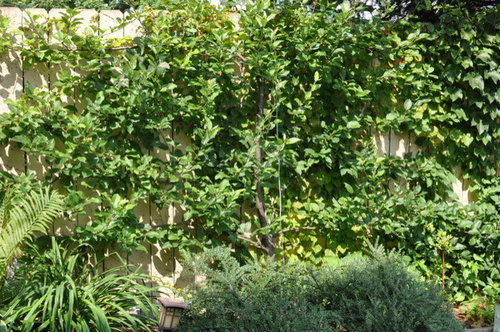
My house came with this hybrid apple tree that was espalier'd. For the last three years I have been pruning the "shoots" or long branches that come off the main horizontal branched. However I have never seen any buds or fruit develop. This year I avoided pruning at all to see if it would bud. I've not seen anything and I'm wondering what the best practice is now? Should I prune off all the shoots now? Later? Long term when should I be pruning these shoots and is something wrong that I never see buds let alone fruit? Thanks!

Here is a link that might be useful: more images

Comments (15)

  • 12 years ago

    Probably has to do with how and when the tree is pruned. You must retain some of this years wood in order to have flowers next year.

  • 12 years ago

    This info may help -- see link

    Here is a link that might be useful: espalier

  • 12 years ago

    Apple trees can almost always be trained to bear fruit, but they all have different fruiting habits and there is a range of rootstocks that alter how large they need to be before they bear fruit (although this can be adjusted to a large degree by skillful pruning).

    Nurseries often sell espaliers on the wrong rootstocks and/or of the wrong varieties to be productive in a small space, so you can't assume your problem is entirely about how you are pruning.

    I think you should search further for information on pruning espaliers than the link given. It makes it look very simple but doesn't even explain that espaliers are maintained primarily through summer pruning.

    Some varieties you can get to form flower buds by repeatedly cutting new shoots during the growing season to short pieces with just a few leaves while other varieties you need to leave the weakest shoots uncut until they produce flower buds.

  • 12 years ago

    This year wait until Mid-August and prune all the upright "water shoots" to 2 inch stubs with 4-5 leaves. Wait until mid-August because by then the tree should have set its terminal (apical) bud which signals the tree's switch-over from growing new vegetative growth to ripening the fruit, creating next year's buds and storing carbs in the roots for next springs initial growth.

    See the excerpt from "Fruit Grower's News
    ___"Any summer pruning should be accomplished after the apical bud sets. If shoots are removed before terminal bud set, expect to see re-growth near cuts. Excessive early pruning can also reduce conversion of shoots into spurs and delay or inhibit flower bud initiation."__ ( see the link below)

    PLEASE NOTE that espaliers are pruned differently that regular trees. So next spring and early summer you can keep pruning off the new growth through early July. Next year you should prune the new water shoots and growth to maintain the shape of the espalier and to keep it open and airy.

    There are many videos on Youtube that discuss "summer pruning espaliers".

    My espaliers are young and still growing vigorously so the get pruned in late May, early July and September.

    Good Luck

    Mike

    Here is a link that might be useful: FRUIT GROWERS NEWS

  • 12 years ago

    Not knowing what variety it is and I assume not knowing what a flower bud looks like the previous year makes it difficult.
    Doing nothing is a good start. See what it does next year. If it still does nothing I would try late summer (mid-late August) pruning (only, no summer upkeep on the shape). Don't remove too much of the tree, just tip everything.

    Hard to say from the pictures but it does look like what my McIntosh (non-spur) was doing and trying to get a spur but the constant pruning would turn them into branches until it eventually had no fruiting spurs. (3rd picture down)
    It took the late summer pruning to get it back to fruiting. As long as I leave it over grown the spurs will stay spurs quite a while.
    So now I'm trying to thin the over growth back a little each year without shocking it into trying to make everything branches again.

    Timing that late summer pruning is the issue, again coming down to not knowing the variety making it difficult.

  • 12 years ago

    Good fruit grower is a magazine for commercial growers. I've no idea about the actual experience of the writer of the article- the name isn't even mentioned so my hunch is the info is derivative and not specifically applicable to espaliers- it is about summer pruning in commercial orchards.

    Repetitive cutting of shoots during the growing season stops some varieties from setting fruit buds, but other varieties respond differently based on what I've read and my experience with certain pears. (Mike, I told you that your problem with the method is you were performing it on Macintosh which tends to set flowers on 2-year wood- for it, repetitive pruning creates a purely vegetative response.)

    You can also prune espaliers anytime during the growing season for any variety if you are only removing the more vigorous shoots- not just water sprouts (as stated in the article).

    There are several other things in the article I could debate, but a short article has to speak in sweeping general recommendations. Pruning espaliers involves much more aggressive removal of wood than regular "3D" trees, even if there is some overlap in potential response.

    One rule of thumb for espaliers in particular, feel free to remove any shoots or branches off a main branch that is more than a third the diameter of that branch at the point of attachment- and do it at most any time.

    The fruit almost always sets on the less vigorous shoots and with espaliers relative diameter is the primary determiner of vigor. With free standing trees branch angle and position in tree (light exposure) is also important.

  • 12 years ago

    Yes I know it's a bad choice. That's why I now recommend spur types for espalier. Once they're convinced to stay to size they take very little pruning and have no problems fruiting.
    The only thing I can imagine worse would be trying to espalier a Newtown Pippen.

    The replacement espaliers were grafted and selected by me with the intention of them being espaliered by comparing my spur Cortland to the non-spur McIntosh.
    If I hadn't lost my free standing McIntosh this year the espaliered one probably would be either cut down or pruned without a care if it fruited.

  • 12 years ago

    I've managed several Macintosh as espaliers and if you leave the weakest shoots and attack the strong ones you may have some success with it. Just don't worry about it being a trim as most espaliers until it is bearing fruit.

  • 12 years ago

    What's odd is with it overgrown it's willing to continue using the same spurs on old high wood without sending a whispy branch out of them.
    It's just in a bad spot for the garden to allow to be like that.

    One of the others is a spur Mac so once it's bearing full I can play around with the stubborn one.

  • 12 years ago

    H'man,

    The part I quoted tracked most of the info I've read at various extensions and books and also in one of the Dave Wilson vids.

    As you noted, espaliers are pruned differently.
    The one consistent bit of advice to promote feuiting spurs is to prune the water shoots to a stub as described.

    Mike

  • 12 years ago

    Deleted duplicate

    This post was edited by mes111 on Fri, Aug 1, 14 at 20:26

  • 12 years ago

    So I found some old documentation that was given to me with the house and the tree is a Hybrid Apple (Golden and Red Delicious). Not sure if that changes anything. Thanks!

  • 12 years ago

    Here's a photo of what it should look like, a bunch of smaller spurs. I pinch mine back several times during the growing season to the same place.

    Red Delicious has an annoyingly vertical growth habit that is an odd choice for espalier, but can be done.

  • 12 years ago

    There are spur varieties of red delicious.

  • 12 years ago

    Ok I now see some apical buds. Those are the only buds I see. Sounds like I should prune all the shoots to spurs? Or just the big ones?