Software
Houzz Logo Print
austransplant

Pruning young pear tree

19 years ago

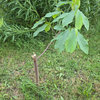
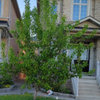
The photo below is of a Seckel pear on OHF 513 planted in the fall of 2006. As you can see, it has grown vigorously, but most of the growth is in the vertical leaders starting near the top of the whip I planted. Articles on pruning seem to assume that there will be lateral branching below the top of the whip, and so don't give much help on what to do with a tree like this. Any suggestions would be much appreciated.
{{gwi:125047}}seckel

Comments (4)

  • 19 years ago
    last modified: 11 years ago

    Hello Austranplant-

    I had trouble seeing your tree clearly in the photo. Is there any chance you could take one from a different angle and with a better background?

    It appears though that your pear is going vertical on you pretty fast. It would have been better if the branches that are pointing UP had been spread when they were quite small. The branch angle you have favors inclusion of bark, which makes for a weak joint when the tree is larger. Fruit does better, too, on branches that are closer to the horizontal.

    Pears love to do that vertical thing. Do you plan to train your tree to a central leader or a vase? Either is still possible at this stage, but it needs to be decided one way or the other. I would favor a vase -Don's very convincing about that- but my own pear is in cramped quarters and I've kept it as a central leader.

    I think a better picture and a clear idea as to which pruning form you want to adopt would give people here something to work with.

    Good luck,

    M

  • 19 years ago
    last modified: 11 years ago

    Austransplant:

    I agree with Mark 100%. Articles and internet sites may assume that pear trees have nice, spreading branches, but in the real world they usually grow straight up. A pear tree allowed to pursue its own instincts can end up 20 feet tall with a narrow footprint making it impossible to tend the fruit.

    The objective with a young tree such as you have is not to prune it, but to spread the branches. There are various ways to do this, but if branch spreaders are impractical, stakes with tiedowns may be the solution. On my own pear trees, I have spread the branches for a number of years, then pruned out the central leader completely, leaving a vase shape normally associated with stone fruit trees. This leaves the fruiting branches of the trees at such a height that I can reach nearly all the fruit to thin and pick without a ladder. If there are still branches that are too close, I remove them completely until they are at least 2-3 feet apart. As with apples, summer pruning is more effective with pears than dormant pruning to stimulate fruiting and control growth.

    Like Mark, I had a little difficulty seeing your pear tree because of the bush behind it, but it appears to be very young and you do not yet have a very complicated situation. Next spring, I would start on branch spreading, when the branches are very flexible. No need to prune yet. If your Seckel is like most European pear trees, it may be a few years before you see significant blooming and fruit set.

    Don Yellman, Great Falls, VA

  • 19 years ago
    last modified: 11 years ago

    Don and Mark,

    Thanks for your comments. This was my first attempt at posting a photo and I apologize for its small size. If you click on the link below you will see a larger and clearer version of the picture. I will have to do more research on how to have get large pictures to accompany my messages.

    In any event, the basic situation is that the tree is about 5' tall (about 3' of growth this year) with three main branches coming out from around the top of the original whip. I did in fact put spreaders in to try to get them out a bit (the speaders cannot be seen in the small image), so the branches originally were even more vertical than they appear in the photo. I like the idea of a vase shape and have plenty of room with a 15' spacing between my trees. I was worried about aggressive pruning, which seems frowned on for pears due to worries over fire blight, but did not want my pear to end up like my neighbor's pear with its unpruned vertical tangle of limbs reaching to the sky. So it looks like staking or weighting the branches down in spring as much as they can reasonably take looks like the way to go. Should I remove the spreaders I had put in or leave them on over winter?

    Here is a link that might be useful: picture of pear tree

  • 19 years ago
    last modified: 11 years ago

    Hi again.

    Please don't apologize for the small photo- I'll confess to not knowing how to post one at all, so you're way ahead of me. The larger one made things much clearer.

    About the fireblight issue: Yes, it can be very serious for pears. A few years ago a local nurseryman persuaded me to remove a Bartlett I'd planted and replace it with a Gold Spice on OHF5xx on the grounds that sooner or later the Barlett would get blight and the OHF rootstock and Gold Spice had shown themselves to be pretty resilient. So I gave away the Bartlett, and it died this year of fireblight. But do be prepared to spray for fireblight if it becomes an issue locally. Pruning is an essential control of fireblight (to remove blighted material) too. So far I've been lucky, even though this year there was quite a bit of it around. Youre mileage will vary- a quick google search will give you a wealth of information, such as this link:

    http://www.crophealth.com/fire_blight.htm

    Also, a regularly, properly pruned pear will have an open, airy structure that is less inclined to disease, and will make it easier to detect the first symptoms. So in time you'll need to prune it, and in time it will require only maintenance pruning.

    I'll take the liberty of copying one of Don's responses to me, when I asked him about summer pruning my youngish pear:

    >>* Posted by jellyman 6/7VA (My Page) on
    Tue, Sep 5, 06 at 11:59

    Mark:

    I think it depends on the tree and its individual circumstances and characteristics. Summer pruning places stress on a tree. In my orchard, where all the trees are healthy and vigorous, and mulched at least once a year with a thick layer of stable manure, that stress is a positive factor since it promotes fruiting spur development and helps control unwanted vegetative growth.

    I don't think I would summer prune a weak, sick, or spindly tree, or a very young tree that is just establishing its scaffold. But when they reach 5-6 years of age and begin substantial fruit production, I think you can switch over entirely to summer pruning so long as trees remain healthy.

    One other thing I have done to the apple trees in recent years is to completely remove the central leaders and change them over to more of a vase shape. I think this has improved the color and quality of the apples, as well as making the trees easier to spray, thin, and pick. And I have cut off these major leader branches in late summer to try to discourage the bushy regrowth that will inevitibly occur at the pruning cut. Regrowth still occurs, but it is less vigorous than if done in the dormant season. When bushy regrowth occurs in the center of the trees, I cut it off immediately as I wander around the orchard. I usually carry a pruning shears in my back pocket when I am out there.

    Don Yellman, Great Falls, VA My own instincts for your tree are to prune it this March in such a way as to encourage some of those lower branches to develop, but Don may suggest waiting another year, and he knows what he's talking about whereas I'm still struggling with a lot of it. I'd really like to hear other opinions and instruction on that.

    Hope this has helped.

    Good luck,

    M