Software
Houzz Logo Print
painfullybrilliant

Bermuda Grass Seed Heads?

15 years ago

Hello,

Complete newbie here so looking forward to learning a lot.

I don't know if my bermuda lawn is growing seed heads, but there is a green/yellow fuzz phenomenon going on and I would like to get a confirmation and remedy if possible. They have just sprouted over the last 4 days.

Some details:

800 sq ft bermuda sod (midiron variety) planted May 5th 2011 (about 8 weeks ago)

mowed twice with neighbors mower until i figure out what mower to go with - dropped wheels to what I believe is as low as they go, not sure how much i took off, but it cut the grass rather low

applied fertilizer for first time this past weekend, June 23rd - Scott's Green Max Southern Lawn Fertilizer - followed instructions for amounts and spreader settings

Watering - here is where I think I need a bit of help. I am in Arizona and temperatures have now reached 115 degrees. I tend to over analyze things a bit and I am a bit paranoid with evaporation - so I was watering the lawn everyday for about 30 minutes before sunrise. Originally I was following the sod farm's recommendations on watering throughout the day for four weeks after planting, but then that's where recommendations and instructions get fuzzy - because it just all depends - moved the schedule to the morning, instead of throughout the day. In other words, the grass is getting the same amount of water, just earlier in the day before the heat really hits. I read somewhere that when in doubt, just water. I think I have been regularly drowning my grass for about 2 weeks now - although there are no obvious signs of pooling of water. I cut back about 3 days ago to every other day, 30 minutes before sunrise. I would like to train the lawn down to 3 days, if that is what is best. I have included a link of my green/yellow meadow below. Please feel free to post comments on both here and the pictures themselves if you have any recommendations or thoughts on what is happening to my lawn.

Thanks for reading and for any help!

https://picasaweb.google.com/117106580084470039322/BermudaGrassSeedHeads?authkey=Gv1sRgCJru8KzKlMSUvAE&feat=directlink

(i am already noticing some issues with my palms, but I will save that for another forum and another day)

Here is a link that might be useful: Green / Yellow Fuzzy Lawn

Comments (8)

  • 15 years ago

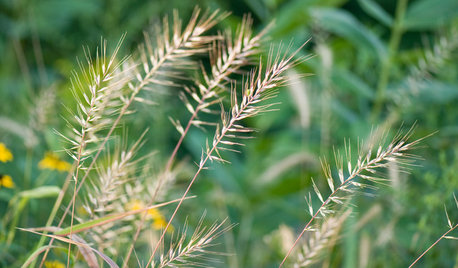
    Boy this subject is getting a lot of traction this year. Yep by looking at the picture of your hand is Bermuda seed heads.

    So all I can say what is the problem? Seed heads are normal and caused by two things, stress and maturity.

    Stress is caused by many things most notably hot dry weather, drought, low soil fertility, PH levels, etc. The seed heads is a defense mechanism to preserve itself

    Maturity is letting the grass grow and it produces seed heads like any plant does to preserve itself and reproduce.

    It is possible you may be over watering or under watering. Being in Phoenix depending exactly where you are your soil type. or lack of soil I should say could be mountain granite rubble and sand, to out west toward Gilbert where soils tend to be sandy loam where all the commercial farming is. Also in Phoenix water tends to be salty.

    You need to learn how to let your grass tell you when to water by looking at it, then when needed soak it.

    With that said I just moved to the north of you up in Prescott. Right now we have to water every morning because like Phoenix we do not have soil, we have rubble and sand and thes 80/90 degree temps with bone dry air just sucks the water right out of everything. There is nothing in the soil to hold moisture. In Phoenix the problem is compounded with 100/110 temps, bone dry air, and being in the low valley you do not even cool off much at night like we do up here.

    So the answer to your water question does depend completely on your soil type. If it is the sandy gravel crap you will have to water everyday, and approach fertilizing differently. With th everyday watering and soiless conditions purges all nutrients out quickly as there is nothing to hold nutrients.

  • 15 years ago

    TW, could it also be that the OP has a cultivar that produces more seedheads than others. I have a lawn w/ a mix of common, P77, and 419, and I noticed some areas have more seedheads than others. And looking at the NTEP report on seedhead, I would have to guess the seedheads in my lawn are the common and P77 areas.

    Here is a link that might be useful: SEEDHEAD RATINGS OF BERMUDAGRASS CULTIVARS

  • 15 years ago

    TW, could it also be that the OP has a cultivar that produces more seedheads than others

    Yes sir and location is a big factor. Look at the report, Arizona will be the one location with the highest seed head production regardless of the variety. This goes back to the stress factor from the intense heat and bone dry desert air.

  • 15 years ago

    That link is very interesting. It at least helps explain why my Strooch lawn (That's what TW calls it :-) ) of three different types of Bermuda is only going to seed on one type.

  • 15 years ago

    One thing TW forgot to mention. Find the Bermuda Bible online and memorize it. It's like having TW at your beck and call.

    I am going to suggest you cut way back on watering frequency and see how that goes. You have the absolute luxury of having a grass that will not die from drought stress. If it seems to have dried out a few days ago, water it now and it will look great in the morning. The mantra here is to water deep and infrequently. I carry that banner. Know where I learned it? From reading and arguing vociferously with a lawn care professional from...Phoenix. Without getting into the argument, in the end I was converted to deep and infrequent. By deep he (and I) means one inch per week. By infrequent he meant once a week. I went through a litany of arguments with him but he had the experience of decades of service in Phoenix weather, which far overshadowed my experience. I chat with a guy from Phoenix daily who is very successful watering his bermuda once a week.

    As Weed says, however, soil is important. If you are growing grass in rubbly sand, you might have to water more frequently. But you can't know until you try it.

    Everyone's watering system is different. My system takes 8 hours to apply one inch of water over 900 square feet. That is amazingly slow but I use one oscillating sprinkler. Use tuna or catfood cans to check your system. Time how long it takes to fill cans placed around the lawn.

    Never let the irrigation water run off the property. If you get any sign of runoff, stop watering immediately and let the water soak in for about 30 minutes. Then resume watering. Cycle like that as much as you need to to get it all watered in one day.

  • 15 years ago

    As Weed says, however, soil is important. If you are growing grass in rubbly sand, you might have to water more frequently. But you can't know until you try it.

    I have only lived out here, Prescott for about 6 months and get to Phoenix about once a week or so. It makes me hesitant to give advice for Phoenix because the soil, or lack of soil in a lot of areas varies greatly in the valley. If you get out west of the City toward Gilbert where the farms are at and it is pretty decent sandy loam. Anywhere near the surrounding mountains and it is just rock and rubble, then interior seems to be just a sand/gravel/rubble crap. Up here where I am at it is just granite.

    But I agree with you David soil type is the key. I can tell you this. All the golf courses have to water daily, and the greens several times per day. But that is a bit different circumstance.

  • 15 years ago

    I am moderately familiar with much of the valley area as well as up in the mountains. I have cousins all over the place. East and north of Phoenix is sandy rubble. West and south is pockets of farmland.

  • 15 years ago

    East and north of Phoenix is sandy rubble. Well if the OP has the sandy rubble he/she is likely going to have to water every day or every other day. Phoenix summer has been brutal so far, at least to my standards as it has been 105 to 110 since the 3rd week in May and it is not even the hottest month of July/August yet.

    I am glad to be up in Prescott. We just had our first 90 degree last week June 21, but nights get a bit chilly right after sunset.