Software
Houzz Logo Print
creekweb

persimmon fruit leather

15 years ago

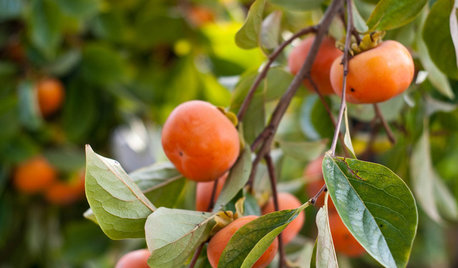
A number of Asian persimmon PCA varieties with Great Wall a common prototype ripen into a state where the consistency becomes mushy to liquified, and the astringency is still slightly perceptible. These persimmons have very little appeal - understandably no one wants them - and most often they end up as compost. Cooking with them just makes matters worse. However, when these same persimmons while still firm are sliced thinly and dried in a dehydrator, they suddenly become very popular. The same people who swear they would never touch another persimmon can't get enough of them. They are highly calorific so dispense with caution. Also, people who wear dentures will be frustrated by them, as they're rather chewy. I slice into 1/4 inch thicknesses and dehydrate for about 36 hours with no trace of astringency remaining, just fruit candy!

Comments (19)

  • 15 years ago

    I can't believe Great Wall persimmon ends up in the compost. These are one of the sweetest Asian persimmons. An Amish farm I go to has one tree and produces hundreds of fruit. They sell the fruit 2 for a dollar and people can't get enough of it.
    I love eating it fresh. I'm sure it tastes good dried as well.

    Bass

  • 15 years ago

    knew

  • 15 years ago

    Bass, I agree the variety Great Wall is very sweet, but I've found after various techniques to ripen it and remove the astringency that I would liken the end product to a balloon full of sweet, sometimes still slightly astringent mush. Those who really like persimmons may find this desirable to eat, but I don't think most people would be able to get past that consistency nor tolerate any residual astringency. Compared to many other PCA varieties such as Hachiya, Sheng and Saijo, all of which have a firmer consistency and easily and fully lose their astringency, I think it inferior for fresh eating but still an excellent choice for drying. In the past I've thrown hundreds onto the compost pile, but not any more.

  • 15 years ago

    Hi,

    I am hoping next year I have enough Fruit to start Drying. Great Wall is one of my 3rd year trees which did not produce this year. Do you folks skin them prior to slicing and drying? I am under the understanding peeling them 1st is recommended, but I am rather lazy and hoping with thin skinned one just to slice them. I believe the astringent ones are more recommended for drying, but does anyone dry the non-astringent, and if you do are they still firm or do you wait until they soften.
    Thanks

  • 15 years ago

    njbiology, Thanks for the compliment on my website.

    Creekweb, I guess I haven't noticed the astringency, it must be the way how I ripen mine. I usually put them in a bag with apples which totally removes the astringency even when not fully soft.

    Bass

  • 15 years ago

    I am going to be drying my Hachiyas in a few weeks -- family has no interest in eating them off the tree so may as well give it a go. I have heard the drying process itself takes out astringency - has anyone tried drying a definitely astringent fruit to see how much astringency is left?

    I have Great Wall and my problem with it is the size -- too small. The Hachiyas have about five times the mass.

    Scott

  • 15 years ago

    Scott, I don't know about drying, but freezing, even a very short one, takes care of astringency, even you take a fruit that is VERY astringent.
    Olga

  • 15 years ago

    Strudeldog,

    I've come across a number of different methods for drying persimmons, some with and some without skinning them. The traditional Japanese method is very labor intensive and requires skinning, sun-drying and actually massaging the drying fruit over a course of several weeks. The drying technique is considered an art form and these dried fruits fetch plenty of yen.
    Dried non-astringent persimmons cut cross-wise with skins intact are fairly commonly available in the U.S. I've seen them at several markets including Trader Joe's.
    I slice astringent persimmons cross-wise with skins attached and dry them with good results, superior to the non-astringent commercial product because the astringent persimmons are generally sweeter and more flavorful than non-astringent. Skins which are sometimes avoided because they have traces of astringency, do not when they are dried, and enhance rather than detract from the final product. Of course the best part of leaving the skins on is the time savings - the washed persimmons can be sliced and placed on a dehydrator tray in a few minutes.

    Bass,

    The difference may be in the persimmons or the method of removing astringency but also could be in the sensitivity of the tasters. There's a wide continuum of abilities to taste small amounts of flavors and compounds in foods, with the so called super-tasters at one end of the spectrum. Luckily, I'm not one of those, but I can still often taste the residual astringency in ripened Great Wall and much less often in others like Hachiya and Sheng.

    Scott,

    The persimmons that I've dried are firm and astringent when they are cut up and put in the dehydrator. If they start to show some softening they will be difficult to slice, so I only choose the firm ones. I monitor them while in the dehydrator - occasionally taste-testing to make sure all the astringency is gone.
    You must grow either monster Hachiya or mini Great Walls. My Hachiya are a little wider and twice as long as my Great Walls with maybe a little more than twice the mass.

  • 15 years ago

    Has anyone tried to dry whole persimmons using a dehydrator? How does it turn out?

  • 15 years ago

    Great Wall is one of my best varieties! It's very productive, has an excellent flavor, and is one of the best for Fall color. It does need curing but responds very well to either alcohol vapor curing or to ethylene (banana or apple) curing.

    I consider an "almost liquid" state in a ripe persimmon to be desirable, making feasible one of the more satisfying ways of eating a persimmon, which I just experienced with a Tecumseh. Pry out the calyx with the thumb. Tear a strip of skin down the side with the teeth. Place mouth over the exposed persimmon flesh. Suck!

    sunghui

  • 15 years ago

    I've read Great Wall has a biennial fruiting pattern. All you Great Wall growers, is that what you've experienced, or are you getting good crops every year?

    MK

  • 15 years ago

    Thanks Creekweb, Glad that a acceptable product will not require the work of the Japanese practice of Hoshigaki. The Hand peeling drying and massage each fruit by hand for several weeks is not for me. As long as the climate cooperates I should be covered up in persimmons within a few years,as of right now I can consume all produce fresh.

  • 15 years ago

    Ohio, my Great Wall has gone into a biennial pattern. There was a small crop this year and, if the branches survive 5 degree F temps forecast for Tuesday night without being dormant, it looks to bear a huge crop next year.

    sunghui

  • 15 years ago

    I have several Great Wall trees, (I like to topwork upon this variety) the most mature of which is about 12 years old. This tree alternates between producing too many fruits one year with much too many the next. I should really thin, but that's not really ever going to happen. Instead, especially on the much too many fruit years, I have to add several supports to the tree to keep it from breaking from its fruit load. Earlier in the tree's life it did fruit erratically from year to year before settling into constant high productivity the past four years or so. Another larger Great Wall, about 10 years old, which had fruited very heavily the last two years did not fruit at all this year, but this tree had not been adequately irrigated and may have set and then lost its fruit early in the season.

  • 15 years ago

    Thanks, Creekweb and Sunghui for the answers on Great Wall. I am in Ohio, USDA zone 5/Arbor Day zone 6 and am interested in Great Wall because it is supposed to be so hardy. (Burnt Ridge lists it as hardy to zone 4, perhaps a bit optimistic?) Also thought about Sheng or Saijo. I am trying to decide on an American persimmon, too!

    Thanks again!

    MK

  • 15 years ago

    I don't have experience with Great Wall, but I'm very skeptical of the zone 4 claim by Burnt Ridge. All other sources I've seen list it as zone 6.

    Alex

  • 15 years ago

    I dried all my Hachiyas last night. They are excellent! I would say they are one of the best dried fruits. The astringency is not completely gone, but its barely noticeable, I only realized some was still there several minutes after eating them. I think the slices that are less clear fleshed may be the ones that need a bit more drying.

    I agree, Great Wall is zone 6.

    Scott

  • 9 years ago

    Earlier in this thread the use of ethylene and alcohol in processing Great Wall persimmons was touched upon, but I thought it would be of value to review this strategy and its noteworthy results.

    Many varieties of persimmons will ripen satisfactorily by just placing in a paper bag at room temperature; however, Great Wall, Tecumseh and a number of other varieties will soften somewhat but retain most of their astringency when processed this way. Freezing and thawing these fruits lessens but does not eliminate the astringency and causes a mushy degradation to the texture. Drying usually needs to be extreme to the point of making persimmon chips in order to precipitate the tannins and eliminate the astringency.

    Great Wall does respond well to combination ethanol and ethylene treatments. Firm orange fruit placed in a sealed plastic bag along with a ripe apple and a small amount of alcohol will become somewhat soft, but may be eaten without any detectable astringency well before reaching a mushy stage. This can take a week or longer. The fruit at this stage is opaque and does not have the typical translucent appearance of tree ripened fruit. The product is reminiscent of Rojo Brilliante and Sharon fruit, and for some consumers would represent an actual improvement over the softer tree ripened fruit. Would be interesting to see if this processed fruit could then be dehydrated without the return of astringency.


  • 9 years ago

    Another method to remove astringency that I've been trying that appears to be working but still a work in progress is exposure to a high CO2 environment. The literature supports using CO2 with higher temperatures and pressures for better effect, but I purposely tried to keep my method as low tech and simple as possible, using common household items to try to keep it broadly accessible to consumers. I placed the persimmons in a large ziplock plastic bag along with a cup that contained baking soda and one that contained vinegar. After compressing the bag around the persimmons and cups, I sealed the bag and then slowly mixed the ingredients so that they did not bubble over. I left the CO2 filled bag at room temperature for a few days, and after that time, the persimmons, still pretty firm, have mostly lost their astringency, though some clearly need more time in the bag. Perhaps this in combination with ethylene exposure from a ripe apple may be a quicker way to process the persimmons than the alcohol/ethylene method.