Software
Houzz Logo Print
ladybugfruit

Killing Hackberry Trees organically?

14 years ago

Ok, this is my last ditch posting here, before I fear, I will have to use the nasty chemicals. We've been in our home about a year and a half and the previous owners let hackberry trees come up everywhere and let them grow. I understand they do have some redeeming qualities, but last year I was literally digging up GROVES of them. I kid you not when I tell you I dug up probably at least 300 saplings. We had the big trees cut down and had the stumps ground as much as possible, but they were growing under the fence so it was impossible to get all of the stump. I have talked to an arborist that told me there was no way to kill them organically, but I don't know how well versed he was in organics to begin with, so here I am still trying to find a way to not use some nasty pesticide. I have tried drilling holes ( burned up 2 bits because the wood is so hard) and dumping salt and it's as though the stumps were laughing at me. I am at a loss but have to do something soon. I can't handle another year of them taking over my gardens and lawn. I have had the tree killer chems all winter and just can't bring myself to do it. Hoping someone here has a solution.

Thanks so much,

LBF

PS I have dug up as many of the roots as I can find as well, but of course, the trees grew where the power lines are buried and hackberry trees have roots that go to china, so....I am limited on how deep I can dig

Comments (16)

  • 14 years ago

    The only way is constant mowing to prevent them from leafing out. If they don't photosynthesize, they will eventually run out of energy and the roots will die. You need a brush trimmer - basically a circular saw blade on a stick - a marvelously dangerous tool - for anywhere the lawnmower can't cut. Wear good boots.

  • 14 years ago

    Since I know nothing whatever about hackberry trees (but I'll definitely google them later), I doubt the information I'm about to offer will be of merit.

    But killing most trees I know of is done at this time of year--in the Spring when the sap rises--by "barking" them, which is removing enough of the bark around each growing tree ( 4 inche diameter, or so, all around the tree) to cause them to lose the rising sap--until they exhaust themselves sending up sap, and the tree dies.

    My father and uncles did it, and I've done it with a number of diverse varieties of trees, but I'm out of the loop regarding hackberry.

    Good luck.

  • 14 years ago

    Are you sure what you have is a Hackberry, "Celtis occidentalis"? I have not found them to be that invasive and have not seen the one that grows in my yard to be any problem. The research I did before planting this tree indicated that it was no more invasive then an Elm, Maple, or Oak.
    As Billme stated keep new growth mowed and that will keep the root system from getting access to the sunlight needed to make the nutrients necessary to survive. Pouring salt on tree stumps is not an organically acceptable method of killing trees. Girdling, aka :barking", removing the bark to expose the cambium layer, is one method that could be used although that can take some time and still requires the tree be cut down.

  • 14 years ago

    I wouldn't be surprised if you don't have to resort to chemicals. Down here those trees are really a problem since birds love them and spread the berries everywhere. And talk about deep rooted. I've dug up a twig that wasn't 1/4" thick and it's had a 3 foot root on it. Keeping them trimmed will kill them in time but you have to keep at it.

  • 14 years ago

    Yup...it's like the kudzu of trees here! I am exited that there may still be a way to avoid chems though. I just really have a hard time justifying it even though they are the spawn of satan.
    I am not allowed to play with fun dangerous tools as mentioned above...so here's a question with the idea of stopping photosythesis...what if I were to cover the areas where there are a gazillion sprouts with plastic garbage bags and cover heavily with mulch? I fear ( and shebear, you know what I am talking about here) it would be like with bermuda grass that would just laugh and pop right up through and keep growing. I am going to try the girdling and peel bark away on the bigger sprouts.
    I appreciate the suggestions...please let me know if you think my smother approach would work.
    Thanks.
    LBF

  • 14 years ago

    ladybug:

    Well, I thought I'd seen everything, but in researching hackberry trees, it appears I've not seen one in my mid-Atlantic area (though I'm a right fur piece from Texas).

    Wikipedia lists 40 varieties of hackberry, and you probably don't have "Celtis Occidentalis" that kimmsr is accustomed to in his area. You could have any of the imported Oriental hackberries, and you may very well have "Celtis Pallida", also called "desert hackberry" and "shiny hackberry", which is noted to grow in Texas.

    Any of those names sound familiar to your area?

    No matter: you obviously have an invasive hackberry of one kind or another, and all the new plants you see are either being sent up by the roots of an established tree, or they've come from the fallen berries that have germinated.

    I believe black plastic will work--but not covered in the heavy mulch you mention using. Mulch has a cooling effect on the soil, and my opinion is that you want hot sun on black plastic--period. You can use mulch or soil around the perimeter of your plastic to hold it down, but make sure the sun contacts the black plastic, which should kill anything beneath it.

    Years ago in southern California, I used (large size) black plastic to cover entire lawns for people who wanted to kill weeds and grass and weed seeds and native grass seeds, (and everything else beneath it), before planting new grass seed.

    Hot sun on black plastic killed it all--and allowed the new grass grown from planted seed to be the only living thing in the yard (which was our intention).

  • 14 years ago

    Plastic in an organic garden? I would think any plastic wouold not be acceptable to an organic gardener/farmer because the plastic will stop the exchange of air in the soil needed by the Soil Food Web to surviveas well as the plants roots to grow strong and healthy. As well plastic is made from non renewable resources.
    Covering any "weed" with renewable material such as paper will do the same thing, deprive that "weed" of acees to sunlight, while contributing something to the Soil Food Web, and the paper does not seem to stop the air exchange like the more impervious materials do.

  • 14 years ago

    Salt not organic? Too funny.

    I drill many holes just inside the bark and put in a very small amount of copper sulfate (natural mineral) solution. It sometimes takes a few treatments. Copper, while an essential trace nutrient, is very toxic to plants at only very moderate concentrations. It is not dangerous to handle but keep children and pets from eating it obviously. It is the blue crystal in the "kill roots in sewerlines" products in hardware stores and also sold to kill algae in ponds.

  • 14 years ago

    Never thought of copper sulfate...however, I have dogs that play near where "the grove" is. Good to know it's an alternative though. However, there is really no drilling holes in hackberry stumps/trees. The wood is VERY hard... I burned up two drill bits trying to drill holes last year when I tried salt.
    I finally have time today to go out and deal with them. I am going to try and dig up the little saplings which in theory won't be as bad this year since I didn't have a gazillion seeds flying around last season. Then I am going to whack down the saplings near what's left of the trunks and cover them with black plastic. I am hoping that works. One of the areas where I am covering trunks only gets mostly shade, so won't have the heat of the sun working in my favor, but if I am understanding other suggestions above, it should still work since there will be no light for photosynthesis. Here's hoping. I really would like to spend more time on the fun stuff than the "have to's" this year in the garden.

  • 14 years ago

    Actually, chopping the heads off the young plants should be more effective than the black plastic.

    Mow the sprouts, prune the heads off the ones you can't mow, use a lopper on the others (or a handsaw). Most woody-type plants just can't tolerate losing their heads.

    Sue

  • 14 years ago

    top using cheap drill bits and go to a specilized tool store and get bit designed to drill in steel.

    If you want to kill a tree girdle it, it will die, period.

    I have a locust tha I wanted dead, I drilled holes in it put stump killing poison in the holes.
    I was a bit gimpy the next year and now it is very healthy.
    I learned to live with it by trimming it branches up thiry feet.
    It does not shade my garden now.

  • 14 years ago

    ladybugfruit, the salt & copper sulfate should work.
    If dogs are out, wrap the holes with cloth or leave the top 1/2 inch of the hole empty & use organic bees wax to fill the hole & cap the poison.
    You may be using the wrong bits for the tree or you need to take your time.
    Make sure your bit is sharp & turning the correct way.
    Sorry, but I do not know what your skill level is, so you may know & do all of this.

  • 8 years ago

    I have wrapped (with black plastic) scores of stumps of hackberry saplings and more mature hackberries. So how long do I need to keep them wrapped in order to kill the plant and keep it from coming back, assuming there's no light reaching it?

  • 7 years ago

    Nothing like an everlasting thread--and a notification of posts made many years ago. Thought I answered kimmsr's post many years ago. Black plastic is TEMPORARY, as is the disruption of organic activity in the soil below it. Earthworms, insects, etc., are MOBILE, and all have the ability to remove themselves from the area covered by the black plastic. Everything will return to normal once you've kiiled the tree roots and REMOVED the plastic. Newspaper is NIGHT AND DAY, compared to black plastic, regarding the heat-generating ability required to kill the roots. Don't like plastic because it comes from non-renewable sources, as kimmsr declares? Use organic black plastic, made from plants. Plastics from plants will soon become all the rage, again, as the concept was YEARS ago (1940) when Henry Ford made an entire CAR from plant-origin plastics. Google "Henry Ford's plastic car". And plastic from plants are now on the market, and will become more so as we transition from fossil fuels.


    But common sense tells me there's no harm in temporarily placing ANY black plastic of a moderate size over the area required to kill a tree's roots. Again, (notwithstanding Steve Eubanks post about trees that cannot be covered with plastic because of other infrastructure in place, such as fences, etc.) when black plastic CAN be put in place, the heat it generates should be sufficient to kill most any plant material, including roots, beneath it.


    Regarding Brian Schill's latest post: It would be best if the entire tree can be cut to the ground and then the GROUND covered with black plastic, held down by staples and/or soil. I couldn't guess the amount of time required when wrapping protruding stumps with plastic.

  • 6 years ago

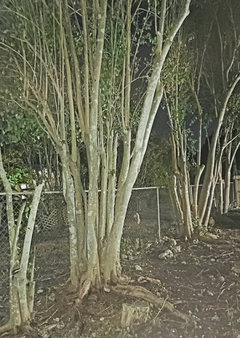
    For the skeptics, everything ladybugfruit said is so true, though it's possible we have the name of this beast wrong. I live in South Texas and these monsters will grow into your chain fence. We moved in here with 6 so tall they're well above and in between the power lines. You can not kill them. If anyone knows what this is called please tell, down here they call it hackberry tree but that could be wrong. This photo is after days of cutting, carefully, that's a power line behind them and see that stump in the fence, impossible to get it out, there are several of them.


Sponsored
Mary Shipley Interiors
Average rating: 4.8 out of 5 stars34 Reviews
Columbus OH Premier Interior Designer 10x Best of Houzz