Software
Houzz Logo Print
cymraes

Filling raised beds

19 years ago

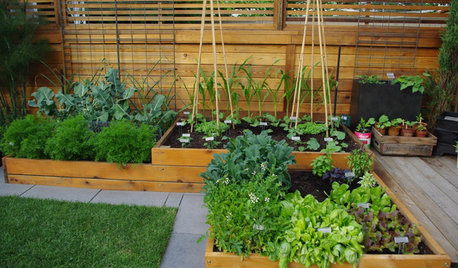
We are building raised beds because our natural soil is very rocky. Here is what I have available to fill them with - old hay, straw/horse manure mixture, a little composted horse manure/shavings, and some organic mushroom compost. Will this be enough? Or do I also need to find some topsoil? Thanks!

Comments (22)

  • 19 years ago

    You have plenty of organic matter but you do need soil. Organic matter breaks down.

  • 19 years ago

    If it's veggies- you'r probably fine. The only issue is that you need to stake them up really well as they get kncked over in that very loose compost. A little soil in there would help that a bit

  • 19 years ago

    a good list of materials you have there, we've never added soil as such to our garden beds when we build them, our prefferd basic medium is mushroom compost and then we add the other material as it is available.

    we have pic's and story on our site might be some ideas there for you?

    len

    Here is a link that might be useful: len's garden page

  • 19 years ago

    You already have "topsoil" where that bed is going even if it is rocky. There is no good reason to spend money on "topsoil".

  • 19 years ago

    Thanks, I was hoping to just be able to use what we have.
    Len, thanks for the website - some great info!

  • 19 years ago

    Just be aware that you will have to keep adding for a while - as the mixture you are using breaks down, it will take up less space. If you fill your beds full now, by fall, they will be down - maybe by a third, maybe less, maybe more. Adding more, both over the summer, as you can, as mulch to keep weeds down and the "soil" moist, and in the fall, to break down over the winter, will help keep the beds full.

  • 19 years ago

    Something that is reasonably inexpensive, but will maintain it's volume longer is peat moss. Often you can find a good price on it in 4 cubic foot compressed packages and if you find some with torn bags often those are sold at a large discount.

    It makes a great growing media as it stays nice and loose in the bed and it holds a ton of water as well. It's also good at holding onto nutrients that the other materials leech out as they break down.

  • 19 years ago

    Peat moss, around here, is expensive. The same amount of compost is a bit less, if you have to purchase everything, but a far better choice to add to soil would be leaf mold. Unless the only option is peat moss there is no good reason to use this non renewable resource.

  • 19 years ago

    Why do you keep saying it is nonrenewable, Kimmsr? I have addressed this repeatedly. The rate of harvest out of the Canadian bogs is substantially less than the rate of growth. The industry is managed by the Canadian government to ensure it remains sustainable.

    Love peat or hate it, but please stop saying it is a non renewable resource.

  • 19 years ago

    seems a confusion of terms has arisen in the 'us of a' and canada side of things, it all happened a few years ago when gardeners only knew a product called peat moss (what kimmsr referes to) which is a brown dead dry product derived from mining (the unsustainable part) of peat bogs, this peat product (well saught after by gardeners but almost of no real benefit to gardens), did ruin wet land and was unsustainable.

    but there was this sphagnum moss industry that wanted to survive but gardener neither knew what sphagnum moss was or even heard of it (mostly used by orchid and bromeliad growers), so as it is the growing part of a peat moss bog the sellers associated the name calling it sphagnum peat/peat sphagnum (yes if harvested properly this is very sustainable, again almost no real value in a garden but that is personnal choice).

    there are far better organic materials that can be utilised and in a far better way for the planet and the garden than using peat/sphagnum in any shape or form.

    so sphagnum is sustainable, peat moss isn't, there is a difference. peat is the decomposed dead sphagnum moss. it was probably easier for the suppliers of sphagnum to associate their product with peat than it was to try and educate the gardeners about the difference. so same product source with 2 end results.

    using peat moss is unsustainable and for me of no real value for the garden. now using sphagnum moss is another thing still no real value.

    len

  • 19 years ago

    Well, I've never been a fan of either peat or sphagum, and with all the natural compost I have here on our farm, I don't feel the need to buy anything to add to my gardens. I have plenty of the the straw/manure mixture that I can continue to add all year. This fall, we will fill the beds heaping with the stuff and let it sit over the winter. And we are getting a semi load of the organic mushroom compost on Monday, so will sit some of that asdie for later use also. Most of it will be going on our lawn and garden areas first.

  • 19 years ago

    some links that may explain:

    sphagnum moss.

    and from this site:

    Peat moss

    they say the following:

    "Peat Moss
    Introduction

    Peat is the partially decomposed remains of plants and animals which have accumulated in oxygen poor, water saturated freshwater environments. The partial decomposition of organic debris which occurs at the time of deposition is referred to as humification. In normal soil forming environments, humification transforms organic debris to humus, however, in a water logged environment that is poor in nutrients and oxygen, the organic debris is transformed into peat.

    The deposits consist of a mixture of organic remains which reflect the types of plants growing in the wetland at the time of deposition. They are commonly formed from Sphagnum moss, sedges, reeds, shrubs, wood and other organic matter. In general, mosses are the major constituent of Nova Scotia peat.

    Most of the peatlands in Nova Scotia occur as bogs, of which several types are present in the Province. They range from extensive blanket bogs in northern Cape Breton Island to small, flat deposits found throughout the Province. In general, the deposits have been forming since the last glacial period (about 11 000-13 000 years ago), accumulating at a rate of approximately 30 cm per thousand years."

    hope this clears the murky waters a little? so we can get on about chatting about gardening and gardens, the confusion is not with us gardeners but with a supply industry wanting to gather more market share.

    and along with many others i still cannot see the value of the product against the very many other organic matter products derived in more environmentaly friendly ways.

    len

    Here is a link that might be useful: len's garden page

  • 19 years ago

    Keep in mind that any wetland, anywhere, was once considerd a wasteland that needed to be filled in. Today some few people are aware (I still talk with people that think these wetlands are wasted space) that these wetlands perform a very significant service to our water supply, to filter contaminants from the water.
    Peat bogs are wetlands, and are the prime habitat of many species of animals (birds, mammals, insects) that we have no idea what and how they affect our environment. Harvesting of these peat bogs destroys these habitats. For most people buying peat moss of any kind is not necessary so the destruction of these bogs is unnecessary.

  • 19 years ago

    Harvesting of these peat bogs destroys these habitats. For most people buying peat moss of any kind is not necessary so the destruction of these bogs is unnecessary.

    It destroys nothing, the bogs are replanted and the process begins again. The restoration takes about 10 years.

    Again, it is managed/regulated by the Canadian government to be sustainable.

    I agree there are many other organic amendments one could use, often for free, but peat simply lasts longer than most making it ideal for areas where rapid volume loss isn't desirable.

    It also is a water and nutrient sponge and will hang on to nutrients from the other organic matter released as it decomposed.

    It is also naturally acidic and remains that way as it decomposes, something not true of most other organic matter.

    These facts make it of great value in soils, in my opinion.

    With respect to the peat/sphagnum distinction, I don't think I have seen the former in any garden center.

  • 19 years ago

    Peat lasts longer in the soil because the soil bacteria have a hard time digesting it. Another indication that peat is not a good soil amendment.

  • 19 years ago

    Justaguy,

    You're right. I've explained before on this site that my brother works in this very line of work, he restores peat bogs for a living.

    They not only restore the habitat of freshly harvested peat bogs, but also ones that were harvested years ago and never restored. Harvesting does not "destroy" the habitat or the wildlife and hasn't for many years since they started the restoration process.

    I'm afraid kimmsr's information is many years out of date, but I do understand that there are a few countries out there that still do a slash and dash type of harvesting. Then there are cases like in the UK, where many peatlands that were cleared cannot be restored because they have built housing over top of the land.

    Peatland in Canada builds up faster than it's being harvested. As long as people and companies stay responsible with their harvesting and don't abuse the land, peat moss is certainly sustainable.

  • 19 years ago

    The peat bogs in Ireland fuel electric power plants and the peat is harvested from the 8 meter thick bogs until the bog is only 1 meter thick at which time the bog is put back to grow. The latest information from Ireland on recovery, this is not years out of date, is that it will take 1,000 years per meter for these bogs to recover before they can start to harvest that bog again. No one is building houses on these bogs now and no one did in the past although some people have tried to cross them. Their bodies are being found as the peat is harvested and work stops when the find a body until the anthropologists have a good look.
    There is a lot of misinformation about peat being spread by people employed by that industry mostly about peat bogs being sustainable and if you consider that 1,000 years plus is sustainable then go ahead and use that very expensive product that you do not need.

  • 19 years ago

    Ya, stop using Irish peat moss LOL

  • 19 years ago

    kimmsr,

    You still aren't understanding what is being said.

    In Canada, peat is gathering at 60 times the rate it is being harvested. The US gets 95% of their peat moss from Canada and they aren't using it to fuel their power plants. This is sustainable.

    Your information on harvesting "destroying" peatland is out of date. You even said yourself that in Ireland they harvest until it is 1 metre thick at which time it is put back to grow. This is not destroying peatland.

    In the past, they would harvest the peat and not worry about ecosystem restoration. Often in the UK, that peatland would be developed afterwards into housing or farm use, making the restoration today pretty much impossible. I am glad to hear that practice has changed and that they are now restoring peatland after harvesting.

    You say the misinformation is being spread by the peat harvesting industry, but you have ignored when I said my brother works in ecosystem restoration. He works for a company which restores specifically peat bogs and wetlands. He is one of the "other side", an environmentalist. The harvesting is sustainable. It does not destroy the ecosystem or the wildlife. Peat is a renewable resource as long as the industry is responsible and the process is monitored by government agencies and companies like the one my brother works for.

    The misinformation being spread here is by the extreme eco-warriors. Not everything and everyone has a hidden evil agenda. Try to remember that.

  • 19 years ago

    FWIW, I always use 1/2 topsoil, 1/3 Canadian peat and 1/3 composted cow manure when making new beds.

    I add bonemeal, bloodmeal and kelp in small quantities. Then mulch with woodchips, leaf mulch, etc., thereafter.

    Kimm, peat moss bogs in Canada are now renewable for the most part. People started complaining massively years ago and it appears to have helped. I live near Canada and talked to a Canadian a few years ago on a golf course. He said the peat harvesting is now handled so the bog renews itself. He was a retired horticulturist.

  • 19 years ago

    Last year we built four 4'x8'x1' raised beds because they are easier to work and maintain. To fill them we used some of our creek bottomland soil mixed with compost. They were so successful that this year we added six more raised beds and the fill mixture is the same.

    Becky

  • 19 years ago

    The Royal Horticultural Society has determined that peat moss is unsustainable, non renewable and is urging its members to stop using it. A newspaper from somewhere in Saskatchewan has written about the unsustainability of harvesting the peat bogs as well as another Canadian paper that right off I don't recall.
    Peat moss is a non renewable resource that should not be used unless there is absolutely nothing else no matter what the industry that harvests that material tells you. I fully understand what you are saying, but you are wrong.