Software
Houzz Logo Print
andalee

What do I do with my soil report?

12 years ago
Hi all,

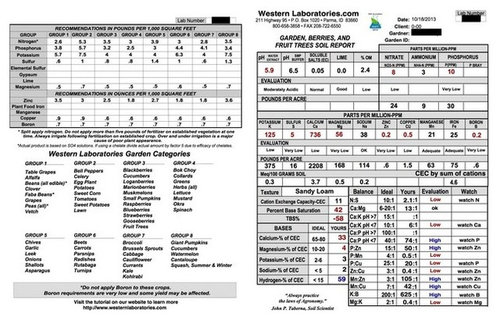
We just got our lovely soil report back, and now I know (sort of) what my soil's problems are. I'm now wondering what exactly I can do to add organic amendments to the new garden (120' x 120').

I know blood meal and bone meal are usually considered good sources of N and P, but what else might I use, considering the results of my test? (I have to admit to not understanding about half of what's on that report. lol) Any other advice or experience that might help me? This is our first go at a big garden, and I really want to build a good foundation for our plants to really thrive.

I wish the lab gave recommendations in organic amendments, instead of chemicals. ;o)

I often order things from Azure Standard (kelp meal, alfalfa pellets, sea minerals) so if anyone is familiar with amending their garden with things supplied by AS, then that would be a bonus.

(Image of results is attached--page one is on the right, page two on the left. I think my image software was feeling Chinese today . . . and I can't get it to be higher quality, so please forgive me the headache you might get from fuzzy numbers . . . )

Thanks so much!

Comments (6)

  • 12 years ago

    Someone at your local agricultural center should be able to read that. That's who does our local soil tests. They should be able to recommend what you need.

  • 12 years ago

    Ours is singularly unhelpful. :o( Hence my posting here . . .

  • 12 years ago

    Sorry that happened to you. If they did the test they should be able to read it. If you can enlarge it somehow maybe someone can help you. I can hardly read the small words. I wonder if another county would mind reading for you?

  • 12 years ago

    Our county extension doesn't do tests directly. They send them away to a lab, which is nearly as much as the lab we ended up sending our sample to. (And we got a much better test for our money.)

    I'm really looking for an organic gardener's perspective on amendments, as well. (Hence this forum.) Our extension is really pretty darn conventional.

  • 12 years ago

    Nice report...it gives a lot of good info.

    Your pH is a bit low, but not dangerously low. You shouldn't have a problem with most garden crops.

    You can pretty much use a general purpose NPK fertilizer in-season, especially if you're adding organic NPK.

    You need some Zn, Mg, and S help, too.

    You need a little Cu + B help, but you need an extremely small amount of it. Your Ca level is low, but it's not dangerously low. Something slow-release and cheap like bone meal will help over time.

    Long story short...NPK fertilizer at time of planting (or just before) along with NPK during the growing season...Zn, Mg, and S amendments...look for a micronutrient source of Cu and B (which you might be able to find in combination with the above nutrients in a mix)...Ca help is needed, but not as urgent as the others listed.

    Be very careful with the Cu and B if you choose to amend it outside of very small amounts...especially the B.

    Blood meal (great/cheap N source), bone meal (Ca/P, some N), potassium sulfate/"potash" (K, S), sulfur (S)...various ways to get Zn and Mg organically.

    Some people don't consider potassium sulfate "organic"...but that's splitting hairs, imo. It comes down to a binding agent for the purposes of organic grower approved...and some formulations (a bit more expensive) use an organically approved binder if that's an issue to you. Would I recommend non-certified potassium sulfate to a certified organic farm? No. Would I recommend it for a home gardener? Yes, unless that harmless-to-anything binding agent is an instant-"no" because you want to do it 100% organic as a choice.

    Since your organic matter is 2.5% (which isn't bad at all, though it may sound low) you can search out many other ways to achieve these nutrient balances...such as poultry manures and various composts...and many other things.

    That said, you're working with a lot of land (14,400 sq ft) so you might find it easier to get it done with straight amendments...even the Cu and B (be very careful with the B).

    This post was edited by nc-crn on Fri, Oct 18, 13 at 23:33

  • 12 years ago

    The soil pH, at 6.5, is in the middle of the range most plants like 6.0 to 7.0. Organic matter is low, 2.4 percent where 6 to 8 percent is optimal. Phosphorus and Potash are both low, however if the amount of organic matter is increased they most likely will also.
    Sources of Phosphorus besides bone meal (not too acceptable to organic growers anymore) would be rock phosphate and sources of Potash would be granite dust, however, the levels of those macro nutrients increased in my soil with just the addition of organic matter.
    Perhaps these simple soil tests will also help.
    1) Soil test for organic matter. From that soil sample put enough of the rest to make a 4 inch level in a clear 1 quart jar, with a tight fitting lid. Fill that jar with water and replace the lid, tightly. Shake the jar vigorously and then let it stand for 24 hours. Your soil will settle out according to soil particle size and weight. For example, a good loam will have about 1-3/4 inch (about 45%) of sand on the bottom. about 1 inch (about 25%) of silt next, about 1 inch (25%) of clay above that, and about 1/4 inch (about 5%) of organic matter on the top.

    2) Drainage. Dig a hole 1 foot square and 1 foot deep and fill that with water. After that water drains away refill the hole with more water and time how long it takes that to drain away. Anything less than 2 hours and your soil drainsâ too quickly and needs more organic matter to slow that drainage down. Anything over 6 hours and the soil drains too slowly and needs lots of organic matter to speed it up.

    3) Tilth. Take a handful of your slightly damp soil and squeeze it tightly. When the pressure is released the soil should hold together in that clump, but when poked with a finger that clump should fall apart.

    4) Smell. What does your soil smell like? A pleasant, rich earthy odor? Putrid, offensive, repugnant odor? The more organic matter in your soil the more active the soil bacteria will be and the nicer your soil will smell.

    5) Life. How many earthworms per shovel full were there? 5 or more indicates a pretty healthy soil. Fewer than 5, according to the Natural Resources Conservation Service, indicates a soil that is not healthy.