Software
Houzz Logo Print
boulder345

new pond - need advice

19 years ago

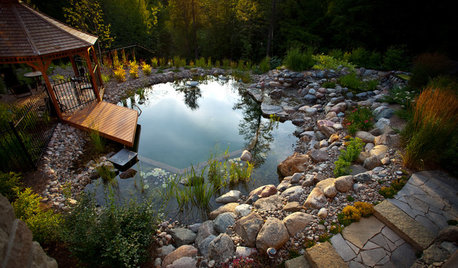
Over the winter, we have had a water feature built in our yard. It consists of 1 small pond (6 ft x 3ft, ~12" deep) at the top of the feature. That is where the water is fed into the feature by two 1 hp pumps. At the bottom, there is a larger pond (20 ft x 10 ft, with a max depth 3ft  4ft). Between the two ponds there is a stream that is about 45 ft long, about 3 ft wide. The bottom consists of loose rocks and boulders. Initially, there is no organic matter in the pond.

There are two waterfalls  one is about 1 ft high (at the outlet for the smaller pond) and the other is about 3 ft high and drops into the larger pond. Therefore, oxygenation and dissipation of chlorine should not be a problem. I am in Boulder, Colorado elevation 5,600 ft, climate zone 4. The water will get full sun all day for 9 months of the year. I have no idea what to expect for summer water temperatures (summer days can get above 95 F for several consecutive weeks, but at night the temperature usually drops 30 degrees).. I have been told that during the summer, I can expect to lose about 1" of water per day to evaporation. In the event of an extended power outage, most of the water will gradually drain into the larger pond.

I want to put in plants that will over winter. Last winter, which was exceptionally harsh, the pumps were not running and the larger pond was not completely full, but it did not freeze to the bottom. I have a lot of questions:

- Which types of plants would be best?

- There is space behind the first waterfall (facing southeast) where I can place some plant(s). The waterfall is about 3 ft wide, cascading over a spill stone. There is about 9" Â 12" between the waterfall and the wall behind the fall. What kind of plant would be well suited to that spot?

- Are there issues that I should be aware of regarding the introduction of wild plants instead of cultivated ones (assuming the same species)?

- Duckweed (wild) is readily available in this area. Is it suitable for use in some of the calm areas?

- How much vegetation is appropriate for this environment?

Comments (19)

  • 19 years ago

    Can you show us some pictures. Sounds lovely. Glenda

  • 19 years ago

    It turns out that I have lots of construction pictures, but none of the finished system. Weather permitting, I will try to get some later today and will post.

  • 19 years ago

    I'm definitely looking forward to some pics! It sounds like a terrific set up. :D I don't have any answers to your questions, but I just want to see.

  • 19 years ago

    OK, I give up. I took some pictures when I got home from work, however I can't figure out how to post them. I have seen that others are able to do it, so I know that it is possible.

  • 19 years ago

    Here the photos. I included a "before" shot. You can see that this has turned out to be a really big project. The project is still not done - perhaps a month to go.

    {{gwi:193058}}

    {{gwi:193059}}

    {{gwi:193060}}

    {{gwi:193061}}

  • 19 years ago

    Wow! Gorgeous!! Great work!

    Ahhh...so many plants to choose from!! Here's a few...

    Duckweed will work and provide shade to reduce algae early in the season before other plants take off. You can always skim it out with a net if it takes over. Other floaters (good for bio filtration) may be water hyacinth, water lettuce, Azolla, water cress (you can buy watercress at the grocery store and it will grow in the pond).

    Hardy marginals - plants that grow in shallower water - anywhere from just wet feet to a couple inches under water might include pickeral rush, water iris, arrowhead, cattails, etc. There are many more. I prefer to pot mine so they can be contained and moved as I wish. Research potting pond plants. These can be sunk to the bottom of the pond over winter as long as it doesn't freeze solid (and some some can even be frozen, think about what grows in the wild in your area).

    Hardy water lilies can be overwintered the same way. Pond plants not hardy to zone 4 can be brought in for the winter and stored or treated as a house plant (you'll need to research individual plants) for instance I bring my water canna lilies, mexican bluebells, and papyrus inside.

    Some plants like water forget-me-not and mint like running water. Careful with mint, some ponders consider it very aggressive!

    Don't forget some submerged oxygenators like anacharis, eel grass, or hornwort.

    Many garden annuals (and perinnials for that matter) can be grown in the pond, impatiens, hosta - See the thread "what plants can be pond plants" with a link to 'unconventional pond plants - archived'.

    As long as you are a responsible gardener you should not have problems introducing new plants - NEVER discard, transplant, or otherwise put pond plants in natural wetlands or waterways. Compost them or use them for mulch in your flower beds.

    Are you going to have fish? I've never had problems with my goldfish/comets eating plants, but some say koi like to dig in the plants, and they can destroy them. Most fish will nibble on floaters like duckweed or hyacinth too.

    There's lots more info here, enjoy the research!

    And welcome to the forum! Post more pix as your plantings grow!

  • 19 years ago

    That is really really fabulous! You must be thrilled to bits! Excellent work you've done, thanks for sharing. :D I can't wait to see it done and all grown in!

  • 19 years ago

    Sheepco, thanks for the recommendations.

    I **definitely** plan to add critters to the ecosystem. [Translation: I can't wait to do it!!!] I probably won't try to put any fish in the pond for at least 1 month. I am not at all concered about them munching on the plants. Insofar as possible, I'd like to build a sustainable ecosystem.

    I'd appreciate your feedback on my thoughts about what to add. First, carp in their various incarnations and forms (koi, goldfish, grass carp, etc.) are simply not an option. (It's a long, long story, not worth telling.)

    My thinking is that I should first introduce some plants. Next some minnows. After the minnows, fingerling bluegills and bass. (Minnows will help to control mosquitos and later might become food for the bass.) Bass and bluegills should be able to tolerate the higher water temperatures that I anticipate in the summer months, unlike trout which are so popular in this area.

    If I can, I would like to introduce some crawfish - nice scavangers to clean up after the fish. Yes, the neighborhood racoons will eat some of them, but the large pond has relatively steep sides, so the coons will be limited in the damage they can do. Also, there are lots of rocks for the fish and crawfish to hide under. Until we get another pair of golden retrievers, I don't think that there is going to be a way to prevent racoons from using the water feature as their private buffet.

    I'm not sure about trying to add frogs. I'd love to have them. However, I have heard that they may be prone to wander away - and the racoons would probably love to eat them.

    I assume that I will have to provide feed for the fish - at least during the first season and perhaps forever. Your thoughts?

  • 19 years ago

    Ah, Golden Retrievers! You like the best of life! (Oops, sorry other breed people!)

    Emma fishing...
    {{gwi:167802}}

    I know somebody with pups JUST like this right now! (Murphy 1 year ago)
    {{gwi:164366}}

    When I first started my pond I rarely fed my few goldfish, maybe once every 3 days. There's plenty of algae, bugs, larvae, etc for them. I feed them every other day now, mostly just cause I like to see them when I'm sitting by the pond in the evening.

    There are several ponders here that keep bluegill, etc that may pipe in, I've not tried them. Lots of folks keep minnows of various persuasions. Crayfish (as we call them here), and snails are good scavengers. Go for it!

  • 19 years ago

    I love the pictures of Emma! How did you get them inserted with a reasonable size rather than gargantuan like mine? Unfortunately, we've been dogless for two years. Because of the amount that I currently travel, it is probably going to be a couple more years before I can defend getting a pair of goldens again. BTW - I subscribe to the theory that goldens are much happier in pairs. Ours used to sit patiently under a big pine tree (where the large pond is now located) for hours after they chased a squirrel into it.

    What type of snail would work? I am not aware of any places locally where I can capture wild ones. Will the pet store variety work?

    Are frogs likely to stick around or will they go "on a walkabout"?

    Do I need to introduce plants before fish? Right now, the pond is pretty sterile. In a week or two, when the flowering trees drop their blossoms, some organic matter will inevitably end up on the bottom of the pond.

    BTW - we are at 1/4 mile from the nearest natural body of water. So, no need to be concerned about prison breaks by the pond critters.

  • 19 years ago

    boulder345:

    Your ponds/creek are look great. I would think twice about adding bass. They eat a lot and if you want to keep any, you will have to be feeding them. Also, they will probably eat your sunfish and minnows. I'd stick with the sunfish and minnows.

    Hardy water lilies will do well in your deeper pond and will overwinter.

  • 19 years ago

    Boulder go to the your photobucket website, click on MY ALBUM then look for option "very small letters" right under Mobile Phone and just above your first line for adding more uploads Click on that and it will bring up a screen to change your picture sizes. Website, email is a good size or the next one Messsge board is a little larger. Select one of those. Glenda

  • 19 years ago

    Pikeco,
    Thanks for the instructions.

  • 19 years ago

    Kalevi,
    Actually, I was expecting the bass to eat the minnows and, when they get bigger, to also eat the sunfish. I am counting on all of them to eat the mosquito larva that will be in the water. West Nile Virus is a mosquito borne disease that can be very bad. Unfortunately, this is one of the worst areas in North America for it. I will be using BT (germ warfare) as the primary means of control.

    The problem that I face is getting bass that aren't too big. I want ones that are less than 2 inches in length. However, I haven't done a serious search yet.

    I thnk that I will enjoy feeding the fish. Feeding should also allow the pond to support a higher population of fish, right?

  • 19 years ago

    Boulder, I'm one of the 'build it and they will come' believers. My snails came with my plants (the ones from local nurseries, not on-line)1 good reason to quarantine plants and fish before adding to the pond, somethings are good, some are not). You can buy them, I'm no snail expert and I don't think over population is much of an issue in zone 4. My leopard frogs appeared almost over night and overwinter in the bottom, and I never knew we had tree frogs here and now I have 10 or 12 crawling on the siding of the house by the pond on a summers night. I have no idea where they hang out in the winter. I get a few garter snakes that like to hide under the rocks on the edge too.

    I put plants in first and then added fish a week or two later, just something I read. Let the plants add some O2 and start cycling the pond 1st.

  • 19 years ago

    Racoons are very likely to tip over and mess with potted plants, or tear up rooted ones, generally raising havoc and muddying the waters. Give some thought as to how you're going to either secure plants or place them out in the water out of reach on bricks or whatever.

    Happy planning!

  • 19 years ago

    Boulder:

    We have West Nile here too. It overwinters on mosquitoes hibernating in the sewers. I don't think larger bass will eat mosquito larva. You need to maintain a minnow population for that. Mature bass need a very large pond.

  • 19 years ago

    Bolder, that is a beautiful stream and pond set up.
    Give it a couple of years and it will look like it has been there forever, once the plants take over.
    Good luck with your new venture.
    "Horton"

  • 19 years ago

    Your pond/stream looks gorgeous. I love the blue conifers (spruce?). Water lillies prefer relatively still water--that is one thing to keep in mind. The flowers are beautiful and some of them are very fragrant.