Software
Houzz Logo Print
carolinamary_gw

Maggie

15 years ago

I'm trying to figure out whether I might find a place for Maggie, and wondering about two things:

1) Its degree of shade tolerance in your experience. (One person at HelpMeFind says "Excellent" for shade tolerance, though the meaning of that is changeable, depending on the degree of shade you're dealing with.) And have you dealt with it in a less than full sun area while also using no chemical sprays to keep down blackspot, etc.?

2) Whether it loses its leaves in the winter, or behaves like a China and keeps them (in a climate where Chinas and teas keep their leaves in the winter).

Thanks for any information!

Mary

Comments (17)

  • 15 years ago
    last modified: 11 years ago

    Thanks so much for this information. I'm trying to visualize her in the sunnier spot now, and I kind of think that she'd work in okay... but originally that spot was going to be mainly pale and mainly pinks with a few hot accents. I think it is evolving some at this point into a hotter bed.

    Best wishes,
    Mary

  • 15 years ago
    last modified: 11 years ago

    {{gwi:208215}}

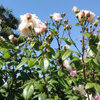
    I have three Maggies, and they are beautiful. Our weather has been in the single digits, so they and many other roses have lost leaves or the leaves are brown.

    My Maggies will spring back, and look very pretty in the spring.

    Maggie does get black spot, but not all the time. When the leaves black spot, the plant does not defoliate, and soon the black spot is gone.

    One Maggie is on the south side of the house, maybe 6-8 feet from the house. It does not get the complete full sun that the other two get, but their size seems to be the same.

    I guess the winter does make it defolitate more than Ducher, and a few others, but they will all be fine in the spring.

    Sammy

  • 15 years ago
    last modified: 11 years ago

    What a gorgeous picture, Sammy! No wonder you decided to get three of these beauties!

    Thank you for posting!

    Best wishes,
    Mary, sniffling this rose this very minute... in my imagination. :)

  • 15 years ago
    last modified: 11 years ago

    Thank you, Mary. My Maggies are 10 years old, and are good examples of roses that I should have kept up with by cutting away the old wood.

    They are beautiful, but I don't have full shots.

    Sammy

  • 15 years ago
    last modified: 11 years ago

    Oh boy oh boy I am so happy I ordered her finally! Beautiful pictures of her! ~Meghan

  • 15 years ago
    last modified: 11 years ago

    I'm curious about Maggie too.
    what color is Maggie"
    is she a deep pink, rose red, or more of a red rose?
    any fragrance?

    Love your photo, now I really want that rose if it would not class with my pink Tea roses.

    Lux.

  • 15 years ago
    last modified: 11 years ago

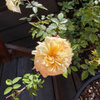
    I have Maggie planted next to a pink rose and she doesn't clash, she is a deep "rose red" and one of my favorite roses.

    {{gwi:223929}}

  • 15 years ago
    last modified: 11 years ago

    Maggie is the raspberry red shown in the pictures here, a great color.

    Needs spraying here or will get lots of spots and look a mess.

  • 15 years ago
    last modified: 11 years ago

    Gorgeous pictures both! I've never known whether to order this rose because of conflicting reports about rebloom, beauty (or lack of) of the bush itself, disease etc. My climate is warm/hot and dry so it should do well but at this point I don't have the room any more. I hope I haven't missed out on a really special rose.

    Ingrid

  • 15 years ago
    last modified: 11 years ago

    Mary,

    I have Maggie and planted her in a less than prime location because I had heard reports of her being a black spot disaster.

    For me, she has put out long arching canes--not awkward at all. She does get some black spot but not nearly as much as some others. I went outside today and looked. She has some of the healthiest leaves in the garden. Most of my roses have those burned by the cold look to their leaves but Maggie's leaves look good.

    She gets more shade than she should but she still gives a lot of bloom--who knows she might give more if she got more sun. The fragrance is great. I wouldn't call the bloom color red at all. Absolutely not red like a raspberry. Mine is more a dark pink with some mauve tints--very much like the pictures others have posted but with maybe a hint more purple--maybe it's the shade, I don't know.

    Bottom line: I like her MUCH more than I thought I would and she is WAY healthier than I expected.

    Hope this information from a garden in a zone near yours. Jeff

  • 15 years ago
    last modified: 11 years ago

    >Michael: Needs spraying here or will get lots of spots and look a mess.

    Hi Michael,

    Though our spot might be warmer, your overall conditions are probably not so far off from ours. But I'm thinking I might remember that you also had bad blackspot problems with Gruss An Aachen? If so, perhaps there's hope for us with Maggie, because we had no noticeable blackspot problems with our Gruss An Aachens.

    I haven't ordered Maggie yet, and the list for this spring is going to have to get paired down some, but I'm thinking that eventually we might try it with crossed fingers. We've never used poisonous sprays, so perhaps there's a little less of a dependency arrangement for our roses to have to overcome?

    On the other hand, Lyda Rose, that rose that so many people can grow no-spray, was a terrible mess here, and it lost so many leaves that it was barely surviving at all. Have you tried that one, by any chance? If it and Maggie are susceptible to the very same forms of blackspot, then Maggie wouldn't do well here. It's hard to guess... unless you have had a similar terrible blackspot problem with Lyda Rose.

    But Maggie will of necessity have to be in a prime spot to have a chance in our yard with limited sunnier areas... so if it actually is a mess, it will have to be shovel pruned. I read some positive things about this rose before paying good attention to its Bourbon classification, or I'd probably not still be considering planting Maggie. There are a couple of other Bourbons I'd be willing to try in our no spray yard, but overall, not many.

    Are you able to grow chinas and teas no-spray there, by any chance, Michael?

    >Michael: Maggie is the raspberry red shown in the pictures here, a great color.

    >Jeff: I wouldn't call the bloom color red at all. Absolutely not red like a raspberry. Mine is more a dark pink with some mauve tints--very much like the pictures others have posted but with maybe a hint more purple--maybe it's the shade, I don't know.

    Hi Jeff,

    Well, I have figured out something about roses I especially like, and it's that my favorites are hard to pin down in terms of what color to call them. General Schablikine makes it hard to tell anyone else what the color is too, but whatever it is, it's interesting and it keeps inviting me to continue looking at it to decide how the colors blend and shade the way they do. A little more looking, and I'd be ready to paint the rose.

    I was listening to an interesting linguistics lecture the other night... and heard that there's an intersection between language and color perception in whatever language is being spoken. That, for instance, in some languages there's no blue or green, only a color in between the two, like teal... and people who grow up learning that language pay attention first to teal and can much more quickly identify it than its "off-shades" of blue and green. They can identify what are for them the off-shades, but they do so more slowly than for their basic teal color. And there's a language that has two words for what in English means a single vague "yellow." (We really do need at least two words for yellow, I think!) ...But how might you change a language to take into account what some roses can easily and always accomplish in gliding from one color to another and perhaps increasing or decreasing a hue saturation, lightening or darkening, at the same time? It's too hard, but I keep on looking and looking as if I believe I am about to figure it out any minute now. Actually, that's one of the things about flowers generally that I like - so many are complicated and nuanced.

    >Jeff: She gets more shade than she should but she still gives a lot of bloom--who knows she might give more if she got more sun. The fragrance is great.
    ...
    >For me, she has put out long arching canes--not awkward at all. She does get some black spot but not nearly as much as some others. I went outside today and looked. She has some of the healthiest leaves in the garden. Most of my roses have those burned by the cold look to their leaves but Maggie's leaves look good.

    Long arching canes are something I know I'd love to have again. (Lost a Cornelia and a Prosperity to RRD; planning to replace at least the Cornelia and maybe try out a Moonlight too.)

    >Bottom line: I like her MUCH more than I thought I would and she is WAY healthier than I expected.

    Where I'm thinking of planting her, she'll get maybe six hours of midday sun in the middle of june and july, and extra hours of afternoon sun as well, so I think she'll have enough sun for good summer blooming (provided we water sufficiently). In the fall, maybe the sun pattern isn't so great, but at least we'll have a couple of hybrid musks, along with some fall-blooming camellias, to hopefully provide a decent amount of blooming for that season.

    If only she's not overwhelmed by blackspot. The few spots in the Atlanta area I can recall might have a bit grittier soil than our heavy red and gray clay area here, though we do add some sand and organics to the clay where we do our planting. The overall weather in Atlanta might be slightly more humid, though I'm not certain of that at all. But we are plenty humid here, except in the winter.

    I was looking at our roses today too. Duchesse de Brabant looks as if she has had a tough, tough winter buried under a sheet of ice for all those days (4, I think), but even that one appears intact for now and still has some green leaves on her. Ghislaine de Feligonde has actually put on some tiny new growth, and so have Madame Plantier and Eutin. Ducher has come through beautifully thus far, as well. I just hope we don't get any really low temp freezes very late in the season, after the plants have started up full throttle again.

    Very, very helpful information, Jeff. Thanks so much!

    Best wishes,
    Mary

  • 15 years ago
    last modified: 11 years ago

    >Carol said: I have Maggie planted next to a pink rose and she doesn't clash, she is a deep "rose red" and one of my favorite roses.

    Hi Carol,

    Your picture of Maggie is wonderful, wonderful! How does your Maggie do in terms of warding off blackspot on her own? Does she need spraying to keep most of her leaves?

    Best wishes,
    Mary

  • 15 years ago
    last modified: 11 years ago

    It might be a bit early to start hollering about this rose, but...

    I'm thrilled with Maggie!!!

    We took Maggie out of the pot three weeks ago and she has taken off with growth and is doing spectacularly well here already in our no-spray, slightly too shady spot in the yard. Not a drop of blackspot, cercospora, or powdery mildew in sight. Not a drop. Large beautiful, beautiful flowers. No frying in our heat, which has been up to 97 degrees and plenty of other days in the nineties. Lots of overhead watering, and lots of rainfall and good organically enriched soil (especially bananas). The Japanese beetles are everywhere but have left us a few blooms to enjoy.

    The color of our summer blooms on Maggie are slightly lighter and brighter than the single bloom that came on the rose as delivered from the nursery in April. The spring bloom was a deeper dusty purple red, and smaller than its current 3 1/2" size (it must like our bananas!). It's a showy rose, something you now might classify as a light bright raspberry rosy red during this heat. It looks good next to Duchesse De Brabant and will soon look good in the yard with General Schablikine's blooms in the yard too. General Schablinke, even though it just came as a band in April, has grown and bloomed a good bit already so it was just put into the ground a couple of days ago. It has shared a vase with Maggie and several other pinks and whites and they all looked good together.

    So far, I'd say that this is a good rose, potentially a great rose, for a no-spray yard; I'd highly recommend going ahead if you have thought about trying Maggie for a no-spray yard.

    Best wishes,
    Mary

  • 15 years ago
    last modified: 11 years ago

    Hi Mary, hope Maggie does well for you, she's a beauty. I noticed a couple of questions from January that I didn't answer.

    Blackspot pressure up here seems to be significantly worse than Piedmont or coastal NC. You're right to remember that I reported terrible blackspot on unsprayed Gruss an Aachen. You asked about teas and chinas. They are hardy in our current actual climate (7a to 7b), but historically we've had some zone 5 winters, so traditionally they aren't grown in Asheville. I used to be in touch with a grower who tried a bunch of them. He said that some were OK without spray, but most got blackspot. I recall a plant of Crepuscule that did very well on a warm wall. I've observed several plants of Mutabilis. They get terrible canker in late winter and sometimes lose all the green canes from the previous season, so I've never seen one get big. They get some blackspot.

  • 15 years ago
    last modified: 11 years ago

    >Hi Mary, hope Maggie does well for you, she's a beauty. I noticed a couple of questions from January that I didn't answer.
    Blackspot pressure up here seems to be significantly worse than Piedmont or coastal NC. You're right to remember that I reported terrible blackspot on unsprayed Gruss an Aachen.

    Hi Michael,

    We've had family in Asheville, and owned some property near Asheville too, so I'm generally familiar with the area. What a wonderful place! I can scarcely say that strongly enough! There's a reason you have the traffic problems in summer and fall there; I'm not the only one who thinks the Asheville area is a heavenly place to be.

    I'm not sure you're right about your yard having significantly more disease pressure than ours, though. Maybe so, but I'd guess not. Our yard is a good bit different than many tree-scalped yards in the Piedmont that you might be imagining for us. Those typical Piedmont lots are more closely related to farmland situations than to forests, I think, but we have more deciduous woods than anything else where we live. Visiting us for the first time, a friend once exclaimed over our yard that it was "Just like the mountains!"

    We have to search to find areas sunny enough to grow roses at all--a condition I think applies to many of the homes/lots I recall seeing in the Asheville environs. Anyway, somewhere or other I was reading about soil fungi a few months back, and a woods environment has *lots* of different fungi, including many that tend to be different from those found in cleared farmland. And even in the spots where we have hauled in more sandy topsoil, there's fungi everywhere in the leaves covering almost all of our yard... and those fungi would be blowing all over with every puff of wind. I'd guess that our disease pressure comes from mainly the same kinds you have--cercaspora is the biggie here--and that you have those pressures for somewhat similar reasons: lots of deciduous forests all around and within Asheville.

    The roses here that so far have no noticeable blackspot, or very little: Maggie, Mrs. Dudley Cross, Ducher, Duchesse De Brabant, General Gallieni, General Schablikine, Westside Road Cream Tea, Mortimer Sackler, Crepuscule, Renae, Lion's Fairy Tale, Cornelia, Amazone, Spice, Cornelia, Reine Des Violettes, Marie Pavie, Little White Pet (this year in a sunnier spot), and Lyda Rose (this year in a sunnier spot). Cornelia will probably get some problems later, but at this point I haven't noticed any. It's currently in a pot, not the ground, but thus far its smaller leaves makes it look as if this one from Greenmantle might be a slightly different cultivar from the one we'd had earlier from ARE. Our old Cornelia, before it got removed from RRD last year, did show some blackspot and cercaspora by August/September the previous year, but nothing we couldn't live with. Our Rise 'N' Shine does have significant blackspot here now too, but that might get better in its new location in the ground (fingers crossed but in any case its bare knees are hidden now by a peony).

    I am planning to order more Gruss An Aachens this fall; we are still replanting after recovering from RRD infection problems. But everything is RRD free again now and I'm optimistic about having a good future with roses. And Maggie may just be one of those roses we must have more of!

    Best wishes,
    Mary

  • 15 years ago
    last modified: 11 years ago

    Maggie is one of my favorite roses. It makes a good plant. Mine is right beside the hot street and blooms in big flushes with quick repeat. It is not a floppy plant but very bushy and sturdy, with so many branches that it is just covered in blooms. I tend to think it is a little blackspot prone, but this spring which was very wet up until a month ago it is one of the cleanest plants in my garden. A very small percentage of leaves have bs right now. It has a strong fragrance with peppery notes. My plant ranges in size from 6x6' to 8x8'.