Software
Houzz Logo Print
daydreamernh

Suggestions?

18 years ago

{{gwi:247328}}

I just started seriously gardening last year after a purchase of a new house. Taking it one step at a time and I have a lot to learn.

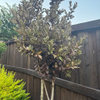
This is a picture of my lilacs after blooming but before I finished prunning last year. They continue further up the fence line as a privacy screen. They are great but once their blooms are spent it gets a little boring. I was wondering if any one can suggest something that may grow well under there. Looking for a little more color or interest. I was thinking maybe some Hostas and then some flower for color. Not too much clutter though. Any thoughts?

Comments (9)

  • 18 years ago

    That looks like rock so that maybe a bit difficult to do but while planting perennials you could start removing some and replace with bark mulch which generally adds more character. Some perennials bloom all summer, like coreopsis which come in yellow, white, red or purple and will spread if in a good soil mix. Daylilies will generally bloom over a two week period. Visit a garden center and see what you like and how long they bloom and then in the fall plant spring bulbs.

    Here is a link that might be useful: Propagating Perennials

  • 18 years ago

    No, that's just colored mulch, not rocks. Very popular these days, but kind of artificial looking in its vibrancy.

    So daydreamer, you don't want more shrubs? You want some perennials (hostas, flowers) and annuals to go underneath the lilacs?

    What kind of sun exposure is there in the afternoon?

  • 18 years ago

    Full sun most of the day, no shade till dinner time. When the lilacs are bare in early spring there is full sun down to the mulch, as you can see from the photo when they are grown in we have a sort of part sun/part shade underneath.

    Thanks

  • 18 years ago

    Geranium 'Karmina' or 'Biokovo' will handle sun or shade, dry soil and will flower in late spring. They're semi evergreen too.

    BTW, though I'm sure you don't want to remove any of the lilacs, your problem is a good illustration of why a mixed shrub border, planned for varied bloom time, berries, and fall color, is so much more interesting than the same shrub planted for miles.

  • 18 years ago

    If you are willing to sacrifice more of the lawn - say about 4-8' - then you can plant more shrubs and some perennials at the base of the lilacs, and get much more interest that way. A curved, not-quite-scalloped edge to the bed would also add interest - just make sure the lawn mower will fit in the curves. And if the house is a slightly formal, square Colonial, then curves may not fit its style.

    Spireas, various evergreens, clethra, blueberries (in the sunniest spots), hydrangeas, various viburnums, all would work. Planting spring flowering bulbs would give early interest - the dieing foliage could be hidden by the other shrubs/perennials. For perennials, there are some daylilies (most need full sun), astilbe, lilies, hellebores, bergenias, heucheras, the groundcover geraniums as suggested above (these are NOT the common "geranium" that flowers all summer in pots but more a ground cover), ferns, violets, lily of the valley, etc..

  • 18 years ago

    Lucky for you, you can use the lilac hedge as the backdrop for a lush secret garden! Layering down with a variety of shrubs that offer flowers, fruit and fragrance. A few clumps of large hardy ferns at regular intervals in front of and between those to soften the edges, forming another backdrop to scale for the perennials. And finishing the edges with a ribbon of soft groundcover, ex. 'Waterperry Blue' veronica (creeping speedwell), or candytuft in more sun.

    If you're not up for that, the combo of hostas and lamium is a tried and true with old lilac hedges, covers and softens their bare legs.

  • 18 years ago

    Thanks everyone!

    I like the idea of the Huchera and I can plant it with the Hosta. Did not even think of the Lamium. I have the Anne Greenway that forms a complete ring around one of my front trees - grows very nicely.

    {{gwi:247329}}

    I love Geraniums, maybe I can find a place for those in the mix.

    One other question. I really love Clematis but have no where to let it really trail, Would it be a bad thing to let it trail thru the Lilacs?

    Thanks!

  • 18 years ago

    It would be a great idea to grow clematis through the lilacs. Two things to keep in mind:

    Lilacs like sweet soil (lime) and lots of other plants like much more acidic soil - blueberries, most ferns, clethra and azaleas, for example. Luck for you, clematis also likes lime, so it's a good companion for lilacs.

    Second, you don't really want to plant under the lilacs, or between them, except for the clematis, perhaps; you want to plant in front of them. The lilac roots don't leave a lot of soil, moisture or nutrients for other plants, and the effect will be much better if you sacrifice a few feet of lawn and plant there. Otherwise it may all look very skimpy, and crowded against the fence. For a really great effect, you could consider making the border as wide as the height of the lilacs - sounds like more than you want to do, but the effect would be really nice - you could also try 2/3 the height if that fits your plans better.

    I personally love straight lines in gardens, with a nice edge - like brick - and plants spilling over that edge to make it less formal. Curvy lines are certainly appropriate in a naturalistic setting, but that's not what you've got here.

    I like prairiegirlz5's suggestion of repeated clumps of one plant, That will help with your concern about "clutter" and will give the new garden some rhythm, instead of the one-long-note look you've got now or the kind of hodgepodge you see everywhere - including in my garden.

  • 18 years ago

    I'm going to disagree with the last post a bit :-) There is nothing in this planting as it exists now that prevents it from being a more organic shaping or naturalistic setting. Unless the garden is very formal in style (as in response to a very symmetrical house architecture, curving lines generally offer a more pleasing visual aesthetic as well as suiting most suburban residential architecture. Curving the bed line so that it makes a deeper arc at the corner is the simplest way to accomplish that but a gentle curve all along the bed can work also. Just don't make it too curvy or the curves too tight. A deeper planting bed will also allow a much more varied and layered planting, as previous posters have pointed out.

    And most plants have a far greater tolerance for variables in soil pH than we imagine. Lilacs grow beautifully here in slightly to moderately acidic soils without any additional amendments. Planted beneath mine are a whole host of acid-lovers including rhodies, mahonia, camellias and pieris. And clematis requiring 'sweet' or limey soils is also a bit of a myth. The vast majority are perfectly happy in slightly to moderately acidic soils as well (most species are native to these conditions) and experts only recommend liming (or "sweetening") if the pH tests around 5.5 or below. Regardless, clematis and lilacs - and most shrubs, for that matter - make happy companions.