Software
Houzz Logo Print
coconut526

Replace these shrubs!!!

13 years ago

I just moved into a new home in South Carolina (Not Coastal or Piedmont; Sandy Soil) As in the picture, the shrubs look dreadful and skimpy. I am not a fan of the juniper; however, there is another type of evergreen shrub that is a lighter green and looks like dreadlocks ( I know this sounds silly, but this is the only assimilation I can think of)--does anyone know what these are called?

Also, I do not like the other 4 shrubs that are red and green and want to find something to replace these as well. There is a yew up by the porch on the right, and I want to keep this.

The rectangle area where the 4 red/green shrubs are is 3' x 7'
The 'L-Shape' is 7' x 10'

When I replace the shrubs, I plan to put mulch instead of pine straw. I am not sure if this matters, but the grass is a Bermuda hybrid.

Any information about what shrubs I should use would be greatly appreciated.

Comments (11)

  • 13 years ago

    Lots of things that could work....you are limited more by size than anything. A couple of fast thoughts that come to mind are azaleas or gardenias. Neither grow too tall (and can be pruned without difficulty), they are evergreen and they flower. And they are happy in your climate.

    It sounds very simple but an often overlooked course of action is to visit your local retail plant nursery and see what they have on offer. In mild winter climates like yours, fall is a very good time to plant and nurseries generally have a decent selection of location-appropriate plants. Make sure you visit a real nursery, not a big box store that sells a few plants. Nurseries will always have better selection and better quality.

  • 13 years ago

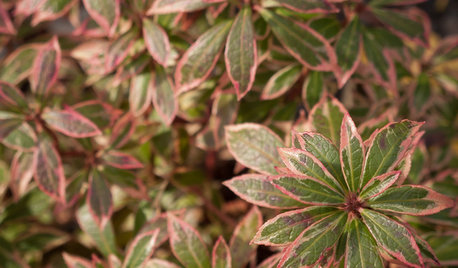
    "there is another type of evergreen shrub that is a lighter green and looks like dreadlocks" - I think those shrubs are called "Japanese Cedar". The foliage turns purple during winter. The max height is 4m and max spread is 2m.

  • 13 years ago

    Your options will be greater if you do something really important with that strip in front of the walkway. Turn it into a quarter circle by removing some turf and enlarging it. Builders always make these L-shaped straightline entry walks, and they are very unwelcoming. Adding a curved line in that spot will make a nice difference.

    You also do not want to plant anything that is so tall that it hides your sidewalk. You don't want people wondering where the walk to the front porch is.

  • 13 years ago

    The little rectangle between sidewalk and porch looks like the mulch is spilling out, which is a pain to sweep constantly, and will probably stain the concrete if not swept. I might add a border just inside the bed, to keep the mulch in (which is a good idea to help retain moisture there.) If the rectangle is under an eave, it's going to be very dry, the plants dying there may be doing so from thirst. Is this in a new housing development? Is there a physical border separating grass from bed? If not, I would install one ASAP, before the lawn eradicates the bed.

  • 13 years ago

    In the small rectangle section, we are thinking of doing the Dwarf Japanese Cedars. Also, we are definitely adding border all around to hold in the new mulch once we replace the shrubs.

    Changing the shape of that hideous L-Shaped is something we have thought about and putting seasonal flowers in the other space we create. In the footprint of the shrubs of the L-Shape, I was thinking about dwarf gardenias. The front of the house has Southeastern exposure, will this be too harsh for the gardenias?

  • 13 years ago

    conifers or shrubs to the outside...

    ANNUALS in that small space ...

    its just too small for anything long term ...

    then add some hanging baskets above ...

    the base problem .. with that small space.. is the sun.. heating the pavement.. and frying plants .. which is not really good for conifers.. but annuals could be found that would work ...

    plus on top.. it will retain the heat long into the night... not allowing an evergreen plant to recover ... and that all can already be seen.. in your pic ... your plants in the small space are cooking... there is simply not enough ground.. to be able to apply water.. to last the day ...

    ken

  • 13 years ago

    Yeah, I couldn't think of much I'd put in that rectangle, or even decide if it should be something really small, or thin and tall. It's probably less awkward in person. Angelonia would enjoy that spot. A pic from farther back might help.

    Going with the hot/dry thing, I would look at succulent plants. Z9 plants would probably survive there. Realistically though, I think I would just continue the patio over that rectangle, get rid of it. I think it would end up being much more trouble than it's worth, taking up an exorbitant amount of time (and/or water) for the small size. There's no room for error (planting something so big that it needs to be constantly trimmed, or hides the house as mentioned. You don't want to give anyone with devious intentions a place to hide by your door. Small stuff is in danger of being stepped on.)

    A compromise might be a shepherd hook or two with hanging baskets, or a few potted plants sitting on the surface there, maybe a cute combo of both. I'm a huge fan of hanging baskets, so totally agree with that suggestion. There's about 30 of them here this year.

    Gardenias need sun all day, but don't really like to be so dry. Don't know that I'd put one in the shade of another plant. No experience with a dwarf kind, but surely they aren't that different. But what is the point of a dwarf Gardenia - would you have to stoop to sniff the flowers? A 'normal' Gardenia on the outer side of the walkway would be lovely though, perfect spot for sniffing!

    If it is a housing development, the top soil was probably removed before anything was built. Shrubs are generally not so picky, but if you would like to do some more active gardening, with flowering annuals for instance, the benefits of adding some organic matter to the soil before you get started (when it's a lot easier to do,) would be huge.

    I would strongly urge you to go back inside and consider things from looking out the window equally as strongly as "curb appeal." Your efforts should reward you with a pleasing view when you look out of your windows. Don't rely on your neighbors for that.

  • 13 years ago

    Cocnut,
    You live in the same soil and weather zone I live in.
    Don't plant gardenias if this is a SE exposure.
    They need afternoon shade here. They will burn up in the hottest months.
    This is what I would do, I would wait til the end of October or beginning of Nov. and dig up all the junipers and get rid of those ugly plants right next to the house.
    Get rid of the pine straw mulch, and go buy some (about 6-7 bags) of composted cow manure from anyplace.
    Mix the soil the with the manure, be generous with it. If you need more, buy more. (40 percent manure).
    Then, I would replant the junipers on the side of the porch like you have them, where the yew is, they will help hold that soil there in bad rains.
    The front part where you have the junipers now, you can plant whatever you want, but add LOTS of manure first.
    Then plant your cedars, if that is what you want.
    Then if you really want them, you could plant the spreading gardenia, (check to see how much sun its getting in the summer months,) if too much you may have to shade them with hanging pots, Radicans, they sell them everywhere down here, Then this is the most important part, MULCH. At least 3 inches. If you don't buy mulch, don't plant anything at all.
    You will need bags and bags of it.
    Mulch the yew and the junipers on the side too.
    I use the big pine bark pieces, they last for years, you don't have to remulch, and they sell them in dark brown, which I like.
    It will look real nice, and they sell those cement edgers at Home Depot cheap, don't forget them for the very front, or your grass will eat your plants. Bermuda LOVES mulch.
    Congrats on your new home!

  • 13 years ago

    I'm 15 miles from the FL border, and Gardenias are for full sun here. Otherwise, they look floppy.

  • 13 years ago

    For the outside of the sidewalk area you might consider Pittosporum 'Wheeler's Dwarf'. Either green or a variegated version. Really nice and low and compact. Or maybe a dwarf India Hawthorn if you have no deer issues.

    If the outside area gets afternoon shade, perhaps Azalea 'Chinzan' would work with mulch and extra moisture. It forms a low mound as well.

    For closer to the house, I don't know how deep that bed is. Maybe consider a pruned Yuletide camellia closer to garage and really keep it pruned. Then another Wheeler's Dwarf to the right of it, in front of your porch.

  • 13 years ago

    You've already been given several good suggestions concerning the shrubs. As far as the Bermuda grass goes, make sure you bury some plastic lawn edging around the perimeter of your flower beds. I would use 5" wide lawn edging and bury it 3" inches. This will keep most of that Bermuda from creeping into your beds. There is a product called "Deep Edge" that is 6" wide lawn edging. If you could get your hands on some of that and bury it 4" around your flower beds, you would keep 99% of the Bermuda out of your beds. I live in SC Kansas and have nothing but Bermuda grass in my lawn. The 5" edging has been a great investment, which as saved me hours of labor in pulling grass.