Software
Houzz Logo Print
bradarmi

Winter heating dilema

17 years ago

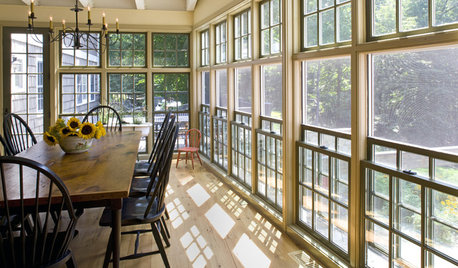
I need some help, and I think the wonderful people in this forum can help me. We just got our heating and electrical bills and the total for both was almost $600 for a typical 3 bedroom, 3 bathroom split-level home in the Chicago suburbs. We think it is due to the attached sunroom we just put on. While the sunroom has proven wonderful in terms of growing plants (all my orchids flowered this year) as well as azalea, clivia, jade, and gardenia; it has proven very drafty.

Here is the set-up, it was an attached white aluminum screen porch and my dad and I put wood studs and walls on the outside and the inside. We stuffed lots of insulation in between the studs and put concrete siding on the outside and the inside. The walls do not actually feel cold even when Chicago had -20F nights. We took the screens out and then put the really nice windows (forgot the brand) but they are the white ones you see at Menards with the square white panes. They are double glazed I think, the same ones we have throughout the rest of the house. The roof is aluminum, but we added insulation again in between roofing studs and another piece of aluminum sheeting on top. There are no skylights.

The sunroom faces west with some windows facing south, and there is a door to the north that opens out to the backyard that gets openned frequently since our Shih Tzou has a small bladder. I think the majority of the heat loss comes from the door (metal door with stained glass window) and a storm door on the exterior. The sunroom is off the patio and the air flow through the house and sunroom is open. The average day temp is around 70-75 F and the average evening temp is around 60F with humidity ranging from 45% on the coldest nights to about 60% on the warmest days/after watering which has contributed to the success of the orchids. By the way, the floor is a concrete slab, covered with thick padding and thick outdoor/indoor carpet. We also routed a heat vent from the furnace directly and have a electric fireplace for added heat (aesthetics)which we run on cold nights.

I guess my question, which I seem to be answering, is whether or not I should seal off the sunroom door and let the dog out on the other side of the house? If I seal it off, what should I use, bubble wrap, plastic, etc? My old man put it in perspective by asking "are there actually $600 worth of orchids/plants in there?" If not, you could just buy new ones every month...it's hard to argue with that logic. I hate when he's right, lol. Even after I explained to him that the fun is getting them to rebloom!!

Comments (14)

  • 17 years ago

    The information you have provided is new to me. Thank's for it.
    Lisa11

  • 17 years ago

    Sorry to hear about your staggering heat bill! Without actually walking through your sunroom I can only offer some guesses.

    I think you are right about your door to the outside...both from potential leaks and frequent opening for your dog. But that alone won't contribute that much to your overall heating bill. One key piece of information that would be helpful is what a "normal" winter bill would run. Also, since utilities have raised rates, a comparison of heating oil/natural gas/electric consumption rates from previous years to this year would offer a glimpse to the actual change you're experiencing.

    You say that you don't notice obvious drafts, but that could be due to good air circulation masking a potential cold spot. 10-15F is a pretty hefty day/night temperature swing for your interior. A well-insulated house should be half that.

    Sealing off your outside door is certainly an option during the winter, but better yet, check your moldings and weather-stripping. Yet another option is to install sliding doors to your sunroom. I know that aesthetically that's not going to give you the effect you're looking for, but it may help. You could mask the appearance of the doors with plastic greenery and trees, which of course won't require care and light, and provide a transition point and "blending" into the sunroom. They only need to be closed when it's exceptionally cold outside.

    Also, are the windows you put in giant ones 5-6 feet tall? Double pane may not be enough for what you're asking them to do, if there's a significant surface area. The insulative properties of glass can be improved some with the addition of a film, but that will reduce the light to your plants. Other types of coverings, i.e. bubble wrap, would be unsightly but temporary, and would accomplish the same thing.

    You don't give the dimensions of your sunroom, but compare that number against the square footage in the rest of your house. If the relationship is on the order of 10-15%, this could be enough to reduce the efficiency of your furnace, causing it to run longer and more often. And, unless you have a 220v electric fireplace, it's only good for 1500 watts, which is the same as a tiny space heater. In a large room, this is only good for essentially warming your toes temporarily, and won't contribute anything significant to the overall temperature. What it WILL do, if run any amount of time, is draw lots of juice. That said, I occasionally run two 1500-watt heaters in my gh, and they may cost $.20 per hour, each, to run.

    It may be money well-spent to have an insulation pro visit your home with one of those infra-red cameras. That will identify precisely where your problems are.

    That's about all I can think of. Hope this helps.

    -Bruce

  • 17 years ago

    Ouch.

    Hard to tell from here, and you should easily be able to determine how many panes of glass you have, but if your atchd sunroom is 60º at night, your house is heating it. From here, you have a decision to make, as your dad implied. There is greenhouse bubble wrap that will help, as well as sealing your door tighter, installing a solid door, passive solar gain, etc. But if it were my house, I'd keep all my money in the building envelope. YMMV.

    Dan

  • 17 years ago

    Bruce and Dan, thanks for the input.

    Bruce, there is a patio door that can be closed off, as well as a kitchen window that could be shut, the problem is the tropical plants will die when the temperature drops and the sunroom is used primarily to overwinter tropicals much to the family's dismay. (Come summer, most of them go out).

    We (I) want to make the sunroom weather-tight so we can avoid bringing the plants indoors or getting rid of them, as we have poor light inside. There are well over 40 orchids, some larger succulents, and 5 hanging epiphytic cacti. The 10-15 F drop is an average since there are two thermometers (one on a window sill facing south, but under the bench, the other is against the adjacent wall). You are right, at first I thought the temperature drop was a good thing since the orchids bloom well with such a drop, but you are right, all those windows let in light and cool air.

    I will have to get back to you about normal heating bills (they seem worse this year, but probably because everything else in this economy sucks, I just notice it now).

    I inquired for a inspector with such imaging capabilities.Anyone have experience, are they pricey?

  • 17 years ago

    We (I) want to make the sunroom weather-tight so we can avoid bringing the plants indoors or getting rid of them, as we have poor light inside.

    Even doing this, with double-pane glass this is only R-2 or at best R-2.5 insulation value. You should think about the fact that all your heat gain will be completely lost at some time during the night, and temp will be equalized to outside (colder, sooner & warmer, later). Therefore you will need supplemental heat for the aforementioned plants.

    There are literally scores of websites on The Internets that discuss, address, lament this issue.

    Bubble wrap will give you ~R-4-4.5 and greenhouse film over that might give you R-5-something if you are lucky. Insulated curtains can be made which can give you R-4-8 depending upon the curvature of your glass and how strong you are to operate each evening and morning. Even with this insulation value temps will sooner or later be equalized and you'll require supplemental heat.

    If you have a GFCI plug outside you can run a heater, numerous Internets places exist today to help you calculate how many BTUs you need to keep x temperature with y sq ft glass and z temp differential. I'd avoid a propane heater for the CO and subsequent foliage damage risk.

    Good luck.

    Dan

  • 17 years ago

    I misunderstood what you were measuring as far as the temperature range...I thought that was your general house temp. Don't worry about greater swings in the sunroom.

    I'd recommend closing the patio door and window, and heating with one or two electrical heaters. Your orchids (with the exception of most vandas) and tropicals won't suffer with 45F nighttime temps. Is the sunroom insulated well enough to achieve that? Perhaps you can find some attractive blinds (or something on that order) that will seal the windows well at night.

    By closing the door and window, your furnace won't be working so hard, although some heat will trickle out of the vent. Is there a ceiling fan to push the heat down towards the floor? A fan will also stir any window coverings if they're free-hanging...try to avoid that.

    Take advantage of the sun during the day, and it might be possible to raise the temps to 80F or so. It won't be worth an awful lot, but may delay having to turn on heaters for an hour or so at night.

    Another benefit to keeping the doors closed is your humidity will improve, which your plants will appreciate when things are normally dry in the winter.

    -Bruce

  • 17 years ago

    Bradarmi,

    Are you sure the problem is your sunroom, and not the "extras" on your gas and electric bills? Take a close look at both and see how much of it was for the gas or electric you actually used, and how much was the rates per btu/klw, taxes and delivery charges.

    Then, check the same bills from a year and two years ago. Did the sunroom actually add that many more btu's? Then factor in one of the coldest winters we had had in a very long time.

    However, you can still add insulating to your sunporch if you add another layer of insulation to the windows with shrink film. The air trapped between the glass and the plastic will make a fair bit of difference without affecting the light. From your description of warm lower walls in -20 temps, it doesn't sound as if they are where you may be losing heat.

    Also, if you add insulating drapes to the windows and close them at night, they will help keep the space warmer.

  • 17 years ago

    Bruce, Dan and others, thanks a lot for the information, you guys sure know your stuff.

    I have some great pics that I will try to post this week, and I have blinds in the sunroom over all windows, so lowering them and closing them at night would not be a problem. I am going to try shutting the windows and doors as well and see what the temp is.It is actually pretty humid in there, but increasing the humidity to 70-80% would be nice. There is a ceiling fan that I can reverse the direction for winter/summer. I tried that and my mom swears on her life that it makes the attached kitchen /living area cooler. I am going to try all the above and see if it changes this months' bill. Of course, it isn't as cold now, but I can practice for next year.

  • 17 years ago

    Your sunroom sounds remarkably like the setup I had when I lived in Colorado, except for the door on the North end. We bought an insulated wood-clad exterior door and built a small porch with a windbreak on the North side. This door stayed dry inside the porch and a strip of insulation all the way around the opening prevented any draft at all.

    The contractor used 1x2 framing on the concrete patio deck and laid waterproof cement board on top of that. Then he laid the 1'x1' ceramic tile on top of the board. Even with the concrete just 2" below the tile never was cold in winter, but always felt cool in summer. I believe that the 1" air pocket between the patio and the cement board was enough insulation to maintain a constant temp in the floor.

    The windows were dual paned windows and only the ones on the ends of the room would open. The three windows that faced West didn't open and we covered all of them with translucent insulating shades.

    Then we put in a doggie door on the South end which was a lot more cold proof than you might think. It was close to the house exterior wall and was shielded by the eave and some large evergreen shrubs planted close to the door. It also had a solid insulated sliding door that locked from the inside when not in use. Normally the dog could come and go whenever she wanted to and the sunroom stayed an even comfortable temperature year round.

    We also didn't run any heat out to that room and we kept the sliding patio door closed all the time. That room was snug and warm and humid enough for my orchids to bloom yearly and my angel wing begonia bloomed constantly year round. I had one electric outlet and ran a small portable heater occasionally in winter.

    There was virtually no difference in our electric bill after we had the sunroom built. That one little heater barely used any power and the room was so snug that even on the coldest nights it didn't run all the time.

    The only thing I can think of that might be contributing to your heating bill is the door that leaks and the floor that, although you say you have thick pad and carpet, doesn't have an insulting air layer between the concrete and the pad. You also said that you stuffed lots of insulation in the walls. Thing about insulation is that it works by trapping air. If you "stuffed" it in tight, you may have actually reduced it's insulating properties by collapsing the air pockets. I don't know if that's what you meant, but that could be another issue.

    Lastly, we had to build a small ramp for our dog to get in and out of the doggie door and we laid a pea gravel path from the grass to the ramp so she didn't track in mud. By keeping the glass slider closed most of the time, she couldn't track in any mess and we kept a little bathtub out there to wash her paws before she was allowed in the house. Cheryl

  • 17 years ago

    Seamommy and bridwidow, thanks for the info as well. I am going to lower and shut the blinds for a few nights this week and let you know how that goes. I am also going to try closing the patio door and windows too.

    I find it really odd that seamommy's sunroom remained warm enough to grow orchids with the room being sealed off and only supplemental heat from a electric heater..our sunroom has a corner unit fireplace, the decorative ones from Menards; I cannot imagine it to be able to cope with the temps required since the last time we sealed off the patio door and windows the temps plumeted into the 50's F. Our dog has a tendancy to jump on to plants, so I went out and brought a grate for the sole puprose of being able to leave the patio door open while we are not home to keep the plants warm and the dog out.

    To all of you with electric space heaters - do you leave them on when no one is home during the day - we would be worried about accidental fires.

  • 17 years ago

    I've used those inexpensive Holmes 1500-watt heaters (about $17 from WalMart) for years in my gh, and never had a problem. They have a "tip-over" switch, such that they shut off if they fall over. They also have an overheat circuit to shut them down in case of failure. I had one do this because of a defect a week after I bought it, and took it back for a replacement. (It didn't overheat, the circuit somehow failed.)

    They really don't put out enough heat to catch anything on fire. I could see the potential in those old radiant-types with the glowing wires, but these heaters are a completely different ball of wax.

    If you want to be especially cautious about operating one while you're away, sit it on top of a couple of bricks. However, the case is made out of plastic, and never gets beyond the "warm" stage even when on high.

    -Bruce

  • 17 years ago

    Attached greenhouses/sunrooms are notorious for heat loss.
    I would put an exterior door and solid wall between the greenhouse and the entry to the house, and have it be a greenhouse that sits against the house but does not share air.
    Another great idea is to put a chicken coop on one end of your greenhouse and let the chickens' body heat warm the greenhouse, instead of your indoor heated air. The chickens breathe out CO2 which the plants breathe in, and the plants breathe out oxygen which the chickens breathe in.

    That info is even on this Garden Web.
    Good luck!

  • 17 years ago

    Meg, you have no idea how bad I want a chicken coop

  • 17 years ago

    An idea for after the house is closed off and curtains/blinds installed: If the sun hits a spot on the greenhouse floor consistantly throughout the day, it may be worth using bricks or something to store the sun's heat for at night. I've read of people using water filled barrels for that purpose as well, but I think to be worth that effort might require more south-facing exposure.

    Here is a link that might be useful: search for thermal mass