Software
Houzz Logo Print
newfiewoofie_gw

My 401K landscape re-do

18 years ago

I had drawn up some beautiful plans and designs for ripping out and replacing my entire front landscaping which is 35 years old and very overgrown and plain old ugly. But, I don't feel comfortable spending so much $$ right now, for many reasons. So I am having the yard re-graded and will plant new foundation plantings and also deal with several slopes using mixed plantings of shrubs and perennials. To the point-I am looking for suggestions for shrubs that sit especially well on slopes. Flowers and interesting leaf colors are a top priority. My conditions: Zone 5B, 5-6 hrs sunlight, facing N-NE so there is a bit of wind especially in in these NE winters. Soil is loamy with a few larger poplar, pine and oak trees and their roots to contend with. I will add compost and mulch yearly and water for the first 2 years, but after that, they should be able to stand on their own. My total frontage is about 150 ft-but the sloped area is about 50 ft x 30 ft. Do you all have some favorites to use in these conditions? Thanks for your help!

Carole

Comments (4)

  • 18 years ago

    without a picture.. i have nothing ... i just cant conceptualize your words...

    ken

  • 18 years ago

    personally my favorite are 4 o'clocks they can work very well as a hedge they are 3 to 4 feet high 3 to 4 feet wide and they have that bugle or horn type look which attract hummingbirds and are so multicolored you would be looking at everything from pink red black yellow and white striped and every combination of colors you can think of ....they are perrenials and it would go great on portions of your footage ...to add to it you could grow morning glories infront of them so you have flowers which look very similar the really cool part to this idea or concept is , the morning glories would show their stuff in the morning and during light hours and the 4 0'clocks when it is gloomy cloudy or late in the evening including at night ...that is how they got their name , because they bloom or open after 4 PM when the sun goes down or when there is shade and since you have portions which are north facing it would work and may be something to consider .

    okay so you have wind well you may want to consider hardy everything resistant shrubs like Caraganas for protection and since they take nitrogen directly from the air they survive anything and provide nearby plants with loads and loads of nitrogen I admitt they are not pretty but they do their job ...personally I can't think of anything better than swedish aspen , they are formal looking up to 36 feet high grow fast do not have invasive roots and are only 3 to 5 feet wide ... during even the slightest breeze they provide a beautiful rustling sound which has been said to be very pleasant ...well I could keep babbling on and on but I hope this gives you a few ideas .

    I'm trying to figure out why you are putting that much money into such a small footage of space don't get me wrong but you would need to put in stones and have some forms of trickling water along the rocks with lights to really give it that 401k look . moving all that oak shrubs and trees is going to cost a bit there is an awful lot of roots you must have going on there btw I really admire your go for it agenda , it's something I wouldn't do but that's just me and of course 401k is part of it .

  • 18 years ago

    Hi Carole,
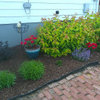
    I have a slope mixed with bulbs, perennials and shrubs. It is about 20X30 and faces east. Here are some pics if you're interested in any ideas. I'm not sure how steep your slope is.

    {{gwi:280529}}

  • 18 years ago

    I am assuming that you are having any "hard-scaping" put in - paths, walls/terracing, benches, fences, pergolas, arbors, rocks, etc., as well as running water lines and electrical lines as planned - before you do anything much about making beds or improving the soil? Since these will all require earth-moving, to whatever degree, it's MUCH better to do them before trying to make beds and plant things, only to have to move them for workmen, or to re-improve the soil that is now compacted from machinery, tramping on, etc.!

    As shown above, a good "background" of hard-scape will look good in the winter with all the leaves off, and not be really be noticeable in the summer, except in little vignettes, like the picket fence at the top, or the rocks at the bottom of the slope.

    I would (cliche warning) strive for a mix of evergreen and deciduous shrubs, the former including a mix of both conifers and broad-leafed evergreens. The more dwarf conifers will stay in proportion for longer, but if you plant the larger ones anyway, leave enough room for them to get full size, planting around them with perennials or with shrubs you don't mind losing as the "star" grows to fill its allotted space. It is SO easy to succumb to the easily done feeling that things out of 1 or 2-gallon nursery pots won't REALLY get THAT big - "only see how small it is now, I can easily put 2 more plants next to it, there's plenty of room", only to find 3-6 years down the road that they are all growing badly, overshadowed by their neighbors and looking awful!

    For flowering shrubs, full sun, try lilacs, spireas, forsythia, the Knock-out roses (I prefer the reds, single or double, but..., the pinks are nice too), other shrub roses, Clethra, various dogwoods, Hydrangeas, mountain laurels, viburnums, etc.. Blueberries are another possibility, flowers, fruit, if you get to them before the birds, and fall foliage (and if you have a bad deer problem, never mind...). Taller sun specimens can include service berry, red bud, smoke bush, crab apples, mock orange/Philadelphus, ink berry. Shade includes the azaleas, rhodies, calycanthus (pick one noted for scent), witch hazels, etc.

    For evergreens, there are almost too many conifers to choose from, but a short, quick selection would have to include dwarf Alberta spruce, if hardy, any of the smaller Hinoki cypress, smaller cedars, yew, junipers, etc. Broadleaf evergreens - hollies, rhodies, kerria, some viburnums, boxwoods, etc.

    Don't forget the ornamental grasses and carex, sizes ranging from a few inches to more than 8'.