Software
Houzz Logo Print
fishacura

Builiding a vegetable box garden

15 years ago

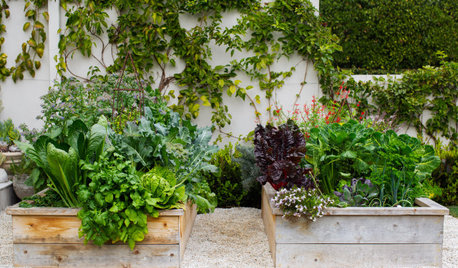
I've decided rather than plant in the ground this year I'm going to build a box garden approx 12-12 feet by 3 feet for two rows of veggies. My problem is, what type of lumber to use.

Originally I figured pressure treated 4x4s stacked but have read perhaps chemical will leach into the soil. Is this true?

If not pressure treated, I thought maybe two 2x6 placed on top of one another to give a 2x12 box. But if not pressure treated, what type of wood???

Comments (17)

  • 15 years ago

    If you can get cedar or redwood, they would last longer. Regular Yellow Pine will last several years. You can get either the 12" wide boards, but they will costs more than 2-6" wide boards. If you do the 6", add a stake and screw the into the stake. If you want higher, you can add more, up to the height of the stake. Put 2 stakes on the 3' sides and every 4' on the 12' sides. You might want to use pressure treated stakes, to last longer. The pressure treating used now-a-days isn't as bad as in the past.

    I asked hubby, who was a former builder.

    Marla

  • 15 years ago

    An alternative to wood is composite "lumber" made out of recycled plastic. It's chemical free and lasts indefinately. I made a special raised bed for my Asiatic/Oriental Lilies using it and has performed wonderfully. A little pricey but pays for itself by lasting "forever" and no worry about chemicals leeching into the soil.

    I used 2' rebar every few feet to keep the lumber from bowing.

  • 15 years ago

    This is terrific. Thanks for the ideas. The "staking" is something I hadn't really considered but sounds like I absolutely need to do it. Of course, I'll have to probably find a nice long bit for my drill as I have no idea how to get my drill through a 6" board lol!

  • 15 years ago

    You don't need to drill THROUGH a 6 inch board.

    Although it would cost a little more, if you have the room, I think you would be happier with beds that are no more than four feet wide so that you can work across them without having to get into the bed. Walking on your soil will pack it down. Also having your crops a little closer to you is helpful so you don't have to bend down so far to work, or if on your knees you can reach across, not down and across.

  • 15 years ago

    Sure I do (need to drill through a 6 inch board) don't I? If I want to stack them to make 12" height AND I want to prevent warping, don't I need to insert rebar every 3 feet or so along the sides?

  • 15 years ago

    Composite lumber is much more flexible than standard lumber, which is why the rebar was suggested. But the rebar goes outside the boards, not through them. The boards would be too weak if you drilled all the way through the width of them. You could also use wood posts, and screw the boards to them. Either way, you'll need more support than you would with standard lumber.

    If it were me, I'd probably use ACQ 2x12's with 2x2 posts. You could line the inside with plastic, but I think ACQ is quite safe to use with vegetables. Here are a couple good articles on pressure treated lumber used in gardens.

    Does Pressure-Treated Wood Belong in Your Garden?

    Are Pressure Treated Woods Safe in Garden Beds?

    You could also use retaining wall blocks which are very easy to stack once you get the first row leveled.

  • 15 years ago

    Oh ok....that makes sense. I'll use wood posts. I wouldn't know how to attach rebar without drilling through...that's why I was confused. I may still use composite versus MCA pressure treated lumber. I am not as worried about chemicals but have to believe the composite will have a much nicer look and there's no doubting the longevity will be greater.

  • 15 years ago

    I should have mentioned putting the rebar on the OUTSIDE of the boards. I used 2' bars and pound down as far til the top of the rebar is just a little below the composite lumber. The force of the soil will push the "boards" against the rebar but will not move it . . . so need to attach the rebar to the boards. I wasn't over-concenred about the look of the bed but longevity was the prime factor by using the composite lumber without any leeching of chemicals into the soil. But it does look quite nice.

    PS: there are several brands of composite lumber . . . so you may be able to get a lower price if you shop around. Regardless of the price, once you buy it you'll never have to replace it . . . so it's worth whatever you pay.

  • 15 years ago

    To stack the 'bed sides', you would put the stakes in, out the outside and inside, then slide your sides in between. OR just 'sister' boards onto the sides on each side to hold the boards on top of each other.

    Marla

  • 15 years ago

    tommyk - THANKS

    myfamilysfamr - Thanks! I'll probably still marry the boards together with some kind of plate with screws just so there's no risk of sliding.

  • 15 years ago

    Alright, you asked about lumber and it looks like you have gotten lots of feedback on that so I'll throw in another alternative for you, concrete blocks.
    Here in AZ they cost $1.09 a piece at Lowes or Home Depot and are 16"X 8"X 8". I have built three 4' X 8' raised beds out of them. It is really simple, just lay them on the ground and fill up the inside with your planting mixture. You can even fill up the holes in the blocks with planting mixture and plant in them.
    They last forever so no worries about termites or rot and there is no leaching worries.

  • 15 years ago

    Good idea...never considered it.

  • 15 years ago

    If you're going to pound rebar 2 feet into the soil and your telephone, gas, electric and or cable are underground it would be wise to know where your utilities are located. Most power companies offer a free service to homeowners for this service.

  • 15 years ago

    Has anyone done a cost comparison on standard size like 4-foot-12-foot by 1-foot deep using Cedar, versus, concrete block versus versa-lock (landscaping interlocking block).

    Just curious becaus eit seems fairly close by the time you add in all the parts. We're struggling with this.

    Cedar seems expensive and most of what we can get is 1-by material (1x6x12-foot).

    Concrete block seems cheap, but doesn't look so great.

    Versa-lock is expensive.

    and composite is real expensive and pretty flimsy). I know some of these last longer and are a better value...but I'd love to see the pure build cost if anyonehas done it.

  • 15 years ago

    Yes, check to see where underground utilities are, but our garden is far enough away from the road/house to not have to worry.

    I only built one 4x8' raised bed using composite lumber and that was a special bed for Oriental/Asiatic lilies lined with hardware cloth to keep voles/rodents from getting at the bulbs. The majority of our beds are "free-standing" which work wonderfully. Every spring I just touch them up a bit (never dig them up) and add my organic nutrients/fertilizer.

    If you want a formal raised bed for "show" I would recommend the composite lumber. Yes, it's pricey but remember . . . once it's built you never have to replace the "boards".

  • 15 years ago

    Just as a reference:

    Composite 6-inzh x 5/4-inch x 12 feet =$21.97
    Cedar 6-inch x 1-inch x 12-feet =$17.26
    Untreated pine 6-inch x 1-inch x 12-feet =$10.96

    Concrete block 4-inches x 8-inches x 16-inches =.98
    (or $8.82 to cover the same 12-foot length as the lumber)

    Concrete block 8-inches x 8-inches x 16-inches =$1.41
    (or $12.69 to cover the same 12-foot length as the lumber)

    Locking Block 3-inches x 5-inches x 8-inches =$1.47
    (or $52.92 to cover the same 12-foot length & 6-inch height)

    From a pure price standpoint...assuming all asssembly/reinforcement materials being equal, concrete block is the cheapest. Not sure how well a 4x8 block would stand up to the pressure of the soil. I guess you could add rebar and dry stack them, but that would be a lot of rebar to stake each block.

  • 15 years ago

    I used concrete blocks as a front for my mobile home, 28' wide by 2-3' wide. I put the dirt in both the holes of the blocks and inside the 'box'. This was just for flowers, but it would work for veggies. I would put some vining type of flowers or veggies in the block holes and let them vine over the 'ugly' looking blocks. I did this in FL and the blocks helped to keep the dirt from getting too warm.

    Check on craigslist or the like for free ones.

    Marla

Sponsored
Whisler Home Improvement
Average rating: 5 out of 5 stars9 Reviews
Franklin County's Committed Home Improvement Professionals