Software
Houzz Logo Print
due_east

Help me with my soil analysis please

17 years ago
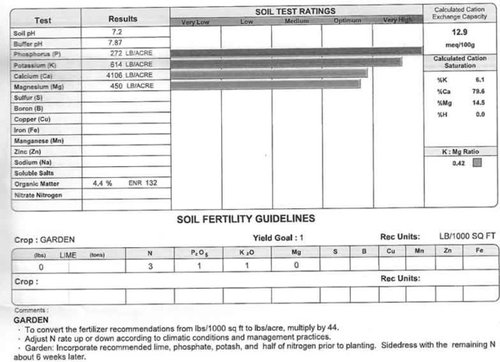
Hey

Just got my soil analysis back from the co-op

and I'm not too impressed.

The one I did a few years back had a bunch more info on it.

If any one knowledgeable could give some advice on what

I need to put down I would really appreciate it.

Also, I was going to add aged manure this Spring,

would that put my N too high?

Here is a link that might be useful:

Comments (14)

  • 17 years ago

    What are you doing with your soil? Is it pasture, lawn, orchards, tobacco, or what?

  • 17 years ago

    It's a small vegetable garden.

  • 17 years ago

    Well, they did give you some recommendations at the bottom of the page. If you want to follow those and just need to figure out a fertilizer application rate you can use the garden calculator I came up with.

    Having said that, I wouldn't follow those recommendations. Based on the CEC, I would say that both your phosphorus and potassium are about 3 times higher than full sufficiency. You may need some potassium within the next year or so, but I would stay away from phosphorus. You won't need any P for plant nutrition for more than a year (probably more) and excess phosphorus can inhibit the uptake of micronutrients in some plants.

    Your pH is only slightly alkaline at 7.2 and should be suitable for a broad range of plants including vegetables so don't worry about changing it.

    I would stay away from manure because it is a significant source of phosphorus. Instead, I would use a green waste compost, which typically won't over-load you on nitrogen of phosphorus and should supply enough slow-release potassium to see you through the year. Your organic percent is already at 4.4% (presumably by sample dry weight) and optimum is in the neighborhood of 5% to 6%. I would only apply 1 to to 2 cu. yds. of green waste compost per 1000 sq. ft. tilled to a depth of 6 to 8 inches. The calculator linked to above can yelp you with a rate on that too.

    For nitrogen, I would apply a nitrogen only fertilizer and shoot for 1 lb. total N per 1000 sq. ft. You could go with a synthetic like ammonium sulfate (21-0-0) or sulfur coated urea (46-0-0) or stick with an organic source like bloodmeal, which usually clocks in at around 12-0-0. Be aware that those synthetics are acidifying and can decrease the soil pH over time with repeated use. That change happens very slowly and you are slightly alkaline, so it wouldn't exactly be a bad thing some most plants prefer slightly acidic soil conditions.

    Good luck.

  • 17 years ago

    Of course, there's no such thing ans "nitrogen of phosphorus". I was trying to say "nitrogen OR phosphorus".

  • 17 years ago

    gargwarb,

    Very nice calculator. Have you thought about adding Ca, Mg and S as well? Ammonium sulfate of course has 24% sulfate ions.

  • 17 years ago

    Thanks, that's kind of you.
    I have thought about it but I have a tendency to give more information than necessary and over-complicate stuff. I made an effort to streamline a somewhat bloated calculator but I could always add those if folks really wanted them.

  • 17 years ago

    For nitrogen, I would apply a nitrogen only fertilizer

    How often do you hear that?

    Chicken manure might be the ticket.

  • 17 years ago

    Garbwarb, that is a pretty cool calculator! not that I know a dern thing about fertilizers or hi-tech spreadsheets...Amy

  • 17 years ago

    Thanks, seedsilly. I hope you find it useful.
    idaho_gardner. I've spent some time in your state (family in Twin Falls, Idaho Falls and Clover). Wow, what a beautiful place.
    I personally would even stay away from chicken manure. If you look at commercially sold chicken manure it usually has an analysis of somewhere around 3-2-2 or 4-3-3. I have a few clients that I work for who are egg farmers that also sell composted chicken manure (if you can imagine that) and their material actually comes in with an analysis of around 2-4-2 to 2-5-2 pretty consistently. Although chicken manure definitely has its place, I would try to stay away from too much P if possible in this particular case. But hey, opinions are like......well, you know the saying. I suppose I should try to keep it rated 'G'.
    ;)

  • 17 years ago

    Thank you for the info.
    So over all my soil seems to be in pretty shape?
    Will the phosphorus & potassium being "very High" a issue
    for this coming springs garden?

  • 17 years ago

    Sure, you could say it looks pretty good. the major and macro nutrients look like they're in good supply. They aren't high enough to cause any real problems at the moment, but no reason to add more of what you don't need.
    The test didn't check for micronutrients so..(shrug). But the compost should provide some micros. You're pH looks good so the micros that you do have should be pretty available. Boron and salinity weren't checked so......(shrug again).
    According to the estimated cation saturation data, sodium is a non-issue in regards to its effect on soil structure and drainage. (Since K, Ca and Mg make up 100% of the exchangeable cations, your ESP is 0. That's good).
    I think if you mix in some green waste compost and add some nitrogen at or right before the time of planting, things should work out pretty well.

  • 17 years ago

    The test didn't check for micronutrients so..(shrug).
    Boron and salinity weren't checked so......(shrug again).

    Yeah, the lab that my co-op used last time seemed to
    have tested more stuff and made it easier to understand
    what I needed to add.

    When you say green waste you mean grass clippings and stuff
    like that or is that something I can buy?

  • 17 years ago

    No micros, no boron and no salinity on the test isn't really that big of a deal. If everything looks good in your garden, then don't sweat it. If problems start popping up, cross that bridge when you get to it. You'll probably be just fine.
    Yes, green waste compost is exactly the stuff you have in mind. You can make your own or buy it. Unfortunately, I'm not familiar with any suppliers in your area but maybe someone else can chime in.

  • 17 years ago

    You do not need to add any P or K and your Calcium and Magnesium are in good balance. While the level of organic matter is a bit low, 4.4 percent, adding more could move the P and K levels up even more. Nitrogen is highly dependant on soil temperature and whether any would be needed would depend on how the plants grow, but with similar soil test results in my planting beds I have not seen any reason to add any N. Mulch, which will slowly add more organic matter to the soil may well be all you need.