Software
Houzz Logo Print
bob64_gw

Garlic Mustard Compost

16 years ago

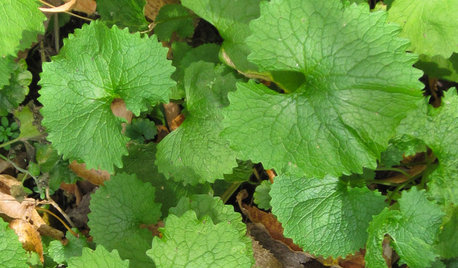
I have a very large amount of pulled up garlic mustard in a few piles around the property and will have even more over the next few weeks. Supposedly it can still go to seed even after being pulled so I gather it up in designated areas which are my "hazardous waste" piles. The seed stays viable for several years. Sending it to the landfill is essentially impossible. Pulled garlic mustard looks very green and moist when first pulled but dries out and turns into what looks like straw pretty quickly. I have some in a pit that I cover with a large scrap of outdoor carpet, some in open piles and some in black plastic compost bins. The piles do not heat up like piles of grass clippings do. Local animals and bugs will not eat the stuff (not even deer) and I don't have access to farm animals (goats would be great though). Burning is also ruled out due to local law and also due to "red flag" warnings for fire danger lately (previously kind of rare around here). The property is woodland. My goal is not to make useable compost out of the stuff but I'd like it to break down quicker to make room for more loads of this and other pests. The stuff in the pit seems to break down the fastest -- maybe due to having more moisture and being in better contact with soil. Budget is tight and I can only tend to the piles maybe once a week at most. Any thoughts on the current methods I'm using? Should I build big bins? Cover the piles with burlap? Any suggestions?

Comments (27)

  • 16 years ago

    Bob
    I don't even know what garlic mustard is but if, like you say it quickly dries into something like straw, it probably isn't going to give off the nitrogen your thinking it is to break down the pile.Grass gives off nitrogen and is mixed with brown leaves and such. If you can't do anything else make a small pile and put in about a pound of some kind of fertilizer that has a lot of nitrogen, wet it and wait to see if it heats up.This will tell you if this garlic mustard is going to do what you want it to.Sorry I couldn't help you more' I make a lot of compost but never heard of mustard garlic. Good luck

  • 16 years ago

    You said "Supposedly it can still go to seed even after being pulled ..."

    That's true of most seeds. But they must have already started to develop when you puled/removed the weed or developing seed head.

  • 16 years ago

    Lawndivot, hopefully you don't know what garlic mustard is because you don't have it. It's very invasive. The only plus is that it is edible by humans but I don't like it enough to eat acres of it. To keep in moisture on the piles and also limit area of seed spread I've been thinking of some sort of porous cover like burlap or whatever. I guess I should treat it as a carbon. I have earthworms in abundance but haven't yet figured out if they eat the decaying plants. I have been able to count on worms to eat a lot of my other garden waste but I'm not sure about this one. Maybe they eat it after it's dried up and crumbled? I haven't found any literature that mentions the relationship to worms other than to say that the plant and our common earthworms are both from Eurasia so they are apparently able to coexist. I don't see a lot of worm castings around the old garlic mustard piles like I do in my leaf and woodchip piles.

    Jean, The seed pods or siliques have begun to form but are still not fully ripe. The plants are now in flower. A lot of the literature I have read suggests that once the plant is in flower it can develop seeds even after being cut or pulled although I don't recall any of the literature giving great specifics about the timing. The irony is that It's tallest and easiest to pull when it is in flower. It's a nasty weed. If I was sure I could leave it where it falls that would be great but I keep coming across these warnings.

    Here is a link that might be useful: Garlic Mustard Info

  • 16 years ago

    Hi Bob,
    Here is a very simple solution ,Go to Harbor Freight (or ???)
    and purchase a small Chipper/Shreader.. I got mine on sale for 100.00 Here is a pic

    {{gwi:261266}}

    Go gather up all that stuff from around your yard into one spot (the hole sounds like a good spot) , once you shredd them, they will be such a small pile you will be amazed, not only will they start composting right then and there,but if you pee on them or pay money for some other nitrogen source, they will be usable compost the following year... What you have growing ,can now be looked at as a growing medium for your new compost operation...many will be jealous ...I assure you... Paradigm shift Brother ;-)

    {{gwi:90905}}

    {{gwi:275409}}

    Here it is in action;
    The pile on the left was ten feet tall when I started ,it reduces to a very very very small pile, it will be an excellent source of viable product for you... You are blessed... ;-)

    {{gwi:261267}}

  • 16 years ago

    I compost garlic mustard, successfully, every year. It goes onto the pile, and I try to cover it up with other material before it dries out too much. Our pile is mostly shredded maple tree leaves, but it also contains raspberry canes, dandelion roots, and various garden refuse. The maple leaves are shredded with a mulching lawnmower before they go onto the pile. Our pile has a pit underneath, the site of an elm stump that has rotted away. In the spring, in May, I fork the upper part of the pile aside, and dig the finished compost from the pit. Then the pile is forked back into place, and the process begins anew. I only remove compost once a year, in the spring. The finished compost gets used in the garden, and around the blueberry shrubs. I am not seeing problems with weed seeds, either dandelion or garlic mustard. But, we have garlic mustard in the neighborhood, so I don't really expect to ever be totally rid of it.

  • 16 years ago

    My Compost bins as of this morning....
    Ahhhh What a glorious sight ;-)

    {{gwi:276436}}

  • 16 years ago

    Here's a USDA distribution map for garlic mustard. It's through New York state & many others
    http://plants.usda.gov/java/profile?symbol=ALPE4

    Here is a link that might be useful: USDA info & distribution map for garlic mustard

  • 16 years ago

    It is sad that garlic mustard has become such a problem in the US - yet another example of a plant which causes trouble outside its natural habitat. In the UK it is a common but unremarkable wild flower which is the larval food plant of the orange tip butterfly. As for composting it I would certainly include it in my heaps if there was any to add.

    Here is a link that might be useful: Orange tip on garlic mustard

  • 16 years ago

    I compost the stems and put the flower heads into the garbage. According to some studies, GM flowers can still produce seeds after being pulled due to stored energy in the flower head.

    I realize that is not practicle for massive quantities. I would compost them and be mindful about where I used the compost.

  • 16 years ago

    Flora, I hear we have sent some "invaders" to the U.K. and other places also. Don't think we are getting any thank you notes for poison ivy.

    Ericwi, is your compost pile a hot or cold pile? If you are getting usable garlic mustard compost from a cold pile I would be very heartened to hear that.

    Jon Hughes, I like the idea of the shredder especially if I could get one cheap. Will the little bits of soil hanging off the roots be a problem? Is shredding the material while still moist a problem? Time is a factor as well since I make my living and live elsewhere. My gardening area is my church's wooded property. Could I shred up a big pile in a few hours or less?

    My largest garlic mustard pile is now several feet tall and around (as big or bigger than a mounded pick up truck load). I picked some up today to transfer to my main piles and it smelled like a bail of hay. I'm wondering what would be a practical and permeable cover for such a large pile. I have been considering turning the garlic mustard piles into some sort of soil covered mound I could plant over with something cheap like annual rye and re-cover again with more waste next season and so on. I'm not a big fan of digging however so shovelling on all that soil does not sound so attractive especially since I already do so much digging for my other projects. Another thought is to cover a pile in cardboard or newspaper and then top with wood chips which I have a lot of. When the seeds pop I would like them to bounce off some sort of cover instead of spreading outward and then be blocked from light to inhibit germination. I'd like for rain to be able to get in so that the moisture helps the pile to break down.

    Thanks to all for the tips and comments.

  • 16 years ago

    Hi Bob,
    I think you have good ideas,you have all the basic concepts down, Go pick up a chipper/Shredder and get on it, the bits of soil is no problem (no rocks though ;-(
    and it will make a mountain go to a molehill in a couple of hours...
    while it is fresh is best,because it still contains lots of Nitrogen, if you let it dry out,it would be more carbon,and then you would have to supply additional nitrogen....

    Get on it ;-)

  • 16 years ago

    It sounds like you might have more GM than would be feasible to anaerobically compost, but if you're really concerned about the seeds, you could try making some kvas or one of the bokashi brews and letting those microorganisms go to work on the GM. In theory, you could stuff all the GM into a bunch of plastic trashbags (old barrels would be better), add water and the inoculant, seal up, and see what happens. Even if you could simply keep the GM fairly submerged in straight water, I suspect that any seeds would eventually rot, or sprout and die. There are several good treads on GW for bokashi or kvas. One of the easiest to follow is linked below; it's continued on in a newer second thread in the Organic Gardening forum.

    Here is a link that might be useful: kvas info

  • 16 years ago

    Vegtiki, getting that much GM submerged is probably not feasible for me given limited time, budget and length of hose. Also, heaps of trash bags or plastic cans will bring down the aesthetics police. If I covered the pile with a non-permeable tarp after a rain would I get similar enough effect (stinky as it would be)? Would sprinkling on some rye flour or molasses help under such an arrangement?

  • 16 years ago

    To the best of my knowledge, garlic mustard, and also dandelion, will compost successfully if these weeds are left in the pile for a year or more. Our pile is open, and it never gets hot. It does get warm, maybe 100 degrees F, from time to time. We have no manure or concentrated source of nitrogen, so our pile is mostly browns. Since the pile is only opened up and dug out once a year, the material in the pit will have been in the pile for about 18 months. I also compost creeping charlie, mint, and bindweed. If it grows in the yard, and its a weed, it goes into the pile.

  • 16 years ago

    That's good news Eric. I guess the key is length of time in the pile and keeping it moist. Do you turn your pile other than as mentioned above? Add any water beyond what nature provides?

  • 16 years ago

    If I covered the pile with a non-permeable tarp after a rain would I get similar enough effect (stinky as it would be)?
    I don't think that covering w/a tarp would have the same effect. Probably hot composting is the way to go w/the amount you have.
    Would sprinkling on some rye flour or molasses help under such an arrangement?
    Making some kvas and then spreading it all over/through your compost pile might help ensure that everything break down thouroughly.

  • 16 years ago

    bob64 - no thank you notes for poison ivy because we don't have any. If by any mischance a plant does get in it is notifiable to the authorities. Another good example is 'English' ivy - a happy part of the ecosystem here - a nightmare for you.

  • 16 years ago

    Our compost pile is watered during the August drought, & possibly in July, depending on rainfall. It is not turned. Items go on top, and spend about a year working their way down to ground level. In the spring, I fork the pile aside, and dig out the pit underneath. This material will have been in the pile 18 months minimum, and more likely two years. This method is not for everyone. If we had an immediate need for more compost, I would be shredding everything, using manure for nitrogen, and turning twice a month. There is no question that one can make good compost in 90 days, by managing the pile correctly.

  • 16 years ago

    Flora, I already did some big purges of English Ivy and have more to do on that score. The English Ivy is much more easily dealt with than Garlic Mustard since it usually doesn't have seed on it. I'm glad we didn't give you poison ivy.

    I'm thinking of trying several of the different methods on my various garlic mustard piles. Of course, my gardening ambition sometimes gets ahead of reality so it might not all get done this season.

  • 5 years ago

    I realize that this is a very, very old thread...but I was doing a search on garlic mustard, and can’t resist adding my two cents on the transatlantic exchange of plants and animals. Years ago, my mother and father were on a birding tour of the UK, and their guide was speaking about the unfortunate (in his view) proliferation of the red fox in Britain, because hunting live foxes had recently been banned. It is a native of North America. My mother, ever tart-tongued, piped up with, “Well, Colin, we’ll take back the red foxes in exchange for YOU taking back the starling and the house sparrow!” which got a hearty laugh from the rest of the group. My mother told me that both those birds were released in Central Park by some idiot in the 19th century who wanted there to be a pair of each species of bird mentioned in Shakespeare residing in the Park!

  • 5 years ago
    last modified: 5 years ago

    Great story sequoia.

    We have garlic mustard here in MO. A friend has wooded property along a rail-to-trail line along the MO River, and it grows like crazy along the edges of the trail where there is more sun than in the woods. They have been trying to eradicate it by pulling it in spring before it flowers. That way there are no seeds.

    GM makes a god-awful number of tiny seeds. My friend was telling me the other day that they pulled a pickup load of it, and he did a rough calculation of how many seeds those and their offspring could produce over the next 5 years. It was a billion or something like that. :-o

  • 5 years ago

    A good story but sadly based on a fallacy. The red fox is native throughout northern Europe, including the British Isles, and lived here long before Europeans went anywhere near North America. At least 10,000 years, having recolonised after the last ice age.

  • 5 years ago

    Thank you for the correction! As this happened over 20 years ago, and my mother has since departed for the Great Birdathon in the sky 😉, I am left wondering whether she was misinformed, got her account mixed up, or I didn’t remember it correctly. Possibly the objectionable animal in question was the American gray squirrel rather than the red fox, as I found that on a list of invasive species in the UK, when I went looking.


  • 5 years ago

    As an American: The American plaid-pantsed tourist bird is also an invasive species in many places. It's very obnoxious too.

  • 5 years ago

    Could well have been the wretched grey squirrel. Bane of the bird feeder and the forestry sector. They eat the tops out of saplings and consequently wreck timber value. They also carry, but are immune to, a disease which has pushed our native red squirrel to the verge of extinction.


    So ... we‘d gladly take back our garlic mustard if you’d have the bloody squirrels.

  • 5 years ago

    Alas, both are toothpaste out of the tube now and can't be put back.

  • 5 years ago

    Do you know the context of why Shakespeare mentioned the starling in one of his plays (and, therefore, the reason the bird was introduced here)? Starlings can talk! https://www.carlcooley.photography/blog/murmuring-mortimer-the-plot-to-torment-a-king