Software
Houzz Logo Print
chickencoupe1

Composting Bermuda Grass

12 years ago

Help! I'm really tired and the answer is probably simple, but I'm scratching my head over my compost that includes enormous amounts of bermuda grass.

Recently, 5,000 sq ft of ground was plowed. I am in the process of digging out the bermuda grass and roots. blah blah

I have clay. Sometimes the clay is rock hard with roots attached. Because I have so much bermuda grass I'm trying to hot compost it. I cannot keep it hot. Bermuda is wiry, promotes drying and often has dirt attached that contributes to new growth when the compost goes cold.

At present, my pile stays around 3' x 3' Seems to drop quickly overnight in mass. I cannot dig it up fast enough to make a very large pile. Eventually, i'll have a bigger pile, though. I'm adding kitchen scraps just as I would with other greens and watering well. I haven't turned it because I'm so tired from garden work and it's very heavy with the clay soil intermixed. But is some of this bermuda acting green while other parts acting brown? I think I'm confused on the necessary ratio. I just cannot seem to get this ratio right. IT dries out quickly, but I just put a tarp over it. It must stay hot or it'll just regrow right where it is. I'm considering having the boys do their leaky bizness into a bucket for added nitrogen. Would that help?

Positive contributions:

Fresh bunny berries and stock, but not copious amounts
Lots of fresh hay.
Access to alfalfa pellets (to be ground into a nitro starter).
Negative Contributions:

Drying winds. (I keep it watered and use a tarp.)

What would you do?

Thanks so much, in advance.

~Bermuda hater

Comments (29)

  • 12 years ago

    I apologize. I realize I'm in the wrong forum. But thanks for reading!

  • 12 years ago

    Just keep piling it on, layering whatever else you have, and eventually it will compost.

    Leave it alone for a year or so, keeping it damp to lure any sprouts out where you can kill them.

  • 12 years ago

    Be very careful though when using that compost. If there is anything that still looks like roots in there, they might be alive.

    I don't know about your yard but I have a Bermuda patch loose in and around my garden, and it seems no matter how deep I dig for the roots, the stuff always comes back. I think it and the cockroaches will inherit the Earth after the big meteorite hits.

  • 12 years ago

    3' x 3'

    That's waaaay too small to get really hot. And you will need it really hot to kill the bermuda.

    Fresh chicken manure is great for heating up a pile, if you can get it.

  • 12 years ago

    Bermuda grass?

    KILL IT WITH FIRE!!!

  • 12 years ago

    I did that once. Burned a patch of lawn, twice. Put Roundup on it. Finally planted new grass seed. Next year it was full of Bermuda again. The stuff is nefarious!

  • 12 years ago

    My entire yard is bermuda and a bunch of other things I cannot identify except crab grass, dock, thistle... but mostly bermuda.

    Composting aside, I can say the best form of bermuda removal is burying raw kitchen scraps right into the soil. Of course cultivating it continually really deeply, too after the bugs work it. It's kinda like a plant would behave if you drastically change the pH where it's kinda hanging on, but doesn't thrive. That's what raw kitchen scraps seems to do when I bury them into a bermuda yard. Manure? different story unless you're piling on a whole bunch. Even then I'd periodically mound the dirt from that area and dig a 6-8" trench (like on edged flower garden plots) to keep the runners and stolons at bay. In many areas this is what I'm doing and coming back periodically and widening the area digging up and mounding the edges further. it's slow, but effective.

    But composting is 'b'. If by some stroke of a fairy godmother's wand all the bermuda were eradicated, the neighbors have it.... everywhere as I'm in cattle and horse country. Just wind from 2 miles away would bring it back. My smaller amended plots do pretty well and I only occasionally lift out tiny clumps of bermuda. So, I hope to have all of it this way..... in a decade? LOL

    So, I'm not worried about the yard recapturing it from the compost pile, as I am worried about the compost pile becoming a nice new immovable mound.
    I'll go bigger on the pile. I can put other composting items in there to create mass and bulk.

    Today I turned it. It was heavy. Some of it was composting. In other places it was trying to grow but only weakly. Dead center was black. Good sign, I guess.

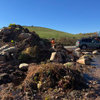
    Thanks. I shall dig on.. Here's a finished plot. You're seeing the previous season's mulch mixed in the soil.

  • 12 years ago

    Just for grins, here it is in all it's glory a few weeks ago when we began. You can see the new pile of bermuda.

  • 12 years ago

    Morning coop. Havn't noticed you around for a while,I hope all is well.
    I wouldn't intentionaly add Bermuda stolens nor roots to compost. You simply aren't talking about that much material,even if you are succesful think of all the extra effort required. Hit up your neighbors to see if they are interested in establishing a plot of Bermuda. Swap the grass roots for some manure or something and both of you win.
    Here's wishing you a good gardening season. Keep us up to date on your undertakings around the place.

  • 12 years ago

    I usually leave it in a dry place in the sun for a few weeks to make sure it's good and dead. Then I throw it on the garden paths for mulch.

    I've found roots down as far as a foot, so I hope your digging is going to get it all.

  • 12 years ago

    Hiya Klem!
    Hiya tox!

  • 12 years ago

    Tox, I meant burn the pile. A weed burner would just kill the top couple of inches.

  • 12 years ago

    Yeah. I found out you really can't kill it in a patch of soil by burning the tops, unless you want to keep doing it for a year or two until the roots exhaust themselves.

  • 12 years ago

    Phase one at about 4' high. It's now about 5 foot high. I carefully inspected the bermuda determining the dead from the live and layered accordingly. right now it's difficult to control the environment and we have much high winds. It needs a wood frame even though the hay helps keep the wind out.

    I checked yesterday and see it was burning at one point. I can tell the size really does matter. I'll double it over the next month as we mow and I gather spring growth and toss it in there.

  • 12 years ago

    Good to hear from you coop.
    It will soon be plenty hot, the Okie weather,not the pile. I predict after fighting the stack of Bermuda for a while you will take earlier advice to set fire to it. Around here it's called trying to make silk purses from sow ears.
    I recall during the Eisenhower administration when barbed wire was expensive and Paw needed to fence a new field of clover to graze a herd of Brahman. Well sir, he had us kids chop Bois-d-arc post, unroll some spoiled Bermuda hay and tie the stems togeather. Last time I was by the old home place,the Bois-d-arc post were leaning and looking a little weathered but them stems weren't even rusted.

  • 12 years ago

    Pardon the language, but Holy crap!

    Maybe I should just let it dry out thoroughly dead and dig it in to fluff the soil.

    FYI: I'm finding that wheat is allelopathic to Bermuda. Whatever it's called. Bermuda doesn't like wheat, apparently.

  • 12 years ago

    My next door neighbors have a nice lawn and my Bermuda patch doesn't seem to invade it. I wonder what they're putting on it. I didn't think regular weed and feed stuff (2,4-D, etc.) would touch Bermuda.

  • 12 years ago

    In the interest of mankind, you should find out.

  • 12 years ago

    Well, I did find out - haven't talked to the neighbors yet, but guess what, there are several Bermuda specific herbicides that will NOT kill other turf grasses! I had no idea. In fact, I assumed there weren't to such a degree that I never asked the Interwebz. Duh.

    Over on the Lawn Care forum, I found references to:

    Turflon Ester
    Ornamec
    Sethoxydim
    Fluazifop
    Clethodim

    Some of these are only accessible to pros, but Home Despot carries a Bermuda killer in a hose-end sprayer. I think it's Ortho. If I can't get access to anything better I'm going to try it. It takes several applications. Our own Hortster posted that the best time is in the fall when carbs are being sent down to the roots.

    I've learned once again, never assume something is still true just because you always thought it was...

    die, bermuda, die.....

  • 12 years ago

    Fabulous! Do let us know how it turns out. Mine is organic but I can tell an exception will probably be made for bermuda.

    It amazes me people are actually buying seed for this. WHY? It's a horrible turf with high maintenance. Most of the time it is brown.

  • 12 years ago

    I know, search a place like homedepot.com for "bermuda" and most of the hits are for SEED! Lawdy.

  • 12 years ago

    Bayer makes 2 products Crabgrass killer and Bermuda control that uses fenoxaprop - p - eythl , that should be available at the big box stores.

  • 12 years ago

    Thanks rednofl, I wonder if my neighbor has used that for crabgrass and it kept the Bermuda from migrating over there.

  • 12 years ago

    Thanks rednofl.

  • 12 years ago

    Hey all! I wanted to say that wheat is allelopathic - for lack of a better term - to Bermuda grass. Unfortunately, crabgrass and nutsedge are not. But one is better than none at all!

    When wheat is well-established root-wise it is allelopathic or combats bind weed, too.

    Getting ready to turn that compost. Will take picks if I find anything significant with the bermuda grass.

  • 12 years ago

    ChickenCoupe, can you explain what "allelopathic means? I assume you're saying that if one plants wheat in a patch of Bermuda, it will kill off the evil grass. True or am I misunderstanding?

  • 12 years ago

    Hey there, sjerin. I was just stopping by to provide an update on the matter of composting bermuda.

    Yep! When I planted wheat, the bermuda in the soil went bye bye. Of course, I did attempt to remove as much bermuda grass and root prior to planting the wheat, but those smaller roots that make it so persistent were in there. That was last spring. I now have alfalfa planted in that plot. Zero bermuda!

    Also, once wheat is firmly rooted it kicks out bindweed,too. However, once removed the bind weed returned. It really likes the alfalfa, too. Darn it.

    Update:

    I turned that compost pile, today. When I assembled the pile in the usual layered fashion the ratio of bermuda to all others was very small. I wanted to insure the bermuda didn't take over when the compost cooled. It worked. It took about two weeks to include all the bermuda grass and roots because of the ratio. And I had a lot of it.

    But when I turned it today there was much that was not yet composted. But zero bermuda was evident. Yay!

    It can be done.

  • 12 years ago

    Great info. I have only a tiny area where the stinkin' grass has come under the fence from my neighbor and have asked a gardener to put a guard straight down to help. But it will not get it all, for sure, so I'm thinking of several options. Thanks much for the info, C.Coupe!

  • 5 years ago

    I had a dream of chickens eating my frustrating bermuda grass in my suburban garden. I went and bought some adult hens from a commercial egg farm. (This turned out to be an important detail because they were STARVED for vegetables.) Well, it worked! The chickens used their strong claws to dig the stuff up and WIPED IT OUT. After 3 years I gave up hastling with my neighbors over the chickens and gave them away, It took 5 more years before the bermuda grass returned.