Software
Houzz Logo Print
sheloolie

Eucalyptus citriodora root system

15 years ago

I'm hoping someone knows whether this species of eucalyptus has a strong taproot or is more shallow-rooted. I know eucs tend to have wide-ranging roots.... We have a very tall one--easily 80 feet--and we have been getting so much rain and wind, I'm worried about it going over. There are cars parked nearby, other trees it could mash, etc. It's about forty feet south of the house, but the wind never comes from the south.

Thanks for any replies.

Loolie

Comments (29)

  • 15 years ago

    Thanks for your response, Dan. Not exactly sure what you mean by "taproots are a myth"? Trees or big shrubs don't have deep roots that penetrate 6-10 or more feet underground? I know that some plants tend to send roots down and some tend to send them out more horizontally. The soil this tree is planted in is a combo of about 24" of topsoil brought in (compacted clay loam) and below that big sandstone boulders (4-8 ft. diameter) in clay going down another 15 feet or so (we live in a little valley in the foothills of a 3000 ft mountain range where a lot of large boulders have rolled down the slopes over the past several million years and been buried in eroded sediments as the millennia rolled on). The tree is about ten feet from a very small (2 feet wide, 1 foot deep) creek that only runs during big storms. We don't have "predictable spring storms" here--it "normally" stops raining altogether in early March, if anyone still believes in "normal", and doesn't start up again in earnest until December. But this year we had 8 inches of rain in two days over the past weekend, so a lot of the clay sediments are like jelly. Maybe you meant to write "unpredictable" spring storms?

    I'm not asking the forum to make an assessment of whether the tree is "wind firm in saturated soil". It's a general question about the root systems of the species, based on a concern about current conditions. Maybe there is not a definite answer, I can accept that. I understand the root systems of trees adapt to the soil conditions where they're planted. But I know some trees tend to have deeper and stronger roots than others (we have a Chinese elm tree with very thick roots extending at least 30 horizontal feet--even though the roots we see are only two or three feet deep, we're not too worried about that tree falling over in the wind). We'll of course make our own determination about how safe the eucalyptus tree is--I was just hoping to learn more about the growth habit of the roots, if there is more to learn, to help us make that determination. I searched a lot on the web before asking a question here, and read a lot about how invasive the roots of eucalyptus can be, which is not a surprise to me. But I saw nothing about this species in particular, was just hoping for a little more info related to the species.

  • 15 years ago

    it is a common misconception that a tree looks, below ground ... like it does above ground ...

    below is a pic of a 30 to 40 year old maple ... as you can see ... its roots are all withing the first foot or two of the grass level ... it is left to speculation whether there is actually a tap root ...

    if you have found references to the invasiveness of E roots.. that would suggest to me.. that they are NOT a deep rooted tree ... if they were.. no one would be complaining about the roots ...

    i do think.. on some level.. you are asking a metaphysical question.. that as you suspect.. has no definitive answer ...

    and as dan said.. if there are any real concerns [beyond a quest for knowledge] .. then you will need an onsite inspection from a certified profession arborist ....

    if i had an 80 foot tree ... 40 feet from my house.. i dont know if i could rely on the wind gods.. to insure my safety ... usually trees adjust to prevailing winds.. on some level.. and it is that freak odd storm.. where the winds come from the other direction.. when toto and dorothy fly ... or your house gets squished ....

    good luck with your quest for knowledge ...

    ken

    {{gwi:208954}}

  • 15 years ago

    Many trees when young DO have a taproot. That is, they have a much longer root in a verticl direction compared to any lateral roots. There are also (of course) many exceptions to this. Hickory trees for example do indeed have very long taproots that reach over 10 feet below the soil. Cottonwood tree roots probably don't ever go lower that 2 feet in most places and rarely below 3 feet.

    As for keeping your tree windfirm, Ken said it best. You need a professional out there, but if your gut says take it down, then that's is what you should do. Keep in mind it has been there in a variety of environmental conditions for a very long time as is and has adapted to the best of its ability to still be standing 80 feet tall decades after it germinated :)

  • 15 years ago

    Thanks, Ken. It looks like we'll just have to bite the bullet and call a tree service. The arborist we used to use retired a few years ago, and since then we haven't found a service whose advice we really trust. This citriodora eucalyptus is beautifully shaped, very elegant (and truly lemon-scented), but as you suggest it is probably too close to the house (and to the neighbor's cars). I know some superficial roots extend at least fifteen feet from the tree, because we've hit them digging to plant shrubs in the past. Was hoping there might also be some roots going down into the subsoil, wrapping around those huge boulders down there. Probably there's no way of knowing that without taking out the tree and bringing in a backhoe!

    Thanks again Dan and Ken.

    Loolie

  • 15 years ago

    No reason to cut it down just out of fear. Call an ISA-certified arborist and have them look at the root zone. Likely have to wait a few days as they are busy right now.

    Dan

  • 15 years ago

    Thanks, Dan, we'll wait. No wind forecast for the next week, anyway, though it's raining again.

    And thanks J0nd03. I planted the tree myself, when I was young (and foolish I guess). It's only 25 years old. They do grow fast! And every summer it sheds ALL its bark, which makes a huge mess for a month or more, but leaves the trunk a lovely smooth pink for a while, til the new bark matures and fades.

    Loolie

  • 15 years ago

    I'm not familiar with this tree, but it sounds very interesting especially in winter...

    After looking at pictures on google, it appears to be a beautiful, unique tree. If it really is close to 80 ft, you must have ideal conditions for that specimen/speciman (help me out here Ken haha). Nice selection, I would hate to lose it if it were me, but safety always comes first ;)

  • 15 years ago

    Eucalyptus is a common landscape tree in California--and you will see them looking very much like natives along the coasts and in semi-wild areas as well. Many people think they are native because they are so common. 100s of varieties exist, with many forms. Australian native, very drought-tolerant, fast growing and propagates from seed very easily. They are generally very messy though, pretty much year-round--bark, flowers, leaves, seeds, always something falling. Some varieties shed bark in great long strips seemingly continually--very messy. Also many other plants don't do well under them--there is controversy about why--some say the roots exude something, others say it's the resin in all the litter they drop. They don't like hard frosts, so they're not suited to many areas. Also they're considered a fire hazard because of all the resin in them (eucalyptus oil, you know). Some varieties virtually explode in a wildfire. There are places in the state where huge groves were planted in the early 20th century with the idea that the oil would be profitable. They naturalize so easily, they can be a problem in natural areas where they compete with natives. So there is a LOT of downside. This variety (citriodora, lemon-scented) is the cleanest and I personally think the most graceful as well. It's the only one I'd plant, though the red-flowering gum is lovely, too.

  • 15 years ago

    IIRC eucalypts are the second-largest genus on the planet in terms of height and biomass.

    Dan

  • 15 years ago

    Fascinating :) Thanks for summary and info! I had no idea they were that common in your area.

    When you say they don't like a hard frost, do they go dormant or do they die during very cold weather (0* F for instance)?

  • 15 years ago

    "IIRC eucalypts are the second-largest genus on the planet in terms of height and biomass."
    Wow, that is amazing, Dan. I knew the tallest tree on earth is a Euc. regnans, taller than the coast redwoods here in California, though not as massive. What is the largest genus?

    j0nd03--I don't know how cold it has to be to kill them, lol. I would guess 0 Fahrenheit would do it, though. I did read on another thread that someone in Arizona had some (citriodoras) that survived okay through several nights of low 20s, just had some leaf drop. We almost never have 5 hours or more of temps in the 20s, so I just don't know, frost hardiness is not normally on my radar. The trees are not deciduous--not in the normal sense, though they are continually losing something! They never go dormant is what I mean by not deciduous. They are big and a lot of varieties shed limbs a lot as well as the rest. I would not plant any big eucalyptus on a normal city or suburban lot. We have several acres here. They are impressive trees but you have to know the drawbacks. I'm no expert, just a rabid gardener.

    Do a Google search, there is a ton of info online about various Euc. varieties. I just found out the citriodora is not even in the Euc genus any more, it's officially a Corymbia now. And citronella oil, that's often used as a mosquito repellent, comes from this tree. That's what it smells like, the crushed leaves especially.

    Loolie

  • 15 years ago

    That eucalypt species is the second-tallest tree on the planet, Loolie. I've been to both the tallest tree and the most massive, a coast redwood and a giant sequoia, respectively.

    Dan

  • 15 years ago

    You've been to the tallest redwood? Oh my. I'm sure you've read Richard Preston's book about the big trees, then. One of the men who found those giant trees and named them is the son of a close friend of mine. Redwoods are such wonders. They completely humble me. But I thought it was in that book that I read there was a Euc. reglans specimen in Oz that was taller. Might have been in the New Yorker, a follow-up article to the book, about Steve Sillett going to Australia to research the canopy there. I'd prefer to believe the tallest are right there on the Calif. coast....

  • 15 years ago

    One of my favorite memories is a bike tour I did from Eureka, where part of the ride was down to Honeydew via Ave of the Giants then out to Mattole Beach, trying not to crash as I rode trying to look up and at the road at the same time.

    Prairie Creek Redwood SP is a jewel, with Roosevelt elk tolerating you on their beach in the morning, then old growth in the afternoon, looking for blue mushrooms while stumbling about in awe.

    And the sequoia up toward Angels Camp and Yosemite (despite the white fir)? Ahhh. My poor knees got that way pounding many, many miles of trail with a backpack looking for big trees. Your big fella has seen worse than this year, and back in the old country lots of wind and shallow soils.

    Dan

  • 15 years ago

    I don't see Mario on here any more, but, if large trees interest you, be sure to check out his site, linked below. Be sure to follow the links found throughout his site. I find it easy to miss pages on his site unless I'm careful. He has a lot of interesting stuff on there.

    Here is a link that might be useful: MD Vaden's Website.

  • 15 years ago

    Lovely, lovely, Dan. I camped at Prairie Creek long ago on a trip up the coast and into Canada--20 years ago. Oh yes, awe is right. Time to go back!

    And thanks Brandon for the link. Mario mentions my friend's son Michael--they went biggest-pine-tree-hunting together in Oregon in January! Great link, so many wonderful photos of redwoods. And the map coordinates for finding the big ones, that's helpful. I doubt I'll get there myself, though. I understand it's like climbing over giant pick-up sticks for miles to get to these hidden giants. They're mostly deep in canyons that were too steep to log. May the trees continue to live in peace!

    I'm including a link to Preston's book on the redwoods.

    Loolie

    Here is a link that might be useful: Wild Trees book

  • 15 years ago

    There's a place deep in the Yolla Bolly W.A. that didn't get logged, and the pondo and Doug-fir in there are tremendous for that part of the state. Almost just like Ishi saw.

    Back OT, looks like the atmosphere has a lot of power at this time, as the weather and snow totals in the Sierra show. I don't think the weather's over yet, see if you can get someone out there to have a look-see.

    Dan

  • 15 years ago

    Thanks for the reminder, Dan, we'll call someone (ISA member for sure). We have more rain forecast for the next few days, but nothing like last weekend's storm.

    Loolie

  • 15 years ago

    I've tried twice now to get seeds to germinate and you want to cut down a healthy pretty tree? I love the smell and shape of my two ecu silverdollars. Hopefully I can get my citrons to germinate.

  • 15 years ago

    Well, ryker-lakes, looks like we will be doing some light pruning, turns out that's all it needs at this time (it was heavily pruned about four years ago).

    How are you trying to germinate the seed? In areas where they thrive, they volunteer easily, given no care, no water--nothing. We have dug up many 5-6 footers and given them away or tossed them in green waste bins. I have no experience with trying to grow eucalyptus from seed--where we live the prospect seems a bit like trying to grow bermuda grass from seed.... Perhaps your climate is not suitable for them?

  • 10 years ago

    Loolie, I wonder if you were ever able to learn more about the root system of your eucalyptus citriodora. I also have a citriodora that's about the same size as yours and am trying to find out how deep the roots might go (in terms of watering, in my case). We're in an extended drought in California, the opposite of your weather when you wrote your message more than 5 years ago. And our soils are likely to be very different, which affects root structure, from what I've read, so even though our trees are the same there could be big differences in their root structure. Nevertheless, I'd be very interested to know what you eventually found out and what happened with your tree. By the way, I didn't find your question metaphysical, per one of the replies, nor unreasonable as others seemed to imply. So, again, if by any chance you ever run across this message, I'd love to hear your update.

  • 10 years ago

    Note: Tree roots and all plant roots need oxygen. Down deep in subsoils, there is typically little in the way of oxygen present, hence few or no roots. Same way everywhere.

    Somebody above said many tree types do have tap roots at first, and this is right on. But don't jump from that to the wrong conclusion-that these structures are permanent and common. They are not.

  • 10 years ago

    As has been said, tap roots in trees are more or less a myth.

    Most of the time, our soils are not conducive to them. Around where I live, the soil tends to be clay, and so the roots tend to spread out.

    A young seedling, grown in a pot of cutting mix, will have a tap root. But it doesn't continue on that way. Real life strikes when it finds itself planted.

    Eucalytpus has been divided up a bit. I looked up Eucalyptus citriodora and found that it is now known as Corymbia citriodora. Here is a link:

    https://en.wikipedia.org/wiki/Corymbia_citriodora


  • 10 years ago

    And here is another link about dividing Eucalyptus up into three groups:

    http://anpsa.org.au/APOL2/jun96-5.html

  • 10 years ago

    Let us hope these posters from 2011 come on back and take a look!

  • 3 years ago

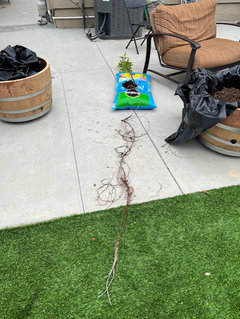
    I recently replanted a potted Corymbia Citrodora. The roots wound around in a circle. They were about 4X as long as the plant was tall. I trimmed about 75% off the roots and they appear to be recovering. The only issue seems to be loss of the Citronella scent from the leaves. But I hope that comes back. Its only been about 6 weeks.


  • 3 years ago