Software
Houzz Logo Print
mary_parsons3820

using "unfinished" compost ...

12 years ago

I began a compost pile last June. It's contained in a wire bin with a 3' diameter. Over the course of the summer, the contents (freshly cut grass, shredded leaves, cut up kitchen scraps and a small amount of straw) got as high as 5' but has settled/composted (?) to about 2'.
While the bottom 18" are black/brown in color and smells very "earthy", I'm a bit concerned about its "structure". Most of it is what I'd call crumbly, but it still contains some fibrous particles. Might these be pieces of straw that did not fully compost?
The questions....
In the event these materials have not fully composted, can they still be used (as a top dressing for shrubs, flowers, and trees) now? I've read somewhere that doing this would initially deplete the nitrogen in the soil. Could I counter this by replacing the nitrogen through the addition of fertilizer?
I will appreciate your suggestions.

Comments (14)

  • 12 years ago

    Conceptually the compost will "never" fully compost. That's colloidal. That's humus. That's stuff that's been passed through the guts of earthworms and grubs.

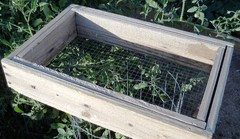
    But without getting weird, if it sifts through one of these (this one is 1/2 inch but 3/8 inch is good too) then it's good. Don't have to worry about N for the most part.

    This post was edited by cold_weather_is_evil on Sun, May 11, 14 at 2:53

  • 12 years ago

    I like the sifting idea but I'd also suggest putting a thin layer of finished compost down and then using your compost over that.

    I'm not a believer in the Nitrogen tie-up theory. If your compost has a lot of woody material, that might be a problem. Usually, unfinished compost is hard on plants because it contains organic acids that inhibit root growth and seed germination. The presence of these acids (acetic, butyric, propionic, valeric acid) as well as the presence of ammonia are the reasons plants don't thrive in unfinished compost.

    I would lay down a thin layer of compost (don't till it in) and then put your unfinished compost over that. Keep your compost away from the stems of your plants. By the end of the season, your compost will be incorporated by your soil.

  • 12 years ago

    OR, if you are uncomfortable with the larger sized pieces, just put them in the bottom of your next pile! They'll break down eventually! Nancy

  • 12 years ago

    Finished compost will not look anything like what you started with, and as long as you cannot identify bits and pieces easily don't be overly concerned. If undigested organic matter is spread on the soil surface as mulch the Soil Food Web, the soil microbes that will eventually digest it will not go to work on that material and neglect feeding the plants growing in that soil. They will not use all available Nitrogen in the soil to digest that mulch tying up what the plants need to grow.

  • 12 years ago

    "While the bottom 18" are black/brown in color and smells very "earthy", I'm a bit concerned about its "structure". Most of it is what I'd call crumbly, but it still contains some fibrous particles. "

    Sounds good to me. Remove the top part where you can still see "ingredients" and use the rest. Recycle the top part into the new pile.

  • 12 years ago

    What I would do with the pile you describe is mix it all up thoroughly and use as mulch. The top layer is not finished but mixed with the more finished layer at the bottom and used as mulch it will not cause problems. Of course I use alfalfa tea as fertilizer so don't have the possible problem of lack of nitrogen.

    Used this way my 'compost/mulch' will be gone within a few months, showing I believe, that the soil organisms are active and utilizing the nutrients.

    In my garden I want to get nutrients to the plants sooner than later and feed the worms as much as possible. The earthworms will appreciate this 'unfinished' compost and turn it into plant nutrients quickly.

  • 12 years ago

    Yup. And the "faction' has been babbling on for years, and years and years. A joy-kill, and morally bankrupt.

    Sometimes, the n'e'er-do-wells hit you so hard in the head, there's not too many options left, but to confront it, head-on, for what it is...

    and stem the flow of p.c. permissiveness for passive-aggressive, boorish, blockheaded, blithering, blundering, boobers that are in effect, little more than wolves in sheep's clothing...

    here, to satisfy whatever unwholesome needs they may have, at the expense of others, with hearts set upon a simple, productive and peaceful experience...

    ...catharsis is sometimes the very best tool that we have. I don't plan on letting naggers shorten my lifespan, and all of you ought to consider, not letting it shorten yours, either...

    For, sometimes, you simply have to call a spade a spade, and let the chips fall where they may.

    M

  • 12 years ago

    Off to the blue skies and God's green earth, go I...it is, afterall, Happy Mother's Day, but unfortunately, I cannot be with mine, today. Maybe next year (!).

    M

  • 12 years ago

    Unless you are gardening for basic survival, enjoy! Experiment. Do some plants one way, and other another. If you're worried about how the compost will do, use it in a small way to see what happens. That's learning.

    After mulching for a thousand years, even though I'm at a new place, without my rich, rich soil, I'm pretty fearless. Plants really want to grow. If they don't look good, change the situation they're in with an organic soil amendment, or if you're REALLY scared, use the dreaded Miracle Gro just for a tiny bit of time.

    Have fun! Your compost sounds lovely. I'd use it in a minute, some in the ground, maybe, and some above as mulch. Keep quick notes on it, for I guarantee you'll forget lots of your decisions!

  • 12 years ago

    If you go to starbuck and ask for free coffee grounds, the acid coffee ground will speed up the breaking down of the straw. The straw is a dry brown, but the green in the coffee will create heat and moist conditions and you will be back in business with your pile quickly.

  • 12 years ago

    I dress plants with unfinished compost all the time. I deal with horse manure and stall leavings and since I don't turn my piles nearly as often as generally recommended I have the same consistency issue the OP describes--more thoroughly composted toward the center of the pile, less so as you get to the outside.

    I top dress my gardens with it every few months in the summer. If I don't like the "lumpy" look I toss an inch of pine bark fines over the top to dress it up. Not only have I not had a problem with it less than completely composted I've been known to take a shovel full of "muck" less than a day from the horse's stall, totally bypass the composting process and throw it straight on a few nearby rose bushes.

    I don't mix it into the dirt (that's when nitrogen tie up could possibly be an issue) and I keep it from actually touching the base of the plant. Also, I'd note that straw contains a chemical that resists the composting process so generally takes a bit longer than other things. (Sorry, I can't remember the name of the chemical.) But as someone else said you could use fresh straw as a mulch so a bit of uncomposted isn't going to hurt anything if you mulch with it.

  • 12 years ago

    Thanks, everyone, for your advice and tips!! I was going to begin by using 'cold weather's ' suggestion and putting everything through a 1/2" sieve today. The inch of rain we've had this morning is threatening to become 2" before the day's over so everything's on hold. But I plan to use many of the other suggestions you've made also.
    I'm sure that I'll have more questions in the future. And, if it's OK, I'll report back and let you know how everything worked out.

  • 12 years ago

    You can mix it in the dirt or top dress, either one. Finished compost will not be an issue, but I even mix wood stuff in the soil, and never have a problem and ferns love it. If I don't have enough compost I use the woody bagged browns to stretch the compost. My plants are big and huge and healthy. I think nitrogen tie up only happens in very bad soil in which they never amend it and then they toss wood on top and then forget to water it. If you soil is super rich and healthy, nitrogen tie up does not exist.