Software
Houzz Logo Print
sujiwan_gw

Front yard tree issues

At my farmhouse there is one massive old white ash tree--the only tree--that shades the south-facing front porch. It is incredibly picturesque with long candelabra like branches and casts a filtered shade. My farm house dates from somewhere between 1780's and 1810 so that tree could be at least that old.

Unfortunately, it has been dying back. The massive trunk is rotting on one side and there's a section of trunk that someone wired to two other areas at one time that is ready to fall. Of course it plays host to many cavity dwelling birds and animals, so it is kind of a "snag" in process.

Meanwhile I need to be thinking about growing/siting a replacement that will shade the house that also provides a filtered shade. I thought about an oak, but the pin oak on the west side of the yard is absolutely covered with galls--most unattractive--and I'm concerned that the wasps will simply do the same to any oak I plant.

I'd include a couple of pictures but I don't remember how to code the jpg properly to get it to appear in the message.

Advice on trees for this situation and how/where to site the new one that will take over eventually?

Comments (14)

  • 17 years ago

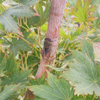
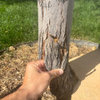
    I remembered I had PB account... This shows the tree when we purchased the farm and the more recent pictures of the ash deterioration over the past 5 years. If you wonder why we haven't cut the separated area, it is because it is wired and under tension though thankfully leaning away from the house.

    {{gwi:340402}}

    {{gwi:340403}}{{gwi:340404}}border="0" alt="Ash branches">

    {{gwi:340405}}

    {{gwi:340406}}

  • 17 years ago

    this thing is a danger... have it properly pruned by a professional.. or take it down completely ....

    the opinion of a certified arborist might be the best investment.. if you have any inkling of retaining it ...

    OK.. i give up.. you in PA or MD??? or should i say.. where is the tree????

    i have at least 10 different oaks ... red, scarlet, black, shingle, white, robar .. and a bunch of squirrel planted hybrids ...

    gall is just not that big a problem.. to forgo a heritage tree like an oak .. bug problems come and go over the centuries.. and gall is not a problem which impacts the overall health of the tree ...

    have the arborist look at that one also ...

    good luck

    ken, of a thousands nightmares of trees crashing through the roof while he sleeps and crushing the spirit out of him ... be gone dam-ned tree ... and if you ask nice.. i will tell you how i really feel about it.. lol ..

  • 17 years ago

    "have it properly pruned by a professional"

    Ken, you either skimmed through so fast that you missed the third picture or you need new glasses! I figured you would have had a heart attack at first glance.

    The tree needs to be removed immediately.

  • 17 years ago

    i SAW them all ... get the pun ....

    i was being tender .... letting them separate from it.. based on a third parties opinion ... wait.. i am the 3rd party ...

    if it were mine ... i would move out of the house until it was taken down ..

    there ....

    i said it ...

    ken

  • 17 years ago

    Good question.
    Why not another ash? I doubt that one's 200 years old but it looks like it was a good tree for you so go for it.
    Yeah I know you're in an EAB state but there's controls for that now.

    The location it's in is prime real estate as it gives you shade over the porch in summer. I'd want to get it as close to that spot as possible. Obviously if you're planning on keeping big daddy for a while you don't want to plant it in the root zone and you don't want it to get damaged during an eventual removal of big daddy.

    The good news is that you can buy fairly large B&B ashes and they aren't too terribly expensive. Big trees take longer to get established but in this case I think it will help you get over the loss of big daddy.

  • 17 years ago

    That is a gorgeous tree! It stinks that it is in decline. I think an oak would be a good replacement for it though.

  • 17 years ago

    Tulip tree would help you get some shade sooner, which I would assume would be a priority. You still can plant a slow grower if you like, but I would plant something fast, and nice first, to get some shade back. Also small is not always the best choice if the tree is slow growing.

    For example, a 5-6' foot 3/4" caliper ginkgo is very unlikely to catch up to a 3" caliper (18-20' locally at 3" caliper) ginkgo in the 5-6 years or so it will take for the larger ginkgo to resume normal growth. It is generally assume 1 year establishement per inch caliper tree. However ginkgo are known to establish slowly, so I effectively doubled the establishment time to 5-6 years for this writing. Plus the small ginkgo will likely take 2 years before it establishes and grows normally again. Leaving a difference of 4 years for the small ginkgo to catch up to the larger planted tree. Most references cite 1' or so growth per year for ginkgo, but commonly they grow as little as 6"/yr, or as much as 24"/yr occasionally . So if we optimistically assume the small ginkgo then grows 18"/year average, then 4 years X 1.5'/year, equals an additional 6'. 6'+6'=12' Total. Well behind, and much smaller volume than the larger planted ginkgo, and not going to catch it anytime soon. This applies for most any slow growing tree, though they may not be 18' at 3" caliper, but nor are they likely to take double the usual establishment time either. In fact the slow establishment of ginkgo gives extra advantage to the smaller tree, giving it more time to catch up. For medium, and fast growth rate, the difference is not as pronounced, and really fast growing trees (Autumn Blaze), it does not make a big difference at all.

    The smaller is better argument is based on research of how much tree roots grow a year, and how long it will take them at the normal growth rate to reach the same area as before transplanting. But the ignores the fact the roots will be regrowing at a much accelerated rate compared to normal annual grow. The tree needs/wants it roots back ASAP will do all it can to attain that. To be sure, smaller is easier to transplant, requires much less careful care, and you will see normal growth sooner, but small and slow does not fit every circumstance.

    It all comes down to what you are wanting.

    Arktrees

  • 17 years ago

    Arktrees,

    I think your post above is well thought out and probably pretty accurate except for the last paragraph. I've never seen a smaller-is-better argument based on research of how much tree roots grow a year as you describe in that paragraph. As a matter of fact, it's generally based on the exact same type of logic you use in your second paragraph. Obviously, as you point out, there are limits to the smaller-is-better argument and the degree to which smaller is better depends on factors including the type of tree.

    If you can afford a really large tree and want one, by all means, fork out that cash. But, if you go to the store and find that a certain size tree is three times the cost of a slightly smaller size tree, don't waste your money. In a couple of years, a 2.5 gallon 'Green Giant' thuja will almost always be larger than a 5 gallon specimen planted at the same time.

  • 17 years ago

    If I had to remove the tree (which I wouldn't unless a certified arborist told me it had to be done), I'd get a 4" or 5" caliper tree.
    I'd start digging the hole a few days in advance and have the tree farm deliver it right at the planting location.
    A grower I use in my area charges $350-400 for a tree that size so it shouldn't be too bad. Ashes transplant easily too.

  • 17 years ago

    Why would you pay someone to come out and tell you what couldn't be more obvious?

    I agree with getting a larger replacement. I'd get the largest tree I could reasonably afford (unless I could find one just a little smaller for much less-see above).

  • 17 years ago

    if budget is of no consequence ... check out the Pebble Beach Golf Links at the link below ...

    please dont waste your money on an ash .... its not worth the risk of EAB ... and treatment could cost hundreds to thousands of dollars per year.. for the life of the tree ...

    GO OAK .... 3 to 5 feet of growth per year.. once established ....

    ken

    Here is a link that might be useful: link

  • 17 years ago

    Until the oaks get struck by SOD or misteltoe infestation or some other problem. No tree is perfect. If everyone stops planting ashes they will go extinct in the urban forest leaving up with oaks and maples to get some bug next. OP's state (MD) had just an isolated case of EAB if I'm not mistaken.

  • 17 years ago

    To clarify, my farmhouse is in PA. We also have 2 green ashes on the property planted by the previous owner--I don't like them as much. This white ash has fall color--purple-y. I'd probably have to wait 100 years to get that branching structure that I like about this tree. The PA agriculture dept hung an ash borer trap in one of the green ashes to test for presence but apparently none were detected. I have heard that ash could be the next tree to go the way of the chestnut and elm in numbers.

    I read that red oak has a fast growth rate and does cast a filtered shade. I like the old fashioned wide-spreading ginkgo. Are there any other trees that have this open branching structure and cast filtered shade that I am overlooking?

  • 17 years ago

    Sycamore has filtered shade.