

Does Miracle Gro Kill Worms?
Hi all -- there's tons of conflicting theories on using Miracle Gro -- just wondering if used sparingly (2-3 times a season), does it kill worms in the soil? I'd hate to kill my worms just for some prettier flowers...
thanks in advance!
Comments (32)
 18 years ago
The way that you intend to use it, no...it does not kill worms. However, it does absolutely nothing to foster healthy soil biology. You can have pretty flowers AND provide for the soil biota at the same time.
- 18 years ago
If one wants to know what is in the commercial product one is putting on their soil the link below can provide some much needed insight. Informed decisions based on "personal values" is most important IMO...
Blutranes
Here is a link that might be useful: Commercial Fertilizers
Related Professionals
Lewiston Landscape Architects & Landscape Designers · Utica Landscape Architects & Landscape Designers · Pocatello Landscape Architects & Landscape Designers · Olympia Landscape Architects & Landscape Designers · Macon Landscape Contractors · Westminster Landscape Contractors · Saint Joseph Landscape Contractors · Tyler Landscape Contractors · Edison Landscape Contractors · Billings Landscape Contractors · Wilmington Stone, Pavers & Concrete · Auburn Stone, Pavers & Concrete · Plainfield Stone, Pavers & Concrete · Stamford Stone, Pavers & Concrete · Syracuse Stone, Pavers & Concrete- 18 years ago
It probably won't kill them per se, but it doesn't help them, either. Chemical fertilizers feed the plant; organic materials feed the soil, which feed the plant.
Chemical fertilizers don't do much for the soil microbes, either. Organically, the microbes break down things like manures and organic materials into a form the plants can use as they need them. Chemical fertilizers sort of force-feed the plants.
In the big picture, chemicals have been heavily used in U.S. agriculture for close to 70 years. Most of those soils are totally dead. They have no real organic material left in them, they are nothing but sand or clay, just something for chemically-produced plant roots to cling to, to keep from falling over. In Asia, fields were treated organically for thousands of years. In America, our farms last about 40 years. Much of our topsoil is now in the oceans.
A little or a lot? All or nothing? The choice is yours.
But if you want to turn away from chemicals, there are lots of people here who are willing to help you do it. It isn't always easy, because there is a lot of info (Ma Nature is a complicated woman), and a lot of it seems to conflict.
Sue
- 18 years ago
Earthworms live on organic matter in the soil adn many people that use products like these do not add, or add inappropriate (peat moss) kinds of organic matter so the Soil Food Web has nothing to live on and they go dormant. Others I know do add compost and other good types of organic matter and have lots of evidence of a good, healthy Soil Food Web and still spray these products under the mistaken assumption that the plants need them. The one thing these synthetic fertiliers wil do is unbalance the nutrients the plants have and make the plants more attractive to insect pests and plant diseases. Most everyone I know that uses synthetic fertilizers also have to spray often to control both the insect pests and diseases.
I think it is more the loss of organic matter that causes the loss of the earthworms than it is the fact that one uses a synthetic fertilizer. - 18 years ago
One thing I've wondered is if some plant varieties have begun to expect the "junk food" levels of raw nutrient fertilizer provides. I try to stick to heirloom varieties, or at least ones that have been around for a decade or more, but I wonder if modern varieties that were cultivated entirely in a world where heavy spraying of MG or the equivalent was normal aren't starting to like it better.
Or will all plants forever always perform better in a properly managed SFW fed by good decomposed OM?
- 18 years ago
If you use well composted material you will experience a boom of worms and beneficial microbes. If you use too much nitrogen you can confuse the microbes and they will use the nitrogen provided and become less beneficial. Also, you disturb the ionization factors of nutrient uptake (I can't remember the technical term) when you go overboard on fertilizers. For example: Too much phosphorous will inhibit the absorption of zinc and copper. Too much potassium will inhibit magnesium uptake. That's kind of one reason they give you balances in the first place.
Miracle Gro isn't evil. It's a great supplement if it's necessary. Try a cheap soil test, use Miracle Gro to amend for today, and try to use compost to amend for the future. Toxicity is not determined by a chemical composition. It is determined by dose of the chemical. Any chemical can be poisonous to worms or any other living thing in the right dosage. Also, the biggest problem with synthetic fertilizers is the damage it does to the waterways if used improperly (which is the case well over half the time I would guess). It promotes the overgrowth of algae which can destroy entire ecosystems.
- 18 years ago
"Or will all plants forever always perform better in a properly managed SFW fed by good decomposed OM?"
I personally think so, I think the big difference is that plants grown organically dont grow as quickly, just at more of a natural rate than artificially and often overfed plants, but they dont have as many pest problems either.
"Also, the biggest problem with synthetic fertilizers is the damage it does to the waterways if used improperly (which is the case well over half the time I would guess). It promotes the overgrowth of algae which can destroy entire ecosystems."
I absolutely agree joe, we have huge problems with our river system every summer because of artifical ferts washing into it and creating huge algal blooms which basically kill entire areas off, the fish are dead, nothing can live in it and entire areas have to be closed down because of health concerns. the problem is so bad that my city is now proposing banning the use of artificial fertilisers in the next few years. the problem has been well known about for many years but the very affluent homes and businesses along the riverfront just are not getting the message.
- 18 years ago
Of even more concern to you should be what these synthetic fertilizers do to your drinking water. If excess fertilization adversly affects the water in the streams, rivers, and lakes around us what does that do to the water you drink? Where does the water you drink come from, other than the faucet on the sink? What is in that water you drink?
If poisoning the water you drink is not a good enough reason to not use synthetic fertilizers, and use due care with any others, then there is none. - 18 years ago
A few years ago I used Miracle Gro exclusively and had fast growing plants. Oh yeah, and bugs and diseases like crazy. Not a single earthworm lived in that raised bed. I followed kimmsr's advise and went the organic material route and now the bugs don't bother and the worms are back. Compost and mulch made a world of difference. I'm especially surprised at the power of mulch and it's relationship to soil improvement.
- 18 years ago
I use roundup to to reduce invasive weeds which will have otherwise taken over the yard. I also add compost every year to enhance the soil. End result is quite pleasing to the eye.
My point is pratical and common sense approach is advisable.-LG
- 18 years ago
I use Miracle Grow all the time and earthworms are in the soil every time I dig. You can use Miracle Grow and have beautiful plants. Anyone who claims otherwise is spreading a myth they cannot back up. I've been using this product for years and it is a good product. Someone said Miracle Grow doesn't add nutrients to your soil, just your plants! That's the dumbest thing I've ever heard. It does add stuff to the soil if you water the soil with it! This "organic" craze is like a cult mentality!
- 18 years ago
So....the question was...."Will Miracle Gro kill worms in her garden"
The answer is "NO".
Miracle Gro, like other 15/30/15's, has a level of nitrogen to aid in development of the plant's growth cycle.
A middle number, phoshurus, to encourage strong roots and flowering.
The potassium level is sufficient to strengthen the stems and roots against what might harm them.15/30/15 is a common fertilizer for feeding flowering plants which will not over-fertilze the soil.
Many speak of "excess".....what is 'excess'. What does it mean. Its thrown out in arguments of pro and con like there's no tomorrow. The base of arguments are not explained...what do they mean by "excess".
If everyone was to apply "to excess", then possibly certain results might change the way the plant develops.
Then again, maybe the soil needs some excess if it has been ignored and left to find its own way. But then, it would not be "excessive" would it.pbaby, when feeding your plants the 15/30/15....water them first...let the water percolate down into the soil, then apply the Miracle Gro...or other 15/30/15.
This then the liquid will be taken down into the roots quicker....without evaporation. Instantaneous feeding is given the plant.The use of such liquid type---if you read the label...is not a once, twice or thrice application per season.....rather is given flowering plants every week--two weeks.
Flowering is the biggest energy stealer a plant has to bear.
Once the flowering is done....remove them and think to feed your perennial plants 20/20/20...to encourage strong growth, strong roots to take the plant into dormancy so they can stand up to what winter throws at them.  18 years ago
For 35 years until last year, my garden areas have been totally organic and my flowerbeds and lawn have been totally contemporary. I fertilize my lawn four times thought the growing season with synthetic fertilizer including weed and feed. There are no more or less little piles of worm casings (which there are many) in the garden than the lawn or flowerbeds. If someone claims that using synthetic fertilizers properly will disrupt the micro life of the soil, ask them for a link to the original data to support that claim.
JohnHere is a link that might be useful: Johns Journal
- 18 years ago
"Many speak of "excess".....what is 'excess'. What does it mean. "
to me excess of artificial fertilisers is the amount that the plants can not use at a given time. this does not stay in the soil until the plants are ready to use it, because it's not bound to anything, it washes through with irrigation and rain. where I live we largely get our drinking water supply from ground water so it is constantly monitored and tested, and they are finding increasing levels of glyphosate and artificial fertilisers in the ground water supply which we then drink.
echinacea, if you read my previous post, I think you can see that artificial fertilisers are not benign, they can create a lot of damage and I doubt if my city is the only place these problems occur, it's just that many people arent aware of them or give them much thought. I dont think organic gardening is evangelistic, it's actually a very logical approach to gardening. trying to fool plants and nature by doing things in a totally unnatural way is not always a good thing, particularly if it causes significant problems as a result. me, I'd like to see my city go ahead and ban artificial fertilisers so that our chocked and polluted river can return to normal, and our water supply can be greatly improved.
- 18 years ago
trancegemini, I haven't seen any problems with Miracle Grow in my normal use of it. This topic is "Does Miracle Grow Kill Worms." It's not about the myths of artificial fertilizers.
The answer is NO, Miracle Grow does NOT kill worms!
I also highly doubt that Miracle Grow is the problem with your water.
Some people put manure on their gardens. I'd rather have Miracle Grow in my drinking water any day than drink their rotten horse manure.
- 18 years ago
Horse manure doesn't end up in drinking water. That's the point. Synthetic fertilizers wash through the soil and wind up in places far from your garden. Any organic amendment or mulch like manure or compost (organic here meaning derived from plant or animal sources) stays where you put it and breaks down slowly so your plants benefit from it and it doesn't even enter water systems.
MG causes a lot of problems that are not easily seen by casual observation; you need a microscope. Yes, plants grow large and produce a lot of nice flowers when you use MG, but it is an artificial stimulant of growth and in the long-term, it harms your soil and your local waterways. Eventually the improved growth and flowering is not sustained. Plants grown with MG or similar have less resistance to pests and diseases and gardeners then feel the need to use more harmful chemicals to treat them. It is much smarter to prevent the problems than to cause even more pollution trying to control them.
Each of us are responsible for knowing about the harm the products that we use in the garden may cause. The harm of synthetic fertilizers or many pesticides is not a theory, a belief, or a cult. It is scientific, documented fact. Your choice is simple. Either you can educate yourself about the products you use or you can stubbornly insist that science somehow doesn't apply to your garden and they are not harmful.
That is all I have to say unless you can manage to be a bit open-minded and learn about new ideas. If you decide you want to learn, this is a great place to do it and I will be happy to help. If you just want to continue to insist that MG and other chemicals are harmless, regardless of any facts to the contrary, I am not interested in continuing the discussion.
- 18 years ago
echinaceamaniac, Nitrates in your drinking water are a poison and Nitrates come from fertilziers among all the other sources, organic as well as synthetic although more likely from synthetic which are more water soluble.
Over zealous organic gardeners, people that add lots of "stuff" to there soil without the guidance of a good, reliable soil test, can be contributing to the pollution of our planet, makes no difference if they are "organic" or "conventional". That organic gardening, when done properly, is better for the people and the planet is well documented, provided you believe the research that has been done. However, large numbers of people simply pooh pooh this research and keep on doing what they have been doing for only a few years in reality, because they believe that this "conventional" type of gardening has been going on forever (beyond their lifetime) when it has not been. Organic gardening, in addition to being more eco friendly, can be much less expensive than "conventional" gardening, so you can spend more on plants and much less on plant food. - 18 years ago
Plants or worms cannot read . They don't know if you are applying Miracle Grow or horse manure or Super Bloom . The results - in the long run over time - will be your feedback .
If you are using Miracle Grow and it is not killing worms and you are happy with the plant results - fine . If you are unhappy or think you could possibly get better results , try something else .
Our Florida Extension Agent has recommended NOT using Miracle Grow simply because there are so many better choices like organic materials as well as other commercial products . Check with your local agency and see what they advise for your specific area .Here is a small sample of the brochure :
Pre-mixed fertilizer materials are very popular because they are easy to use. However, they are relatively expensive compared to individual ingredients, and the premixed materials leave little room for making changes in concentrations of individual nutrients. Pre-mixed fertilizers most often supply the P, Mg, S, and micronutrients, and part of the N. They also may supply part or all of the K.
Pre-mixed fertilizers should be purchased from a reputable source that can supply high-quality materials. There is no need to be concerned with the brand names or whether or not the material is a "tomato special" or a "lettuce special." Often, these are simply brand names and really do not mean anything as far as the plant is concerned. For example, tomatoes probably will grow as well on a 4-18-30 "tomato special" as on a generic 4-16-32. They are too close for one to have superiority over the other.
- 18 years ago
I still call B.S. on this garbage about Miracle Grow. The amount is so small that you put in the water. I believe the problems with the nitrates you refer to have more to do with big scale farmers and not someone just putting a small scoop of Miracle Grow in the water. Most people use Miracle Grow on house plants anyway. There is no way that ends up in water supplies. The water usually ends up in the saucer under the pot and evaporates or is absorbed.
- 18 years ago
"I believe the problems with the nitrates you refer to have more to do with big scale farmers and not someone just putting a small scoop of Miracle Grow in the water."
If it were due to agriculture it would not occur in cities where there is no farming.
you are fooling yourself if you believe artificial fertilisers aren't widely used and that no one uses them in the garden. MG is a huge international company because so many people do use their fertilisers.
I agree with karchita that people should educate themselves about these products before they use them and then decide if they are worth it, the companies who make these things are not going put this information on the label for you.
- 18 years ago
Since when is going organic of the cult mentality? Look back through centuries of growing crops. It is how they grew food and sustained the earths' soil.
I think Mriacle Gro used as directed will not kill the worms, but they will leave the area if they don't like the stuff.
Whether to use chemicals, organics, or a combination of both is a personal choice. However, if you think small scale individual use of chemicals doesn't matter in the whole scheme of things, it does. It all adds up.
That said, I also feel if someone has chemical fertilizers already on hand, they are safer being used up, according to directions, rather than dumped in concentrated form in the landfill.
Sandy
- 16 years ago
Good god can echinaceamaniac be any more misinformed? It's people like you who are spreading myths, please do some homework before you spew nonsense.
- 15 years ago
Wow! This place is full of trolls xD. Thank you for the ones who botherd to atchally anwser what was asked!
- 15 years ago
Just a little perspective - I don't know about the MG but I suspect the acreage covered by concrete and asphalt in this country that allows us to drive on something besides ruts and mud sure does, anybody concerned about that?
Pbaby - I appreciate you thinking about the matter before acting on it, worms are great critters and a very useful resource.
- 9 years ago
This discussion is from many years ago, but here I am debating what to do with old boxes of Miracle Grow fertilizer that I have sitting on my porch. Since I've focused on building the soil, I stopped using MG. So my consideration now is... do I give it away to someone who does use it (maybe for their indoor plants)? Or do I throw it out (ends up in landfill, like Sandy808 suggests... that may more harmful). Or do I use it in limited areas/quantities with plants that need some extra support? Love this discussion.
- 9 years ago
I would give it away. The amount of resources that goes INTO making and transporting it should not be wasted. Yeah, some people overuse it. Yeah, some people don't feed their soil food web with organic matter. Yeah, some fertilizers run off into the waterways along with the dog poop, grass clippings thrown in the street, and all the gunk coating urban pavement. OTOH most people are not causing major environmental problems feeding their plants. The landfill is a sin, IMHO. Let someone use the stuff and the rest is up to them. It's not like you're giving away Ebola virus.
- 9 years agolast modified: 9 years ago
I have quite a bit of synthetic ferts. Some is MG, and some is from the local Farmer's COOP. I use it SPARINGLY throughout the vegetable growing season where it fits the best use at the time. I find that diluted MG is very good for applying to seedlings. It's easy to use, has no smell, and the application rate is easy to monitor. Since it's fast-acting, I also use it to give a boost when I see signs of of deficiencies during the growing season. Again, easy to use, and easy to control the application rate so as to not give too much. I find this is convenient during fruiting where a little can help, but too much can cause a growth spurt that I disfavor.
The COOP granular is great for spreading and scratching in during transplant and direct seeding in the garden beds. Depending on the NPK ratio, It also works well as side dressing at certain stages of growth.
I haven't bought any of these synthetics, but have garnered them over the years from people who no longer had use for them. So, whether you find uses yourself, or give them away to others, either choice is definitely better than the landfill. If you have a lawn, and you want to use it up without giving it away, just apply it in VERY controlled doses over time. Collect the extra clippings for mulch and compost additions. Just try not too add too much at one time, or use too frequently... ether can contribute to run-off.
 9 years agolast modified: 9 years ago
Scarlettblue,
If you don't have a use for leftover chemical fertilizer, and don't personally know anyone who would like to have it, here's what to do: you should find out what your municipality does about Household Hazardous Waste collection. Often times there are mobile collection events for HHW as well as central locations where you can drop stuff off. In the last two cities I've lived in they have had the mobile events, and if one is held near you, they are very handy - they set everything up in a parking lot somewhere on a weekend, you put the stuff you want to get rid of in your trunk, and they take it out for you - done.
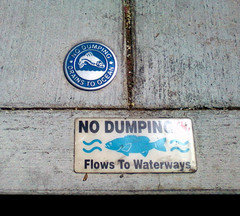
Please DON'T put such items as chemical fertilizers, pesticides, and herbicides in the household trash. Your local government doesn't want that stuff going in the landfill any more than you do. That's why they provide specialized collection and disposal services for it. Even more so, DON'T flush it down the house drains. And not that you would do this, but NEVER EVER EVER dump it into a storm drain, because that WILL put the stuff right into the local waterways by the most direct possible route.
Just to give a typical example, here is the listing of items that my city treats as Household Hazardous Waste:
http://www.philadelphiastreets.com/hazardous-waste
Paint and Paint Related Materials
- Solvent-based paints and stains
- Paint thinner
- Varnish
- Paint stripper and paint brush cleaners
(NOTE: Latex paint is not hazardous.)
Lawn and Garden Products and Outdoor Products
- Pesticides (fungicides, herbicides, insecticides, rodenticides)
- Chemical fertilizers
- Grill type propane cylinders (up to 20 lbs.)
- Swimming pool chemicals
Kitchen, Bathroom Products and Cleaning Solvents
- Cleaning solvents
- Fire Extinguishers
- Aerosol cans
- Bathroom and tile cleaner
- Toilet bowl cleaner
- Oven cleaners
- Drain cleaners
Automotive Products
- Used motor oil
- Antifreeze
- Lead-acid batteries
- Auto body repair products
- Brake fluid
- Degreasers
Flammable Materials
- Kerosene
- Old gasoline
Other Materials
- Fluorescent Light Tubes (transport in original box if possible) and Compact Fluorescent Lights (CFL)
- PCBs
- Dioxin forming compounds
- Mercury
- Asbestos (Non-Friable Only) for Information on proper asbestos removal, go to City of Philadelphia Health Department's web site
- Artists' paints
- Photographic chemicals
- Lead products, including solder, fishing weights, and similar items
- Household Batteries
- Rechargeable computer and cell phone batteries
- Button cell batteries used for hearing aids, watches, and calculators
(NOTE: Household batteries size D, C, AA, AAA and 9 volt are not considered hazardous.)
Other Household Products
- Moth balls
- Stain and spot removers
- 9 years ago
Good advice. I would only add that, for any kind of a usable product, I would offer it on Craigslist Free section first, to friends or coworkers, or if you have any amount of traffic, put it at the curb with a FREE sign on it. That way stuff gets used rather than disposed. It costs quite a bit for them to dispose of things as HHW, which comes back to the consumer either through trash bills or taxes.
- 9 years agolast modified: 9 years ago
Normally, I would freecycle/Craigslist free section for extra stuff I don't want. But in the case of hazardous materials, I deliberately do not recommend doing that, because I would rather be sure the stuff was properly disposed of than have it go to someone who may or may not actually use it, and may or may not handle it/dispose of it properly. That's why I specified giving it only to someone you know personally.
And I really, really wouldn't put spare fertilizer out on the curb at random, for the reason given above: storm drains really do put pollution into the waterways, and I don't want to put something into the street where it could spill. (In Philadelphia they would definitely fine you for doing it.). I would feel better about freecycling it if the packages were new and unopened and I could hand them directly to someone: less chance that an irresponsible person would spill or dump it, or an accident would befall it.





iowa50126