Software
Houzz Logo Print
roserecluse

Help With Downy Mildew Please

13 years ago
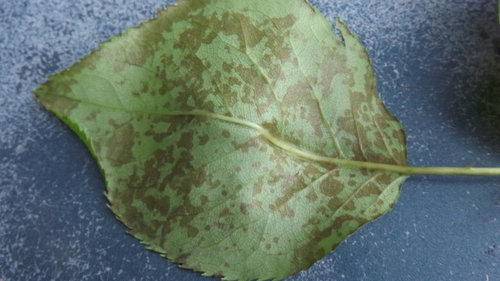
I have kept roses for 10 years and they are like my friends. Last year I bought 2 miniatures from the same source and thought I was battling very persistent powdery mildew. I have never had the joy of downy mildew. Now with this wet spring I have came to believe I have downy mildew. I woke up this morning and all the new growth on my beloved Medallion Tea Rose looked like it had been splattered with oil. I have been nervous because I realized when the miniatures woke up this year those two still had something wrong. As of tonight I have spots like these but darker on two more bushes. I am beside myself. I spray every week for black leaf but my spray is no good for this. The only thing I could find fast and local was Bonide with Malathion. I applied that a few hours ago to everybody. The poor Medallion has been cut to the ground because I was so panicked and it is 6 feet away from my Mr. Lincoln and they wind was blowing that way. The only good sprays at Rosemania are very expensive. If I thought I could save my roses I would order some right away but I think I needed it several weeks ago. I have never dealt with this plague before. I really need to hear some input. What is the most cost effective spray solution? Will my roses have it forever lurking in the roots? Do I need to dig the infected ones and get rid of them? I am so attached to them. Please let me know if you think that is Downy Mildew in the pic.Thanks for reading this and any input is very appreciated.

This post was edited by RoseRecluse on Tue, May 28, 13 at 22:46

Comments (10)

  • 13 years ago

    Here is a picture of it on the stems. Thanks again for looking!

  • 13 years ago

    Having seen lots and lots of it, I must tell you that that does NOT look like Downy Mildew.

    May I please see the TOP of the leaf???

    I wish I still had my old photos of downy, but I don't. Lost, long ago, in one computer change or another. I would very much like you to send your photos to Baldo Villegas. I'm providing a link to his website.

    But -- please. Take a deep breath and relax. In your area, normal conditions are going to knock this disease down, even if you DO have it.

    The first thing we did years ago was to buy the powerful drenches that were supposed to control it. THEY killed two roses, AND they melted a plastic measuring spoon. All of that caused us to reassess our approach.

    Jeri

    Here is a link that might be useful: Baldo Villegas website

  • 13 years ago

    Thank you for getting back with me. The tops show some black but not a lot. I have scared myself badly reading about it and probably ruined my poor Medallion needlessly. I have read it gets in the roots and stays in the plant? Thanks again and sorry it took me a bit to get another picture. In this picture there was some back light and you can see the spots on the back vaguely. The only thing you see in normal light is the dark black markings. There are not nearly as many spots as under the leaves.
    Barbara

    This post was edited by RoseRecluse on Wed, May 29, 13 at 0:34

  • 13 years ago

    I sent my pictures to Baldo. Thank you for that suggestion.
    I am gong to take a deep breath now! It has been a long upsetting day. Like I said I have been worried about those miniatures not being right and I have been reading a lot about Downy Mildew and scaring myself then I went out there this morning and the top third, all the new growth, looked like you see in the pictures and the wind was blowing towards the Mr. Lincolns(who look fine) and I just lost it. I know there was nothing under those leaves a couple of days ago because I was hunting for mites and aphids and would have seen it.
    Thanks again!

    Barbara

  • 13 years ago

    This is why people should never read medical texts. Pretty soon, you convince yourself that you have every disease mentioned.

    Baldo should be helpful with this, but I can tell you that the marks of downy mildew are more commonly bordered by the veins in the leaf, so that you get something of a Stained Glass effect (of course, eventually the leaf DOES turn yellow and fall off).

    On the canes, the discolorations are most commonly a sort of purple-ish color, darkening to black, and eventually becoming necrotic.

    I'm not saying it's not possible -- but from our experience here, I think it is unlikely.

    But -- just suppose it WAS downy mildew. Would that be a death sentence for the plant? Not necessarily.

    When, in the early 90's (I think) we did have downy mildew here, we rushed out and bought the recommended chemical. It was to be used as a drench. Extremely powerful stuff! You used about a tablespoon-full in something like 30-G water.

    The stuff melted the surface of the plastic measuring spoon, and the first roses we used it on died very quickly. We then re-thought the problem, and in the end used what the avocado farmers here were doing for the closely-related fungal organism that causes avocado root rot.

    Fresh manure, piled around the infected plant, out to the drip line.

    THAT brought the situation under control.

    I suppose it WILL always remain in the plant, but the plants appeared to strengthen to the point where they were able to fight off the effects. And I'd far rather deal with a little horse poo, than with a chemical that melts plastic spoons.

    Jeri

  • 13 years ago

    It certainly doesn't look like downy mildew. Downy mildew is a chronic problem only in greenhouses and right along the very cool Pacific coast. If it did show up in Missouri (maybe on a new garden center plant), it would disappear as soon as hot weather arrived.

    There was a big unnecessary panic about this disease some 20 years ago, and lots of misinformation spread around.

    Please come back and tell us what Baldo said. It's an odd symptom that I've never seen.

  • 13 years ago

    We CA rose folks probably spread that panic Michael. It WAS a big problem here, where the temps rarely went down enough or up enough to stop the fungus in its tracks -- and I actually did lose 1-2 plants to it.

    I'm glad I'm not the only person who found those symptoms unfamiliar. To me, they almost look like bruising . . .

    Jeri

  • 13 years ago

    I am curious what other suggestions people might have about the causes of those cane spots. I get those from time to time and I always thought it was mild frost or weather damage of some kind. nothing to worry about.

    but Then, like you, I saw a thread last year discussing similar spots and thought it was downy mildew on my new (bought from a crappy nursery which ships in cheap roses from the south) Intrigue which was struggling generally, I freaked out and pruned hard to remove the spots.
    Later, I rethought it ( and decided I had done just what Jerry cautions against- being a hypochondriac!) and decided it was just frost again-- though my hard pruning was invigorating and helped Intrigue get a better shape anyway..

    Anyone else have ideas as to these spots cause in cooler climes?

  • 13 years ago

    Lola, I suspect there are various fungi that cause cane spots, and some of them are harmless, some not. For example, black spot makes red cane spots which carry the disease over the winter. I know I have also had spots from some other cause. I stopped worrying about it some years ago, and nothing bad has happened.

  • 13 years ago

    Okay, the mystery is solved I believe and I am not very happy. It is the story of two gardeners who don't see much of each other....
    My husband is working the night shift seven days a week right now and I am helping my mother who has not been well for some time during the day. Apparently he sprayed some insecticide hoping to get rid of the green worms which have been heavy this year and doing some rather unsightly damage and those would be chemical burns on the new growth.
    I appreciate everybody's input and I am going to quit reading about rose diseases now and just continue on as I always have and hide the sprayer from my husband. The Medallion will come back but it will be a while before it resembles it's former self. Spraying the Malathion on top of what my husband did has resulted in some burn on all my roses now, some more then others. I am going to just remove the worst of it and tell them I am sorry and let them recuperate. I got rid of the two miniatures which have worried me for the last year. They were not anything special anyway and they sure had a nasty case of perpetual powdery mildew. It seemed very resistant to any course of action I tried to take over the last year and I don't have room for harboring sick roses. That was odd because I have never had that problem with a rose.
    I am glad to find this site and have really appreciated the feedback.

Sponsored
J.Holderby - Renovations
Average rating: 5 out of 5 stars4 Reviews
Franklin County's Leading General Contractors - 2X Best of Houzz!