Software
Houzz Logo Print
melissa_thefarm

Strangers in the night

13 years ago

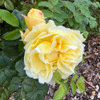
Do you ever get the feeling that, unbeknownst to you, plants are moving into your garden (or pot ghetto) while you sleep? This morning I was looking in bafflement at two roses I have in large pots in the pot ghetto. They have both just come into bloom. They're both ramblers: one has small double pure white blooms, the other dusky little double lavender flowers almost like a double violet, pretty as can be. I have no idea where these came from. Actually, perhaps I do have an idea. A few years ago I was sent cuttings by a lady on the island of Elba: she told me they were ramblers but she didn't know their names. I may not have planted out all the roses I got from those cuttings. The thing is, though, is that I saw those roses when they first bloomed and I don't remember them looking at all like these ones in the pots. A mystery.
About three years ago I bought two different purple ramblers--both darker than the baby in the pot--and a couple of double white ramblers, which I hope are not duplicates either. The purple and white contrast isn't as pretty as I hoped. Perhaps I need to propagate a couple of plants of 'Goldfinch' which is growing down in the shade garden, and which I only have one plant of. And I have a baby 'Ghislaine de Feligonde' which is going to need a home. A cool pink, not too saturated, would look good with the dark purple roses, too.
Melissa
P.S. Memory revives: someone also sent me cuttings a few years ago of a purple rambler, which grew (and was tremendously chlorotic: I do recall that). I don't remember what I did with those plants. Perhaps one ended up in the pot ghetto.

Comments (9)

  • 13 years ago

    There seems to be something about roses that causes labels to move.

    Years ago, we went to the going-out-of-business sale of a backyard nursery. The owner had small children, was moving, and was trying to develop a design business - none of which were conducive to running a nursery. We, of course, were interested in the roses, most of which seemed to be labelled Rosa ?. When we asked, we were told that the children were especially fond of pulling the labels on the roses and the primroses. We picked up a R. nitida, a couple of R. carolinas, something that turned out to be Max Graf, and something we are still trying to figure out what it is.

    When I was doing major propagating, my issues were with squirrels. They would pull the labels, and sometimes the roses, in the process of planting cherry pits. I don't know how many times I found a rose on the ground next to the pot, and a couple of cherry pits in the hole where the rose had been. That was when the cherry tree was younger and much less dead and there were regular squirrel-crow wars in its upper branches. Squirrel-crow wars are LOUD.

  • 13 years ago

    Melissa, I think a white/purple/yellow color combination with your roses could be pretty neat. I have a similar color scheme (but not with roses) front-and-center of one flower bed with dwarf yellow German iris, purple Iris ochroleuca (when it cooperates), white potentilla, and repeats of these colors in other purple varieties of dwarf Iris, yellow Gladiolus tristis, white Silene uniflora, 'Bright Edge' yucca, etc. etc. around the same area. it is one of my favorite parts of the garden in spring.

    I like the "strangers in the night" concept. When my husband next observes that the pot ghetto seems to be increasing and not decreasing, there's always the hypothesis that the new ones came in somehow overnight. My story, sticking to it.

  • 13 years ago

    Melissa, if I had as many roses as you do I wouldn't know if I were coming or going, especially since you're heavily into propagating. It's amazing that you only have these to wonder about. I'm afraid I would have made an awful mess with all your roses of figuring out which rose is which.

    Ingrid

  • 13 years ago

    Well, madgallica, from the point of view of the squirrels, cherries are more valuable than roses (haven't they discovered rose hips yet?), and so they do their squirrel farming. It just seems impossible to keep everything named, between labels, maps, and lists. I try. I like the sound of your garden, wars and all.
    Catspa, I've used purple and yellow before as well: it's the dominant color scheme for mid-spring in the shade garden when the lilacs are in flower. I like it a lot too. It started by accident and then I developed it further. I still have a cherry-pink tree peony that I need to do something about, though the thought of moving a tree peony intimidates me. If I can lay my hands on a deep purple, or even a lilac pink tree peony--I know they both exist--I believe I could nerve myself to try.
    Stick to your story. We need our roses.
    P.S. you name a couple of interesting-sounding plants. Gladiolus tristis? a species? purple Iris ochroleuca? I thought the latter was the definition of yellow and white.
    Ingrid, you work out methods to deal with hundreds of varieties Though accidents happen and discipline slips and chaos is always at the door, and as a result I have way too many mystery roses. I haven't done the mapping review that's so important this time of year when the once-blooming roses are in flower.

    The name of the lavender rambler came floating up to the surface of my mind this morning as I was lying in bed: 'Rose-Marie Viaud', she of the chlorosis, from cuttings I got in a swap by mail. I looked it up on HMF and sure enough that's my rose. One mystery solved. The other rose has cupped, small, double white flowers and is a Wichuriana rambler of the 'Dorothy Perkins' school.

    This post was edited by melissa_thefarm on Sat, Jun 15, 13 at 1:59

  • 13 years ago

    I have a certain number of plants which name I can remember but considerably more which are complete unknowns - especially a genus such as hardy geraniums where there are dozens of them floating around. The obvious ones are easy (Ann Folkard, Rozanne) but mostly, the names have vanished into obscurity. Because I only have around 100 roses, i can remember their names but once they are grown as cuttings, it's anyone's guess....and because I am not selling them, it doesn't matter. As for seedlings, there are hundreds of them so i tend to label 1 pot and rely on recognition when the seedlings start to grow.

    Mystery plants - I blame the birds.

  • 13 years ago

    Yes, thank you, I wrote the wrong name, Melissa -- I meant Iris lutescens, not I. ochroleuca (which I also have, but not in this part of the garden). Another great little purple iris I have in the vicinity is Iris graminea, the plum tart iris.

    Gladiolus tristis is a species, about 2-3 ft. tall, and exotically night-scented, in bloom a long time for a bulb, 3-4 weeks. (photo from this spring below). It doesn't need to stay dry during its dormant period, so it's essentially carefree (but I don't let it set seed -- will too readily spread).

    I had a medium purple tree peony in Massachusetts, a beautiful thing. Tree peonies are unnerving, so regal that I always feared mine might take umbrage at the least slight. A quick check with Google indicates they apparently move as easily as any commoner and are as hardy as horses. Not my first instinct, then.

    Isn't it odd how a plant name will finally float back to you, sometimes days after you've tried to remember it? The photos of 'Rose-Marie Viaud' on HMF are stunning.

    Birds are good suspects, Campanula (and squirrels). Carpets of privet, pyracantha, cotoneaster, nandina, etc. under the oak tree where they congregate (pulling these is one of my most-hated chores). Oaks and walnuts in the rose pots. As Thoreau said, "Some circumstantial evidence is very strong, as when you find a trout in the milk."

  • 13 years ago

    One way to formulate the concept of entropy is "Information tends to degrade over time."

    Another could be "Something there is that doesn't like a wall."

    However, despite the Second Law, we know that order can be built up locally even as it is decaying universally. There is some agency at work (elves, maybe) that is constantly transferring order from my jungley lot to a neighbor's perfect garden down the street.

    This post was edited by michaelg on Sun, Jun 16, 13 at 13:22

  • 13 years ago

    Suzy, my main reasons for knowing the names of plants are so that I don't buy or otherwise come into possession of them twice, or at least more often than I want to, and so that I can talk about them with other people or otherwise research them. I slip on a lot of my minor plants, but the roses are important.
    Catspa, thanks for the information on the species gladiolus, that's interesting. We have an attractive native here as well, a graceful plant with magenta flowers. I appreciate the iris information, too.
    About tree peonies, they do seem to be tough and adaptable. They're popular locally and do well here. I've seen a deep violet that I would love to have to replace the cherry red one (it's growing close to a vividly yellow--actually gold--variegated euonymus, and the combination is awful), and then I'd risk it. It helps to know they're not unusually fussy about being moved. Such noble and exotic plants are intimidating, and a person hates to throw one away with a poor job of transplanting. I might like this particular peony better if it were sited with more aesthetically congenial plants.
    Michael: how do they do that? have a perfectly maintained garden, I mean.
    It's certainly a battle to maintain information order here. I was out this morning updating the map of a portion of the big garden: I spent about three hours looking and drawing and weeding and writing labels, until the sun was beating down and I was covered in salt. And that was just one little section. Fortunately I did a lot of mapping last year. I'm beginning to look forward to the end of big rose orders, and many years spent getting to know the roses I have. With luck.
    Melissa

  • 13 years ago

    Good comment, michaelg! It is indeed sad that most people do not realize that the amount of order in the universe is finite and in constant decline. Thus, they do not recognize the noble sacrifice of those who allow disorder to reside in their plot so that others may have order in theirs...