Software
Houzz Logo Print
ribidibi

Removing Huge Shade Tree, Need Replacement Suggestions

15 years ago

We need to remove a huge Norway Maple (24" diameter, about 50' tall) from our tiny yard in Boston. The space is 36' x 22' with the tree in the southeast corner. We have loved living with this tree -- the shade has been wonderful for us and all our neighbors that gather in our patio area. But... the central trunk was cut off by the previous owners (maybe 15 years ago). The tree has 3 very large limbs around the central stump. The stump has become hollow and we see squirrels going in there all the time. We've been told by an arborist that the tree should be removed. We had our fingers crossed during the recent severe storm that came through. All the neighbors did, too! Whichever direction it fell in, it would take out a house! So... we want to replace the tree with another shade tree and have a hardscape that doesn't get warped by big top roots. We need both shade and a privacy screen. And, we're getting up there in years, so we also want a fairly fast-growing tree (we're going to allocate a chunk of change to getting a bigger tree to go in there). So, suggestions... what to consider, what to look out for (no messy or smelly tree issues, please), and any other ideas you might have.

Thx! Ri

Comments (16)

  • 15 years ago

    ribidib, always sad to see a big one go but at least you get a replacement!

    What part of the country are you in and what is your yard like? Sunny now i guess but is it wet or dry?

  • 15 years ago

    Just going by zone 6 as the only info so far. Unless you have alkaline soil, Pin oak (Quercus Palastris) grows very fast. Red oak does too, but Pin oak is faster. You will have to limb up the lower branches for walking underneath since they tend to droop. I have one shading my patio that's only 6 years old and is about 15 feet tall. It can take wet or well drained soil. And sycamore grow fast and don't mind slower draining soil, but can take well drained soil.London Plane is the sycamore relative you'll probably be likely to see in the nursery, I like the native sycamore's bark better, it's lighter, at least in my observation.I would say Dawn Redwood but my own tree doesn't look good leafless. If you get one with good form it would be another story. I have done major pruning and removed crossing limbs and all, and it goes back all wild with limbs crossing all wild like a misshapen Harry Potter tree. Looks good in leaf though. You may find a better formed tree out there. Sorry for the blabbing on and on.

  • 15 years ago

    Thornless Honeylocust is a fast one and not messy and a favorite of many folks.

    Dax

  • 15 years ago

    For all those that missed it in the original post....BOSTON.

    There are no shortage of shade trees choices but you probably want something more on the medium (rather than large) size? Deep roots too, b/c it sounds like you want to minimize surface roots.

    Consider Nyssa sylvatica (Black Gum), Sophora japonica, Zelkova serrata, Honey Locust, Ginkgo, Kentucky coffee tree, most Red & White Oaks (pretty big trees).

    Pin Oak actually has fairly shallow roots....one of the reasons it's so popular in the nursery trade as it's easy to transplant. Any deep rooted tree will be less common in the nursery trade and harder to establish (yes, those two points are related).

  • 15 years ago

    Boston! It was only ul near the top. I am re-enrolling in that 3rd grade reading comprehension class.

  • 15 years ago

    I missed it too. The pin oaks in my well drained soil don't have surface roots. They may be shallower than most oaks but are far from being what is thought of "surface roots". I shade garden under mine.

  • 15 years ago

    I bought a new mower and my salesman dropped it off yesterday and being's that I have so many trees here he asked me what the deal was; during our conversation he told me he bought a 4' Honeylocust last year and that currently it is 12' tall. I thought I'd tell the poster.

    Dax

  • 15 years ago

    Tulip poplar? It's not as messy as the sycamores or pin oaks, though the leaves are big and, when it's older, the flowers may be an issue in the spring. It does grow quickly, however.

  • 15 years ago

    To compliment the size/shape of a Norway maple, Honeylocust fits the bill really well. I think Zelkova is another choice but the others "smives" recommends either grow to slow or can be too messy of a tree.

    Best Regards of course.

    Dax

  • 15 years ago

    wow! great feedback. thanks! we are still finalizing the landscape plan, so haven't removed our aged beauty yet. we're actually leaning toward a 3-clump river birch. it will give us the privacy screen we need. here's a draft of the landscape plan that i put together while learning to use the SmartDraw landscape tool:
    {{gwi:41289}}

  • 15 years ago

    How is a birch going to get adequate water with all that impervious? Or do you want them to live only for a couple years?

    Dan

  • 15 years ago

    Since you call your yard 'tiny,' and you've got experience with a roughly 50' tall tree, tell us whether you're open to a larger tree, and how large a tree you could take?

    My first thought was an oak might be stronger than a maple since fear your tree could harm a house in a storm, that could be a factor. But a lot of oaks get taller than 50 feet. So do Tulip Poplar, and Sycamore can get outright huge.

    River Birch are reputedly somewhat short-lived, not a 'legacy tree for future generations,' if that's a concern. Of course, even a 'short-lived' tree might outlive YOU...

    Richard.

  • 15 years ago

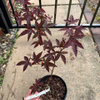
    The river birch sounds like a reasonable idea. Other choices might include one of the smaller maples (like {{gwi:381473}}) or an American smoketree. You definitely don't want (or rather, your successors don't want) something like a tulip poplar or white oak massively dominating and overgrowing that small yard. Someone might want to plant something in that yard that doesn't thrive in dense shade.

    I'd also opt for a relatively large tree rather than choosing one on the basis of fast growth, which brings with it a set of problems that can include weak wood and short life span.

  • 15 years ago

    The rooting zone is inadequate for - and likely cannot deliver enough water to - a riparian spp., according to the given rendering.

    Presuming north is up, the retaining wall will cook in the western sun, making water from the soil dissipate that much more rapidly.

    Its a cool design, but suitable plant material is much harder to come by in such a space. You need something that won't mess with the wall and can take tight rooting area with limited moisture. I owned a landscape design and const business in Sacramento for 13 years, BTW, if that helps.

    Dan

  • 15 years ago

    1) We're in our 60's, so 20-30 years will be long-lived for us!
    2) Water -- we're designing a watering system that takes the water from our basement dehumidifier and puts it into a watering system for the tree. Right now, it's draining into an old washing machine we don't use -- we empty a tub-full every day and a half.
    3) The current Norway Maple lived with hardscape of about the same size for 50 years, so we hope we'll have luck with whatever smaller, deeper rooted tree we put in.
    4) Should have mentioned the shading -- the houses on the other side of the street (city residential) shade the yard in afternoon. It's a hill, so they're higher up from us. The retaining wall will be about 12" high on the West side (yes, top is North), but will be shaded most of the day. I didn't get a chance to add the shading from surrounding buildings.
    5) We're going to be going tree shopping soon, and i'm going to print this thread and take it along -- so many great ideas and insights. Thank you all so much!

  • 15 years ago

    Sounds great. I'm going through a similar situation - more at the beginning stages of getting rid of a giant tree and re-landscaping everything. Given the tightness of our yard as well, dealing with another large tree seems like a nightmare - maybe a smaller tree and a some raised vegetable beds. Best of luck, you're design looks great and gave me some ideas!

    I was wondering though - how are/were you able to take out the tree in the small yard? Is there easy access to the tree from the street/driveway? Going through the same thing and looking at options which appear to be limited.