Software
Houzz Logo Print
greenthumbon1hand

Claymend...Too good to be true?

12 years ago
Calling all master gardners!

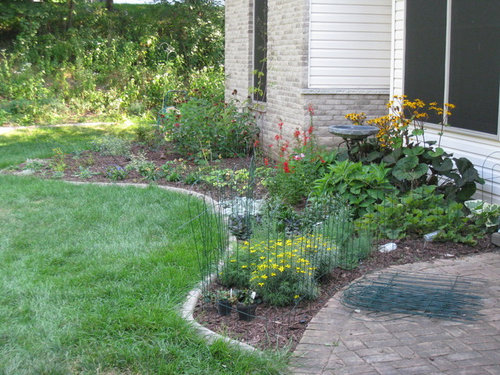
Has anyone tried Claymend? My pops and I have been landscaping the yard, which is nothing but clay after 6 inches. We've been amending the 'soil' with compost, top soil, and builder's sand to a depth of about 1.5-2 ft (we've had a long-standing debate as to the depth we should dig -he thinks it should be a foot, but I'm afraid if we do that we'll end up digging the perennials back up due to poor growth once the roots hit the clay). It would be nice to throw something on top of the soil and be done with it - I might actually feel like we're accomplished something, but this seems too easy. Or, would it be good to apply it when we dig and mix the other stuff in? I've posted photos to give you an idea of the kinds of perennials we've been planting at a snail's pace.
Help me in my quest to be lazy!
Thanks much!

Comments (39)

  • 12 years ago

    Claymend sounds like little more than humic acid...aka, really expensive compost tea concentrate given their pricing on it.

    It's pretty much the only thing that can do what they claim in the parameters they're claiming for a mode of action.

  • 12 years ago

    Btw...roots will do most of the work of amending soil past the first 6-12"...along with earthworms and microbes...if you give the top 6-12" some good soil to work with and a bit of time.

    The roots will move "good" soil on top down as well as loosen up the clay...and worms migrating up/down through trails they create as the seasons warm/cool will also aid in "good" soil movement down the profile.

  • 12 years ago

    This appears to be a very expensive source of organic matter. A couple of places that talk about ClayMend suggest it will "break down" clay soil. It will not. But like any other form of organic matter it will, most likely, make that clay soil workable.
    Sand, if added to clay in large enough quantities like 45 percent, might help clay some, but organic matter in what ever shape or form is best and that is why Ma Nature makes so much of it so readily available to many of us at this time of year.
    There are no magic elixars, fairy dusts, or voodoo potions that will substitute for organic matter in soils.

  • 12 years ago

    Thanks for the replies! Since the leaves are coming down, would it be a good idea to add a layer of leaves before mulching, or would that cause rot?

  • 12 years ago

    leaves are mulch.

    check out the WSU extension page on horticultural myths, specifically the mulch pages. Heavy clay soils have been remediated with lots of mulch alone.

    Here is a link that might be useful: WSU horticultural myths

  • 12 years ago

    Claymend is a great product to use in conjuction with the compost and plant matter added to your clay soil.

    Claymend is more complex than compost tea. Its formulated to help restructure the clay from a particulate level as well as help neutralize salts by deconstructing the sodiom molecule.

    Claymend also has a biological element that helps break down and chelate the nutrients from plant matter and fertilizer in the clay soil so you get better results from the added compost.

  • 12 years ago

    Jeff @ Humic Green what you have posted is known as spam. If you wish to advertise your product on this forum pay for an ad.

  • 12 years ago

    yah sorry about that I realized that after posting, I just wanted to reply to incorrect assumptions.

  • 12 years ago

    jeff@humicgreen, that your product is expensive, and unnecessary, is not an incorrect assumption. Delete your spam and pay for an ad if you wish to promote this stuff.

  • 12 years ago

    I won't ask Humic green, but I will ask greenthumb what you mix solution to water?
    I was given a bottle of this or something like it, and would like to use it on some nasty areas of the yard. Unfortunately, I left it out all winter and can't read the name of the stuff or the instructions! The young lady who gave it to me doesn't know, and her GM died recently, so no help there! Nancy

  • 12 years ago

    I have tried Claymend and it worked great. For the past 20 plus years I have amended my soil each fall with one or more of compost, peat moss, mulched leaves, mulched grass, etc. it always returns to a hard and compacted state. I work it again in the spring and usually by the end of the growing season it is hard again. Typically I get my garden planted by Mothers Day which historically is just past the time of our last frost but I didn't get my garden prepared last year (2012) until I think it was the first or second week of July. I used Claymend and what it did to the soil was amazing. The hard dirt clods broke up and I could actually work the soil. I have never had a compost tea do this for me. My garden did really well considering I started so late in the year. What was more incredible to me was how the soil was this spring (2013). There were only a couple of clods when I turned the soil but they broke apart by just lightly touching them. It would usually take me most of the day to prepare my garden in the spring but I had it prepared and planted in just a couple of hours this year. I used Claymend a couple more times during the year and the garden was spectacular. The bell peppers I planted were much bigger plants than I have ever had, probably about 8" taller, the peppers were nice and big and this is the first year I didn't have to prop the plants up for support. The value I received just in the amount of time I saved preparing my garden this spring far exceeded the cost of the product for me. I can hardly wait to see how my garden performs next year.

  • 12 years ago

    >>as well as help neutralize salts by deconstructing the sodiom molecule.

    As a chemist this does not make sense. 1) Salts are generally already neutral (as far as pH), and if not - as in the case of carbonate, phosphate and sulfate, which have a certain level of acidity/basicity and form buffers as a result - even in those cases the non-neutrality has nothing to do with sodium. 2) It is unclear why salts have to be 'neutralized' in any way to improve soil. 3) Sodium is an element, not a molecule, and the compounds it forms, i.e. salts, are salts, not molecules. If you are referring to dissolving sodium salts, only water is needed for that as they are very soluble. If you refer to 'deconstructing' sodium itself, you'll need a nuclear reactor for that.

    The product may be just fine but I have problems with your explanation of why and how.

  • 12 years ago

    Most salts in a soil (especially sodium based) would actually flocculate soil aggregates and break them up.

    The explanation given is as "off" as it's price for what it does.

  • 12 years ago

    -flocculate +disperse...oops.

  • 12 years ago

    Deconstructing the sodiom molecule...I have real faith in that product now.

  • 12 years ago

    It could be meant as a rather confused explanation of the action of something like calcium on sodic clays, which as we know is beneficial. Almost sounds like some guy in Mumbai doing paid shilling for a product using a text translator. :-]

  • 12 years ago

    I gotta step in on this. I own of chain of nurseries/ landscape companies in central CA and I've followed Garden Web for years. By and large, there's good advice here with some exceptions every now and then. I'm not a chemist but I do know a something about plant products on the market because my business demands me to. And NOTHING irks me more than when a customer comes in with what they were sold as THE product that will cure their problem and yet they come to me wondering if they put it on wrong because they aren't seeing the miracle results the product/company/salesman/website said they'd have. Since we've had the same question twice now on this stuff from two locations, I'm signing on to try and warn off people from just blindly buying these online specialized plant/lawn products.
    To answer the question "does this work", my advice is real simple folks: BEFORE YOU BUY, READ THE LABEL. Over years of selling yard products, the trend I've found is that the companies with products that actually work in one form or another disclose what's in their product both in the ingredients and the description/directions and they do it to showcase how their product is superior to others out there. Its that simple. And just like how food companies use big words in their ingredients list (e.g. fructose/sucrose = sugar or equivalent) and have "smartly" written descriptions of the biological and chemical results their product will have once it hits your yard, its all just to confuse you into buying their product. Be warned, they might just be selling you "snake oil" and nc-crn is right, many of them are in fact "little more than really expensive compost tea concentrate given their pricing".

    The bottle I read really doesn't say much if anything.

  • 12 years ago

    Yes, but I guess you all missed that it has a 'biological element'. I think that makes everything clear.

  • 12 years ago

    Again, not calling these guys out, but I doubt they actually know what's in it. Experience has shown these new guys selling bottles with blank labels aren't usually involved in the actual making of their product UNLESS it is merely compost tea. Even then, most don't know what ingredients in what amount that are actually in the bottle. And heaven forbid you found that out. Otherwise you wouldn't pay the $30 per bottle.

    Snake Oil

  • 12 years ago

    Thanks Mike, great to have the perspective of someone in the business.

  • 12 years ago

    In reference to toxcrusadr, I stand corrected. I meant sodium chloride molecule. I apologize for the error.

    And I bet Mumbai is nice this time of year.

  • 12 years ago

    "Snake Oil!"

  • 12 years ago

    We have kept the ingredients listed on the bottle to those required by the Dept. of Agriculture which are Nitrogen and Sulfer.

    ClayMend also has a proprietary blend of Organic Acids and Microbes in addition to the Nitrogen and Sulfer.

  • 12 years ago

    Compost and other vegetative waste will have the organic acids and microbes, as well as the Nitrogen and Sulfur, your plants will need, if enough is put into the soil. Most of that can be obtained for free.

  • 12 years ago

    And with respect to sodium chloride, my comments stand. NaCl will not exist in the soil solution, so there's nothing to 'break up'. Na+ and Cl- will float around with all the other anions and cations. If you want to talk about displacing sodium to improve clay texture, better study some soil chemistry.

    And it's 'sulfur' not 'sulfer'. Not to be a nitpick. :-]

    Merry Christmas!

  • 12 years ago

    "those required by the Dept. of Agriculture"

    That right there is my problem with this stuff. When one of my customers asks why its not working how she was promised after paying a premium compared to all other products in this space and all that's listed on it is nitrogen, how do I answer her question? More than that though, she had a bigger worry that some spilled and was afraid her young choc lab pup may have lapped some of it up. Where the h$## is the poison label? What if it was her kid instead?
    Anytime I hear "proprietary" in my business means one of two things: a)they don't know whats in it, or b)they don't own the patent/priority on the mixture (or both).
    My experience has been the ones making the least effort yet charge a steep price are only trying to exploit the unsuspecting consumer. e.g You guys are doing it wrong.

  • 10 years ago

    Via the Material Safety Data Sheet on their website in PDF form:

    TRADE NAME: ClayMend (8-0-0)


    COMPOSITION: Proprietary Polymerous Hydrosol Leachate with Urea, Ammonium Nitrate, and Ammonium Sulfate.

  • 10 years ago

    Yes, but I'm just providing the information that was never given.

    So what exactly is polymerous hydrosol leachate and what would it do?

  • 10 years ago

    Well, let's deconstruct it word by word.

    Polymerous suggests polymers or at least large molecules.

    Hydrosol is a term used in the distillation of essential oils (usually from herbs). Basically a steam distillate.

    Leachate is any liquid you get from leaching water or some other solution through something else, such as soil or compost.

    There are too many permutations to figure out what it is they are actually doing. Did they distill compost leachate and then polymerize the distillate somehow? Distill polymers from leachate? Or distill something first and then use it as a leaching solution? And why do any of these steps? Leaching is the only one that is fairly obvious: it's basically how compost tea is made.

    Unfortunately it's impossible for me (as a chemist with enough knowledge of soil chemistry and compost chemistry to be dangerous) to evaluate the efficacy of this product from that description. Obviously they have done something more than just make compost tea. Whether that has any effect/value at all or is just a gimmick is difficult to ascertain.

  • 10 years ago
    last modified: 10 years ago

    Oleaginous herpetologic deliquescence

  • 10 years ago

    Has anyone tried it and compared results? I would think that would be a good way to discern if it has good value or not. It's worth a few bucks to at least try it out and compare to me. I consider that an personal venture capital investment. If it has good ROI, then I get my money's worth. If not, it was worth the ten bucks to find out if it actually works.

    If they are not selling snake oil and really have a new worthwhile product, it would seem that they could produce a bit of a better explanation for the chemists out there on why or how it works and its efficacy.

  • 10 years ago

    Tox : "Leachate is any liquid you get from leaching water or some other solution through something else, "

    At around 5 this afternoon I'll be having some of Tennessee's finest leachate on the rocks

  • 10 years ago

    Claymend is a liquid that you spray on the soil. There is no liquid that will replace organic material in the soil and this product will not add enough humus or humic acids to be of much benefit to any soil. You can get something similar by making compost or manure tea.

    kimmq is kimmsr

  • 10 years ago

    "Oleaginous herpetologic deliquescence"

    Watch your language!

    Oh...snake oil. heehee

    "Has anyone tried it and compared results?"

    If this product/technology actually had benefits, it would have some controlled studies already in the literature. I will bet that loads of nearly free compost will do the same thing in 1/10 the time. Otherwise they'd have those studies to show why it's worth the cost.

    darth: I hoist Kentucky's finest in your honor. Cheers.

  • 10 years ago

    late to the party, huh.

    I have three things to say on this one.

    1. pure. marketing. genius. period. How many people cite clay soil and lament such? Here you go, a product designed to help you alleviate such a common problem! And the best part is, it's bio degradable (so you have to buy more).

    2. I'm always cautious when people use big words and absolutely refuse to tell you what it is or how it works. I understand a certain degree of caution re: proprietary formulations...but come on...while I don't have a degree in chemistry, I do have a pretty good knowledge base and an extensive experience base in growing things.

    3. While we may be doubtful of the efficacy of this product in particular, the concept in general may not be as far fetched as responses here have indicated. Evidence of such, soil surfactants and their use in highly managed turf, ie, golf courses. How does such correspond to "average" use? I guess, in part, in depends on your willingness to try new ideas/spend money/experiment. Revolution

  • 10 years ago

    Couldn't have said it better. They should be able to explain exactly what it does that is a benefit and how it solves your problem. If they can't, or won't, or they use a lot of flowery terms that carefully don't say much, beware.

    Revolution...I thought I saw that on TV...oh wait, I couldn't have. The Revolution

  • 3 years ago

    Are there any current comments on using Clay Mend? Second, SWFL, particularly Sanibel went through Hurricane Ian leaving behind 1-3 inches of clay soil. How will clay mend work in breaking it apart to be re-worked into the soil naturally. I’m sure the clay has a high salt content since it came in from the Gulf of Mexico…any suggestions or comments…

  • last year

    I get the urge to pontificate based on personal experience, knowledge or pedigree — Im often guilty of that myself. But if you’ve ever struggled with heavey clay soil - and tried almost everything with little to no results — you might be more open to TRYING the product before teeing off on all the reasons it can’t work. Sure there’s a lot of ”snake oil” peddled online these days. But I was desperate to try to improve my Heavy Clay Soil bc no matter what I tried — copius layers of organic matter, compost, grass clippings, leaves, various soil amendments — I still had a slow draining mud pit in the Spring that you couldn’t even dig or till unless the conditions were perfect. Too dry and you got hydrophobic dust and too wet, you got clumps and mud balls that then dried into small bricks with almost no chance of being able to break them up once dried. This cycle kept repeating — until 3 months ago when I ordered a bottle of Claymend. I fully expected to be disappointed but maybe see some marginal improvement at the micro level as I had tried all the macro level things. I did the extra work of chiseling and digging my beds up to break the hard pan into clumps and clods as best I could, mostly to just try to expose more surface area knowing I was going to be applying the claymend. The label said you can apply a heavier application than standard with no ill effects — which I did. and since it was Fall and I wanted to accelerate things if possible to see how the over Winter results might be, I did a 2nd application withing about a week or 10 days just to get more product working on my wretched soil. I watered it in hoping it would leach into the soil cracks and work some magic. I did also add some commercial nursery compost ( a couple inch layer) and mixed it in the 1st 6 inches of clumps and clay — but I had done this many times in past with little and very temporary improvements.

    • **Fast Forward 2.5 months to late December and I just accidentally went up to my garden for a look bc we got a couple beautiful sunny days. I was stunned by the look and composition of that 50’ bed. I’ve never seen it look that way — Zero Clods or Clumps and the most grainy, beautiful texture I had ever seen for that bed. I couldn’t resist grabbing the Garden Fork and sinking it in. WOW. Just Wow! That bed was Amazing and I could easily till it with the garden fork and found there were Zero compactions, zero clumps — only beautiful dark soil that was easily turned and what I would call the PERFECT composition for planting / growing. Not only perfect composition — but No waterlogged, soggy or muddy components to it at all, which Ive NEVER seen in that bed — Ever. It was stunning. At first I was thinking it was the Fall Compost I added — then I was back in the garage and saw the bottle of Claymend I’d left out to remind me that I wanted to add it again in early Spring — and That’s when I recalled Adding the Claymend back in early October which I’d completely forgotten about. I went back and inspected the bed again and in very short order, I had run the garden fork through the entire 50’ bed with ease and confirmed that it was all the same — and for lack of a better word — completely ”transformed” from the heavy, rock-hard clay from when I started. No Joke — it Transformed that dirt and I am completely stunned at how it worked for me. So laugh or scoff or continue to look for reasons why it couldn’t work as advertised — or shell out a few bucks and TRY IT (if your soil needs it). I’ll bet you will become a believer. I’ve never seen anything like the results I got.

    • So a couple more nice days and I was out digging up 2 more 25’ beds into the soggy, muddy, waterlogged clayballs that have been tormenting me for years. I broke up what i could and applied a generous coating of the Claymend over these beds bc based on the results in my 1st 50’ bed, I want to see what will happen by Spring in these troublesome beds too. I did not add any compost, just the Claymend so we’re going to see what happens. It rained a decent amount so I went back and dug the fork down even deeper (?12-14” or so) to bring up even more big clay chunks and expose more surface area and crevices. Then I sprayed another application to try to get all the clumps and clods and hope that it will leach even better into the beds and enhance my results by Spring. You can call me crazy, but within a couple days of that, you can literally SEE the changes happening and the difference in the soil. Yes, there was some rain, but the Clods and clumps appear to be literally ”melting” away and the texture of the dirt is looking remarkably similar to the 1st bed that has been percolating for 2.5 months. I’m super excited to see what will happen by Spring. In one final test — I decided to just spray a light application on the surface of my last 50’ bed and did nothing to till or mix it in and Im just going to see what happens with that.

    • You can quibble with the science of ”how” it works. But if you try it — you won’t quibble at all with the results.

Sponsored
CHC & Family Developments
Average rating: 5 out of 5 stars5 Reviews
Industry Leading General Contractors in Franklin County, Ohio