Software
Houzz Logo Print
tennessee_gw

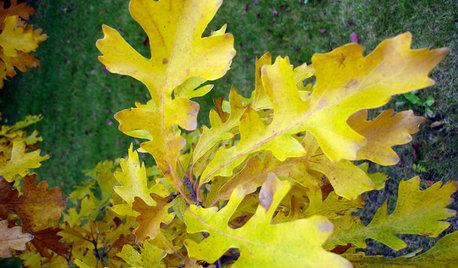
Oak leaves

20 years ago

Someone told me to not use oak leaves as mulch. Is this correct? I have access to lots of them & would like to shred them & use them as compost. Also, I save my coffee grinds & egg shells. After I a lot of egg shells, I put them in the microwave to make them brittle & easy to crush. I use a brown paper bag to put them in & then use my rolling pin to crush them after they have been out of the microwave for a fe minutes. Can I throw the coffee grinds & crushed egg shells onto my vegetable garden & flower beds?

Comments (19)

  • 20 years ago

    You should absolutely not use any of those items for mulch or compst. Send them to me immediately so I can dispose of them properly.

    Ok. I guess that's not going to work. I have no idea why anybody would say that you shouldn't use oak leaves for mulch. I think they break down very slowly if they're not shredded, but if you're using them as mulch, that's not really an issue anyway.

    I wouldn't bother microwaving the eggshells. I would just crush them and add them to the beds, along with the coffee grounds.

  • 20 years ago

    Yes you can put all of the above in your garden. As far as the egg shells, I have a coffee can that stays on the back part of my stove. I throw the shells in there as I get them. Then when it gets full I throw them into the food processor and powder them. I keep them more for my vegetable garden than the flower beds.
    Happy gardening.
    Sandy

  • 20 years ago

    Many people have this notion that Oak leaves are not good for the soil because they are acidic and yes Oak leaves will test out to 3.7 on the pH scale, but Maple leaves will test out to 3.2 as will Beech, Birch, Catalpa, etc. The only problem with Oak leaves is if they are left whole because the tannic acid, a preservative, helps inhibit digestion by the bacteria. Shredded Oak leaves are not a problem and will improve your soil just like any other shredded leaf will.

  • 20 years ago

    I have yet to find anything that I like better than Oak leaves for making compost and mulching my garden after the plants are up tall enough to put down a two or three inch layer of them. I do shred them with my mulching lawn mower and that helps a lot by reducing the volume by about 10 to 1 which makes them break down somewhat faster and without any matting problems or them blowing around in the wind.

    Shredded oak leaves in my zone break down at just about the right time, late summer / early fall and add back to the soil and are not in the way of plowing, tilling or planting a fall garden of greens for a cover crop.

    If I may, I will illustrate why. Under less than ideal circumstances, I hastilly planted my fall crop of mixed greens on September 2nd, just before our prolonged heat wave and drought broke. I watered them in and had to sprinkle the surface a few times before the weather broke and we got some rain and cooler temps. In just a few days, they were up to a good stand (although too thick, or close together and I did not have any chance to thin them out any) and looked like {{gwi:314399}} (Note there were no left over residue from the mulch that I applied in the spring to get in the way.)

    My DIL watered them some while I was in the hospital for major surgery and that helped keep them alive. Now they look like {{gwi:314400}} which to me would indicate rapid growth under excellent soil conditions and definitely no adverse or detrimental effect from all those leaves that I have used to ammend then later to mulch with on a continuing basis over a number of years.

    Although planted too thick as mentioned, I have found a few nice radishes like the white icle one in this {{gwi:314401}}. I have also found a few beginning to make little turnips like {{gwi:314402}} and {{gwi:314403}} which will grow rapidly if they do like they usually do.

    So, based upon my experience and observations over several years in my little part of the world, and after trying several other kinds of materials for composting and mulching, I heartily recommend oak leaves, (especially shredded oak leaves). My second choice would be a good grade of costal bermuda hay which has no seed. I used some lower grade hay and a bit of straw on some parts of the garden this past spring which still has not broke down and I will shred it with my mower good when I mow and mulch those greens after the first of the year when I start adding my layers of ammendments to turn under.
    Bill P.

  • 20 years ago

    Ohh, I love the paperbag idea for eggshells. We ahve a bunch of those, used 'em as luminaries on the driveway for Halloween.

    We have almost half an acre of mostly trees. Did our first 'raking' last weekend (leaves are still falling aroud here) and I managed to reduce the pile considerably by mowing over them. We'll probably work on it again today, so this means I'll need to go out and get another roll of chicken wire for a compost bin. I layer the leaves with kitchen scraps and horse manure. Even have the neighbors trained to bring me their leaves now.

    We also haven't started on the right side of our property yet, the leaves over there are almost a foot deep.

    Hubbie announced last night that he'd stopped during the day and gotten me some coffee grounds. Now if I can only get the kids trained to do that!!!

  • 19 years ago

    Oak leaves at my house take just forever to break down. They go lots faster if you shred them (I don't usually) and/or if you compost them and turn frequently.

    That's the only reason I can see not to use them, they take so long. But if you are mulching with them then slow breakdown won't really be a problem so much as an asset, right? Mulch away!

  • 19 years ago

    Right Regina. But I do not know why it takes your oak leaves so long to break down, unless it is the climate and maybe the type oak you are useing. Here, I can make some darned good compost out of shredded oak leaves in 60 to 90 days if mixed with greens, kept moist and turned occasionally to give it some air.

    Just shredded and set aside to use for mulch in the spring when the garden plants are up tall enough, they will break down and disappear back into the soil by late summer / early fall. I did not reserve as many shredded leaves as I should have last fall and consequently some areas in my garden did not get as thick of a layer of leaves as I would have liked. You can see {{gwi:314404}} that by mid June they are kinda getting a little thread bare. So, I obtained some loose hay and straw from our local feed store and put some of that down for {{gwi:88964}}. It still has not broke down, will have to be shredded up when I mow my greens in mid winter to turn under and I just do not like it as well as I do the leaves.
    That is just my preferences and what I have experienced im my little corner of the world.
    Bill P.

  • 19 years ago

    "Here, I can make some darned good compost out of shredded oak leaves in 60 to 90 days"

    Bill, I think thed key is in the shredding. Regina said that they go fast if they're shredded, but that she usually doesn't shred them.

  • 19 years ago

    Well, like I said I don't shred. So that's problem one. Problem two might be the kind of oak leaves, I have no idea about that. Climate almost certainly plays a role since I am a very lazy composter and so only get compost from about june through september (after that it rains too much and then it gets too cold and things just stop) and then it all just piles up until next year. And problem three is simply the sheer volume. You can only pile them just so deep in one spot and neglect them and expect them to be completely gone by the next autumn.

  • 19 years ago

    (after that it rains too much and then it gets too cold and things just stop)
    Really? We're into November now and the pumpkin part of my pile is coming down nicely. I dug in a chicken on Sunday and found that toward the bottom of the pile I actually had some nearly finished compost. In fact I thought I'd dug all the way through the bottom of the pile into the ground and forced myself to dig a little more to prove I was actually still inside the pile...

  • 19 years ago

    The climate in Massachusetts is not going to adversly affect composting any more than the climate in
    Michigan does, but the particle size, the ratio of Carbon to Nitrogen, and the moisture level will all contribute greatly. Even if the particle size is just right and the C:N ratio is just right if there is too much moisture the bacteria will not work well because they need air just as we do. My compost piles are working quite well right now even though the average temperature now is in the low 40s and they will continue to work until the average temperature drops below 32 for a long time. Because of all the rain we have had here the bins are covered, as they are always, so I can control the amount of moisture in those bins. Compost piles freeze up in the winter because of too much moisture.

  • 19 years ago

    You guys seem to have overlooked the key elements of Regina's post: "lazy composter" and "neglect". For us lazy composters in cold climates who ignore our compost in winter, cold climate is the bottom line. In winter I don't add to my bin or turn or water or anything else; It just sits there. In spring it's compost. Then I start over. I get one nice batch per year. I'd like more, but not enough to trudge through snow in sub-freezing weather to actually do anything with it.

    Besides, in winter my gardening schedule is pretty full with winter sowing!

    Karen

  • 19 years ago

    I would just like to point out that compost can be kept active in the winter. I am one of those who likes to carry some loot to the pile with my little sled to the pile every weekend and add and toss and turn on a nice crisp day. For the last two years since discovering this forum, I've challenged myself to keep the microherd alive and well, and have succeeded. As long as I'm warm too, I love the outdoors in the winter, and this gives me an activity related to gardening which I can do in the winter. (Karen - I still winter sow, but ache for the outdoors so I do the nutty compost thing! :))

    Mind you, there are a few little tricks to doing this. Our temperatures here can get to -25C for a few days at a time, and waiting until they reach the -10C is wise. Insulating the pile with bags of leaves is also wise, as well as covering with cardboard and burlap. Keeping 200+lbs of UCGs slightly above the freezing mark in our basement is also a good thing. The bags of leaves set on top of the compost are kept warm too, so they don't freeze and can be added to the pile weekly.

    And at times, water will be required - even in winter! So two watering cans full of water are at the ready if required.

    Snow never accumulates on the piles all winter - it just melts in through the burlap and is telling me that all is well with the microherd below!

  • 19 years ago

    tiffy: I have no doubt that you can keep the pile going all winter. But it ain't gonna happen in my yard!

    I'll sneak out to my patio with my wintersowing containers, but I just can't compel myself to do the compost thing in winter. For me, compost season ends when winter arrives.

    Happy composting to you and don't freeze to death!

    Karen

  • 19 years ago

    I've literally put on my snowshoes to get to the compost pile. Problem can be that when the outside layer freezes, then you add more stuff, it freezes and insulates the ice underneath it. Now you build up frozen layers and it takes forever to thaw.

    To keep it active- build it really large and a bit on the green side. It'll still freeze in my neighborhood, unless it's several yards.

  • 19 years ago

    Yes, kqcrna has it right, the issue isn't the climate all by itself but the climate combined with the laziness. Or ineptness or something. Even when I try fairly hard I don't do that well when the weather cools. Part of this is because my pile is open so when the November rains hit it gets too wet. Part of it is because my piles tend to the small side so's I can turn them without too much trouble. Part of it is because I spend about ten seconds a day contemplating my green/brown ratios; I add my bucket of kitchen scraps and cover it with a layer of leaves to keep the flies/smell manageable and then I go back inside.

    So, in warm weather my pile cooks nice and hot. In autumn, nope, it slows and stops.

    I do add kitchen scraps all winter, why waste the greens? But they just sit there until springtime, late late springtime.

  • 19 years ago

    I can see most leaves (oak, maple, beech, etc) could be used but I'm hesitant about using my black walnut leaves in composting because of juglone, the plant growth inhibitor. I understand it's less in the leaves than roots, but I'm concerned with making compost with leaves from that tree. Anyone have experience with composting black walnut leaves?

    thanks,
    Moscow

  • 19 years ago

    Juglone will absolutely not survive the composting process.

  • 19 years ago

    I hate to let my kitchen waste go uncomposted, even in the winter, so one year I kept a bin right outside the back door and added scraps to that during the cold weather. I didn't even have to put on my outdoor clothing to add to the bin, and the fact that everything froze in there kept any hungry animals out of it plus kept it from smelling. When things thawed, I dumped the scraps in my composters.