Software
Houzz Logo Print
brandon7_gw

Small Wounds, Big Problems

17 years ago

About a year and a half ago, I ordered some apple trees. One of the trees came in with a case of crown rot which wasn't really evident when it was planted. Shortly after planting it, I found the problem. I contacted the supplier, who gave me a sob story and told me that I could get a replacement tree in about a year when they were once again available. I was ticked, but figured my best bet was to reorder from another supplier later on and replace the defective tree. I half cleaned out the rot on the tree (not sure why) and left it in place thinking I would remove it later. I looked at it the other day and the wound, which had covered about half the diameter of the tree, looked much cleaner and was being closed off. The exposed heartwood was gray and cracked, but was firm. Now, I'm half wondering if I should leave the tree and see what happens or replace it as planned.

This situation got me thinking about what I know about how wounds are contained. Can small wounds really be effectively walled off for the life of a tree? How can the severity of wounds be estimated, especially with respect to the amount of time before they lead to problems. Why do some wounds degrade more rapidly than others even after they are closed off? How does one decide which wounds are OK and which should be considered death sentences? I'm not sure exactly what I'm looking for here, but I'm hoping a discussion of the topic will lead to insights or information I may not even be aware of.

Comments (11)

  • 17 years ago

    This is a question I have thoroughly researched as I have had many trees injured by deer during last year's autumn rut (before I knew enough about what causing it and how to prevent it). Yes, trees can effectively seal off wounds for the natural life of the tree. Technically, trees do NOT "heal"--but as you put it they 'wall it off' and grow around it. If a tree is completely girdled (bark removed around the diameter of the tree), it WILL DIE. But a tree can recuperate from more partial damage to bark tissue. You described the width of the wound (50% of the circumference) but not the length of the damage. I did read somewhere that if the tree does not visibly show decline after a few weeks, then it will probably survive. I have also heard that the tree may show less vigor on the side of the original damage. I left my newly planted, partly deer-damaged trees be. I noticed much older trees in the area also showed evidence of animal inflected bark damage and yet had been there for decades--with no apparent defect in appearance. All the partly damaged trees showed strong, vigorous growth this Spring and Flowered nicely so I guess time has healed their wounds. Good luck!

  • 17 years ago

    For compartmentalization to be truly effective, the tree has to be healthy and established. In other words, it shouldn't be devoting carbon resources (energy) to repairing crummy pruning, root damage, excessive growth promoted by too much N, etc.

    I've seen signs of compartmentalization on very old oaks that occurred very early on in the life of the trees. Of course, witnessing successful compartmentalization requires either a full 'autopsy' or an 'amputation'. But witnessing great examples of compartmentalization on 200 hundred-year-old trees is pretty awesome.

    There are good ways of detecting how advanced rot is in a tree, but I don't know of any way we could forecast the problems (or lack of) a tree might have because of a wound.

    I guess we have to determine the extent of the injury, the location of the injury, the age and vigor of the tree, species, site, etc. I usually assume that a healthy tree is capable of walling off the injury and will do so.

    Re-reading your post, I'm wondering if you are even talking about internal compartmentalization, which you cannot SEE, or the formation of wound wood. Just tell me to be quiet, if I'm going down the wrong road.

  • 17 years ago

    Rhizo, you are exactly on target. And both internal compartmentalization and wound-wood would have to be considered for a situation like my apple tree. I'm very interested in your experience/findings concerning the 200 year old trees.

    I've seen many examples of wounds that eventually led to failures even after the affected area was closed off. I've seen a limited amount of examples where wounds were effectively closed off for extended periods of time. As you said, autopsies on healthy trees (or at least healthy in the area in question) are the only practical way to see successfully closed off wounds. I'm wondering what factors (like the ones you mentioned and maybe others) influence the success rate of these trees. And, I'm wondering about good indicators for future prediction.

  • 17 years ago

    Shigosity aside, IMHO it is a synthesis of different ways of knowing, art, and assuring the nymphs that you are harmless and they should share their knowledge.

    Dan

  • 17 years ago

    dan
    what you write sounds interesting, but I sure don't get the joke. tree nymphs? talking trees? "if the trees could talk"? Sorry, but I hate missing an allusion, joke or a double entrendre

  • 17 years ago

    Brandon:

    I am late responding to this. Partly because I was so busy watering all the little trees I have planted in the last two years, and partly because the discussion has been good and hit some or most of the major points.

    In earlier discussions I reported on what I have seen in my experience as a logger and log bucker and log grader. That experience has not told me much about the effects of injuries to little trees years later. Most of what I have observed in the progress of rot from scrapes to the trunks of larger trees and the walling off, or not, of fungal rots from stubs of broken or dead branches. The ability of larger trees to contain fungal rots from these kinds of injuries/openings is, in my experience, rather limited. But occasionally I observe successful walling off of fungal rots, sometimes even in trees that are reputed to be most susceptible, such as red maple.

    On one or two occasions I have cut through logs and found a hollow center bordered by a kind of "crusty" hard woody border. It certainly seems like a "walling off" has occurred. And one might guess that the hollow center--about 3 or 4 inches in diameter--may have come from an injury when the tree was young. To have really made some good speculation about the source of this hollow space and how the walling off occurred, I would have had to do a longitudinal slicing to trace the vertical extent of the area. This kind of small hollow center does not degrade the value of a log much.

    The only observations I have made of injuries to little trees is of those caused by buck rubbing. I have observed a lot of these. Generally the trees "heal" these with ease, if, as Rhizo points out, the tree is vigorous and fast growing. But injuries to the trunk of little trees that have considerable vertical extent are more prone to infection than those where the wound has a limited vertical extent.

    As you know, I have been using liquid copper fungicide for many years to treat tree wounds of several kinds. Normally a removal of bark something like half way around a small tree--1 to 4 inches in diameter--is not a problem. But because I have a jar of pre-mixed liquid copper fungicide always handy, I see no harm in giving these trees a little extra "insurance" protection. I have seen, once in a while, the smallest wounds get infected very fast, so when I see buck rubbing on a special tree of some hard-to-find cultivar, I am sure to treat it, just to be double sure. Perhaps any infections in small wounds on little trees will generally be walled off, but I really have little or no evidence about whether these kinds of wounds/infections are any more successfully walled off than injuries on larger trees. I would suspect they are, but I really donÂt know.

    --Spruce

  • 17 years ago

    Spruceman, I'm sure you've sliced plenty of trees that healed over lost lower branches. The ash and maples I've cut down around my house have evidence of small branches in almost every slice I've made. Seems like when they're young and vigorous they seal around them fairly well.

    I'd bet a good number of "wounds" are from when natural grown or even pruned trees loose their lower branches and then have to grow around the area.

    I'm going to go out on a non-scientific limb and say the science of helping trees heal is about where the science of helping people heal was 150 years back. We know if I make an inch deep 3 inch oval slice in either my thigh or the trunk of my red maple both the tree and myself probably won't die.

    The difference is we know how to clean and seal the wound on myself. On the tree the science is less well clear or accepted. Although spruceman sounds as educated as any in the clear.

    All I know is if I have a picnic table made of pine I have to seal it or the darn thing will be ate by bugs and acted upon by nature. If I have a scotch pine in the yard and a branch breaks off I'm supposed to cut the wound flush and let it be under the belief the tree will hopefully grow around it before rot, infection, or insects move in.

    I know I can't apply Thompson's water seal or poly to exposed heartwood on a live tree w/o concern the live tissues of tree will absorb the chemicals and it may kill the tree. Just interesting.

  • 17 years ago

    Toronado:

    Yes, of course trees "heal over" the openings made when small branches of the lower trunk of forest grown trees die. I should have clarified that I was talking about the larger branches higher in the crown of more mature trees, and occasionally larger branches lower down where trees have grown more in the open.

    And it depends of the kind of tree. Of all the trees I have experience with, eastern white oak--Q. alba--is able to wall off and close openings left by broken and dead branches the best. Sometimes branches a foot or more in diameter on white oak trees cause no problems for the basic health of the tree when they die or are broken. On the other hand I have seen dead or broken little branches three inches or so in diameter provide openings for fungal rots to enter slower growing slender red maple trees in a forest.

    Yes, we know very little about this kind of thing with trees. I have been pleading for over 20 years for someone to do research to confirm what is patently obvious to me--that the proper application of liquid copper fungicide can eliminate the risk of fungal infections entering trees wounds/openings. And in more recent years I have become convinced that not only does this fungicide prevent fungal rot pathogens, but it also prevents bacterial rots as well. I did some checking, and the copper sulfate that is commonly used in these fungidides kills bacteria. Other ingredients may do that also.

    --Spruce

  • 17 years ago

    Thanks for all the info and opinions so far! If anyone else has relevant experiences, please share! Any opinions (guesses, betting odds, etc) specifically to my apple tree? I may try to post a picture if I get a chance.

  • 17 years ago

    I'd say yes small wounds usually are walled off for the life of the tree. Since branches don't grow up higher with the tree no large tree you see in anyone's yard retains every branch it ever had in its lower canopy. If your tree is otherwise growing well I'd say yes to.

    In my younger trees I've noticed they seal up cuts an inch circular in a growing season. Assuming I cleaned my tool right and kept gunk out of the wound there isn't much in there to continue rotting after its sealed up. (I'd love to know what to apply though to make 100% certain)

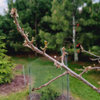
    Below is the 7 year old pruning wound on my walnut tree. At the time my neighbor recommended I put the black paint on it so I did. Not sure if I would or would not now. Probably wouldn't.

    Guess if I ever have to cut this tree down and get to survey it for rot under this open sore I'll be able to give you a better answer, at least for walnuts.

    {{gwi:393376}}

  • 17 years ago

    Toronado:

    In case you have missed the discussions I have posted about the use of liquid copper fungicide, I have posted the link to my explanation of its use below.

    The proper application of liquid copper fungicide would absolutely prevent the kind of rot that seems to have started in this pruning cut. But, sorry, once the wood has begun to soften and break down, it is too late.

    The black paint probably did no good, and perhaps, by sealing in moisture, actually hastened the advance of the wood rotting fungi and bacteria.

    Pruning cuts of the kind you picture here are in my estimation the absolute best place to use the liquid copper fungicide. In the 23 years now since I have been using it--on about 150 trees--I haven't seen one instance of wood rot or softening, or any evidence of fungal growth of any kind. And I have a few very large cuts (a foot or more across) that have still not "healed over" after more than 20 years, and the wood is still perfectly hard and fresh.

    But your tree may survive for a long, long time with the infection in this pruning cut. There is some chance it will be walled off, at least for a time. And many trees live for a long time after they have rotted through the center and become hollow.

    This cut may still close over, but that doesn't mean the rot is stopped. In my logging and log bucking, I have seen and cut through all kinds of large buried (covered over)knots. The larger ones are almost always accompanied by rot underneath. A great many of the trees I have cut I have had custom sawn by a friend on a small band mill, and had reports from him about the extent of rot in logs with various kinds of buried knots. After this kind of experience I have learned to recognise the quality of such logs and can make very good guesses about whether or not they are worth sawing.

    --Spruce

    Here is a link that might be useful: Preventing Wood Rot in Trees