Software
Houzz Logo Print
freki_gw

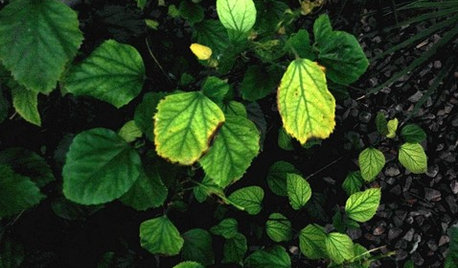
Yellow azalea leaves, not acidity problem

15 years ago

I just planted a Mandarin Lights azalea, and the new leaves came out yellow. I tested and ammended the soil before planting, the original soil was 6.5, and I added a little peat and sulphur (should end up 5.5, will test in fall). We have had a LOT of rain since I planted it, but the soil drains well.. not sharply, but well. There has been no standing water on it. It gets about 3-4 hours morning sun, then open shade.

Is it natural for brand new leaves to be yellow on the Lights series? Nothing else in the garden seems unhappy.

Comments (3)

  • 15 years ago
    last modified: 11 years ago

    New deciduous azalea leaves are pale green, but not really yellow. Uniform yellowness can be signs of low nitrogen or too much sun.

  • 15 years ago
    last modified: 11 years ago

    They are yellow with green veins. I will try shading her a bit, and some nitrogen fertilizer.

    Thanks!

  • 15 years ago
    last modified: 11 years ago

    Yellowing of a leaf between dark green veins is called chlorosis and is usually caused by an iron deficiency. Many conditions can be responsible for an iron deficiency. Poor drainage, planting too deeply, heavy soil with poor aeration, insect or fungus damage in the root zone and lack of moisture all induce chlorosis. After these conditions are eliminated as possible causes, soil testing is in order. Chlorosis can be caused by malnutrition caused by alkalinity of the soil, potassium deficiency, calcium deficiency, iron deficiency, magnesium deficiency or too much phosphorus in the soil. Iron is most readily available in acidic soils between pH 4.5-6.0. When the soil pH is above 6.5, iron may be present in adequate amounts, but is in an unusable form, due to an excessive amount of calcium carbonate. This can occur when plants are placed too close to cement foundations or walkways. Soil amendments that acidify the soil, such as iron sulfate or sulfur, are the best long term solution. For a quick but only temporary improvement in the appearance of the foliage, ferrous sulfate can be dissolved in water (1 ounce in 2 gallons of water) and sprinkled on the foliage. Some garden centers sell chelated iron, which provides the same results. Follow the label recommendations for mixing and applying chelated iron. A combination of acidification with sulfur and iron supplements such as chelated iron or iron sulfate will usually treat this problem. Chlorosis caused by magnesium deficiency is initially the same as iron, but progresses to form reddish purple blotches and marginal leaf necrosis (browning of leaf edges). Epsom salts are a good source of supplemental magnesium. Chlorosis can also be caused by nitrogen toxicity (usually caused by nitrate fertilizers) or other conditions that damage the roots such as root rot, severe cutting of the roots, root weevils or root death caused by extreme amounts of fertilizer.

    The "rhododendron tonic" is, allegedly, a good formulation for rhododendron and azalea problems indicated by chlorosis.

    Diane Pertson, Otter Point, Vancouver Island , otterpt@macn.bc.ca wrote: I have found the following foolproof formula for chlorotic leaves or a rhododendron that isn't looking healthy:

    Purchase a bag of Epsom Salts crystals (magnesium sulfate) (available here in bulk at farm-and-feed outlets), about $4.00 for a 5 lb. bag - and a bottle of FULLY Chelated Iron & Zinc (this is a very concentrated liquid - the chelation means it is in a form that can be readily absorbed by the plant), about $7.00 for 1 quart; In a one gallon watering can, put in 2 Tbsp. of Epsom Salts crystals and 2 Tbsp. of Iron and Zinc liquid - fill with warm water and stir to dissolve; Sprinkle this over the rhododendron - by that I mean drench the leaves with the solution and pour the remainder around the drip line of the root ball.

    In 1-2 weeks, the leaves should be nice and green. You could repeat the process at this time if the leaves aren't fully green.

    This works even better if, a month before, you have sweetened the soil by sprinkling a little Dolomite Lime on the roots. [Note, she lives in the Pacific Northwest where very acidic soil is not unusual. Most other areas don't have that problem. Soil under conifer trees tends to be acidic or very acidic.] Very acidic soil can prevent the roots from taking up nutrients. As many of my rhododendrons are planted in very acidic soil under a canopy of giant cedar trees, I find an application of Dolomite and a light topdressing of mushroom manure in late spring is all they need.

    If soil is too acid, the symptoms can be the same. Very acidic soil can prevent the roots from taking up nutrients. In the western USA where many rhododendrons are planted in very acidic forest soil, an application of Dolomite and a light topdressing of mushroom manure in late spring is all they need. Sprinkle the lime on in late winter, very early spring. Don't overdo it - just a light sprinkle. If it is mid-spring, get the lime on right away so the rhododendron roots will be able to take up the soil nutrients in time for new growth. If you don't have rain, water it in well.

Sponsored