Software
Houzz Logo Print
rmdial

Goldenrod Question

16 years ago

I am a beekeeper in No. Idaho and am looking to plant perenials bees will like. Goldenrod keeps coming up in my searches but I have a few quesiton:

Is this considered a noxious weed?

Are there varieties that will not spread?

Are they deer resistant?

Can I grow from seed?

Thanks in advance.

Rick Dial

Comments (14)

  • 16 years ago

    Rick,
    There are several varieties of Goldenrod.
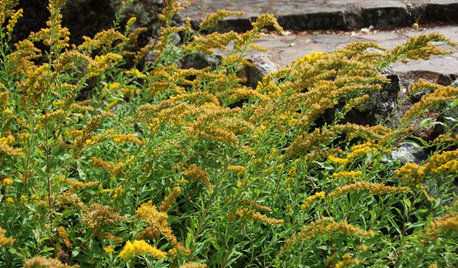
    Solidago canadensis is the kind that spreads very rapidly in rich soil. Several others do no spread as fast or not at all.

    Hybrid Solidago such as 'Crown of Rays', 'Golden Fleece' or 'Peter Pan' do not spread like canadensis.
    My other favorites are 'Firework' and 'Wichita Mountain'. 'Fireworks' does spread a bit but not as fast as canadensis. 'Wichita Mountain' reseeds. But I love this one so much I don't care if it reseeds.

    I got all of these from Bluestone Perennials.

    'Golden Fleece' has leaves much different from other Goldenrods, so don't be surprised if you receive a strange looking Goldenrod.

  • 16 years ago

    Sorry, I don't know whether they are deer resistant or not.
    But I just visited a friend's new property in WI. There are a lot of Goldenrod on the property as well as deer. So I think the deer did not eat it because all the plants were intact.

  • 16 years ago

    Goldenrod is a native and not on your state's noxious weed list. It's everywhere in my area, but so are deer, so I don't think they bother it much. It's a good medicinal plant and not a bad one to have spread(IMO), but it depends on your situation.

    Here is a link that might be useful: Idaho Noxious Weed List

  • 16 years ago

    There are at least 75 species of goldenrod (genus Solidago) that are native to North America. I would search for species that are native to your region. Some are clumping and some spread by rhizomes. Solidago canadensis is one of the most widespread and aggressive goldenrod species. They are excellent nectar plants and beloved by pollinators. I've started 3 or 4 species from seed and they are very easy to germinate and grow out. Mine have bloomed the 2nd year from seed. One of the prettiest IMO is Solidago speciosa, Showy goldenrod.

  • 16 years ago

    Rick, I'm from Eastern Washington about 20 minutes from Idaho, don't know if that makes any difference, but I second the Fireworks goldenrod. It does spread, but slowly, at least mine does. It's quite pretty and the bees love it.

    Alexis

  • 16 years ago

    consider contacting your county extension office for information ... i would find it hard to believe that they wouldnt go out of their way to help bee keepers ...

    ken

  • 16 years ago

    The true "Fireworks" is a very nice goldenrod. Unfortunately, several years ago I bought a plant labeled as "Fireworks" that turned out to be a 6-foot aggressively spreading Solidago that was not "Fireworks", and I'm still trying to eradicate it.

    Interestingly, North Dakota has a "noxious weed" list that cites "Solidago spp." I find it hard to believe that the state has no native Solidagos. Maybe they mean that even the native sort(s) can cause problems for agriculture.

  • 16 years ago

    Not to highjack the thread, but while you're talking goldenrod, can anyone tell me how to get rid of it?

  • 16 years ago

    Yank. It tends to be fairly shallow rooted, so comes up fairly easily.

    You could also try adopting a family of groundhogs. Mine ate enough goldenrod, dandelions, and clover to be useful.

    There isn't necessarily any logic to what ends up on certain lists. Some of them can get quite strange.

  • 16 years ago

    "It tends to be fairly shallow rooted, so comes up fairly easily. "

    True for some, definitely not for my particular space invader.

  • 16 years ago

    Fireworks is a cultivar of Solidago rugosa - which is a somewhat aggressive goldenrod. I've got some wild S. rugosa growing in my native gardens, and it spreads into large clumps. And it isn't 6 feet tall, even in my rich garden beds - Eric_OH sounds like you might have S. canadensis.

    Here's how I got rid of some S. canadensis - I had a weedy area along the front sidewalk that was filled with Vinca minor and Solidago canadensis - they were duking it out but they were pretty closely matched. I mowed the whole thing down real low, and then layered with double layers of cardboard/paper, and covered with 2 inches of wood chips. Gone in a few short hours! (well the roots have to die back)

    Btw, see link below for Idaho's list of noxious weeds - there aren't any Solidago spp. on it?? Sometimes a native plant is on a noxious weed list - the definition is: "A noxious weed is a plant species that has been designated by state or national agricultural authorities as a plant that is injurious to agricultural and/or horticultural crops and/or humans and livestock." I.e. milkweeds which are native to North America but toxic to livestock are considered a noxious weed in some places.

    Here is a link that might be useful: Idaho's 57 noxious weeds

  • 10 years ago

    I am a new beekeeper who also lives in Idaho. I was researching the exact same thing and found native goldenrod (solidago missouriensis) here:

    http://www.nativeseedfarm.com/details.php?sc=common_name&idx=10&id=33&category=2

  • 10 years ago

    This may be stating the obvious, but since many of these are native and local, it might not be the worst idea to take a weekly walk in an area similar to where you plan on planting and check out what's in bloom and what the bees like. Come back in a few weeks for seed and you should be in good shape in a year or two. This of course would work for all kinds of other plants as well.

  • 10 years ago

    While you are planting for your bees, try to include a wide variety of blooming plants. I'm sure you already know this, but it's important to have multiple groups of plants that can bloom throughout the warm seasons. Some plants will do better some years than others, so the wider the variety, the better. I also like to plant a few non-native annuals such as zinnias, cosmos, tithonia, Allysum, and sunflowers that will bloom most of the summer and fill in any gaps left by my perennials. How big an area are you planting? Salvias and penstemon of all sorts are easy and popular with bees. All kinds of herbs, like lavender, thyme, oregano, dill, fennel, borage, etc. are enjoyed by pollinators, and are all easy and drought tolerant.