

Falstaff Vs. William Shakespear 2000
I was wondering which rose is better in the following: Disease resistance, vigor, wet weather, heat, scent, and overall flower and bush form.
-Jason
Comments (26)
 15 years ago
Disease resistance: WS has better rust resistance. Haven't seen any PM or BS on them here.
Vigor: about the same
wet weather: about the same
heat: about the same
scent: WS2K has some. Falstaff no fragrance to this nose
overall flower form: WS2K is larger. Falstaff has a more symmetrical flower. Color is very similar, WS2K slightly darker.
bush form: probably Falstaff is a more graceful grower (fountain). WS2K has a pretty oddball growth habit. Something like one of those carnival rides where there are seats at the end of long spokes--you know those?
WS2K has one huge advantage (besides better rust resistance): it blooms far far more than Falstaff.
If you want the perfection of Falstaff's flower form, look at 'Prospero'. A smaller grower, but much better productivity than Falstaff.
 15 years ago
I have grown Falstaff in my old garden and grow William Shakespeare 2000 in my new one.
Falstaff had been a very tall upright rose for me. It got a little bit of powdery mildew and black spot but not too much (I garden organically, no-spray). I loved the big very dark blusih red perfect flowers. Fragrance was very strong. It had one flaw the repeat was really not great for me. If I had a bigger garden now I would get this rose again immediately.
William Shakespeare 2000. Flowers are a lighter bluish red then Falstaffs and not that elegant and impressive in terms of the size. They have a good fragrance, though. My rose mildewed this spring, but now seems to be over it (it is still a young own-root rose). It has been quite vigorous so far. Bush form seems to be sprawling.
If I only could choose one of these two I would go with William Shakespeare 2000, because the repeat is so much better and the rose is not as tall as Falstaff. If I wanted an absolutely stunning bloom and had a big garden I would go with Falstaff, well come to think of it, if I had a big garden I would get both ;-)!
Christina
Here is a link that might be useful: Organic Garden Dreams
Related Professionals
Owensboro Landscape Architects & Landscape Designers · California Landscape Architects & Landscape Designers · Gulfport Landscape Architects & Landscape Designers · Dubuque Landscape Architects & Landscape Designers · Brainerd Landscape Architects & Landscape Designers · Las Vegas Landscape Architects & Landscape Designers · Coeur d'Alene Landscape Architects & Landscape Designers · Missoula Landscape Architects & Landscape Designers · Lawton Landscape Contractors · Mason City Landscape Contractors · Ithaca Landscape Contractors · Oxnard Landscape Contractors · Knoxville Home Builders · Providence Home Builders · Wheeling Home Builders 15 years ago
Kstrong - Mr. Shakespeare is a total wimp here the first year. I'm still looking for a dark red rose with fragrance, hardy to zone 4-5, in partial shade. Mr. Shakespeare is deep purple, rather than red to me.
Christina, you have settled my question on Falstaff (no-way-hosay). I love visiting your Organic Garden Dream site - it's like a peaceful paradise.
You don't know how much us folks in the cold zone appreciate your pictures, esp. when it's a gloomy freezer here in the Chicago area. When I can't see my garden in the winter (buried in 1 foot of snow) - at least I can see yours. Please keep us posted, with lots of pictures.
Many thanks, Straw.
- 14 years ago
I have had Falstaff for a number of years, and absolutely love the deep purple-red fragrant blooms. It's probably the most fragrant rose in my garden and I don't grow roses without fragrance, they're just not worth the trouble! It is also the only rose that gets coddled; [black spot prone unfortunately, here in the southeast!] My other roses are all pretty disease resistant. Since I love the blooms so much, I put up with the extra care it requires, although I wouldn't plant a whole lot of them, for that reason. If I ever find a rose that is as beautiful, fragrant, with less care and more abundant repeat, I may replace it, but not until I grow it in a pot for a season, lomg enough to see and smell the blooms!
- 14 years ago
Thank you, posyplanter, for info. on Falstaff. Since there are different reports on Falstaff, I would like your help in dertemining what makes Falstaff fragrant. I'm in love with its picture, but am discouraged by the no-fragrance report. I don't mind poor-repeat since I have other perennials and annuals, and not just roses.
Just curious: Is your Falstaff own-root, Dr. Huey, or Multiflora? Is your soil acidic, neutral, or alkaline clay? What's the level of calcium and magnesium? When I dunked tons of epsom salt (magnesium sulfate) on Austins, their scent went away. My alkaline sticky clay soil is super-high in magnesium.
Thank you, Posyplanter, for any info. I'll be putting some fragrant roses in MiracleGro potting soil (pH of 6.5) versus my native soil (pH of 7.7) to see if there's a difference in fragrance.
- 14 years ago
Variations in fragrance reports are mainly owing to variations in noses, plus changes in weather.
Variations in flower size are often due to temperature. WS2K makes very large, flattish, quarter-pounder blooms in my garden.
- 14 years ago
Upon checking previous forums, someone post the question whether or not the chemical fertilizer in the pot makes the rose smell stronger than in the ground. I wonder the same. I did an experiment with my herbs garden (parsley, cilantro, sage, rosemary, and dill). They smelled great until I put chemical fertilizer on them - their scents become too strong for my liking.
In cold October I visited the rose park: Double Delight, Chrysler Imperial, and other hybrid teas lost their scent. After that I went to Home Depot, and sniffed a Pink Double-Knockout in a pot. It smelled GREAT, better than the hybrid teas at the park.
Pat Austin came in a band with a bloom - I did not like the smell, it reeked like tobacco. Once I put her into the ground, the next blooms were much more pleasant. From my herbs experiment, chemical fertilizer changed the scents and made them stronger.
- 14 years ago
In the past, I've grown falstaff for over 2 years and got rid of it because it mildew badly; the blooms were small and I couldn't detect any fragrance. I tried pruning it back and it repeat flowering really well but by doing this you will ruin it's structure if you want an upright climber. Having said all this, the blooms lasted very well in a vase about 5 days if I could remember.
- 14 years ago
I've had a bad time with William Shakespeare 2000, there's a previous thread by me somewhere on here where people are also complaining about their's. I bought/planted two from DA bareroot Jan 2010, they didn't grow much at all and then last year one of them just COMPLETELY DIED. The other is still alive, but again, hardly grows (compared to other DAs planted at the same time like James galway...)... and it gets a lot of vegetative centers. >:(
- 14 years ago
um, both of these are a bit duff for me (mildew and BS) but the fault is probably mine because I do not cosset my roses overmuch while the deep red Austins seem to need a richer soil than my own. There is stingy blooming on both (I no longer have WS but Falstaff lingers on). Not much of a loss either, since they never suited the style or position. I will say that Austins propagate really well on their own roots and this may be the way to go, at least for me, as I am somewhat disenchanted with all my Austins (I don't have many though) apart from Summer song (and that is down to the colour and a definate resistance to disease). Even favourites such as Jude and Pat have a less than stellar performance in my garden so......the jury is still out on Austins in general although it would be churlish to dismiss a whole group (will not say class) of roses based on the behaviour of a few.
- 14 years ago
In my garden I grew WS2000 grafted, probably onto Dr Huey. The flowers were gorgeous, just like the ones in the pictures above, but it exhibited that octopus form a few other David Austin roses show (Scepter'd Isle being the other one that I myself grew). Eventually I got rid of it. Before that happened, I rooted a cutting of it that I grew in a pot for several years where it behaved much better. I do not know if it was the pot or growing on its own roots that made the difference. I ended up giving that plant of WS2000 to a friend who admired it.
I never grew Falstaff.
Rosefolly
- 14 years ago
Thank you, rosefolly, for that info. I don't like the messy growth of Austins on Dr. Huey at the rose park either. I'm not keen on pruning, so I'm happy with my own-root Austins. Upon checking previous forums, someone also made the observation that Austins in the Old Rose Hybrid group are wimpy on OWN-ROOTS. Examples are William Shakespeare, Jude, Gertrude, Tea Clipper, and P.A. of Kent. These are best in an acidic pot, like MiracleGro potting soil at pH of 6.5
After sniffing the delightful fragrance of Pink Double Knock-out at Home Depo in an outdoor pot, I sniffed my neighbor's Pink Double KO in the ground, it barely had any fragrance. She used that stinky Bayer chemical fertilizer, versus whatever Home Depo pot has (Oscomolite granules?) My guess is that acidic soil does increase the scent of a rose. Andrea from UK stated that Portmeirion is too rough of a myrrh scent for her, versus raves from American folks about how great Portmeirion smells.
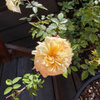
Thank you, rosecavalier, for that awsome shot of William Shakespeare. I'm going to be patient with him, and give him soluble acidic fertilizer next year.
- 14 years ago
After putting up with bad You-Tubes on roses like showing the speaker face 80%, and roses 20%. Or lengthy shot of chubby cute babies running around... I found this good and quick You-Tubes that featured some new releases of Austin. It's entitled David Austin English Rose Garden Autumn 2011.
Here is a link that might be useful: English Rose Garden Autumn 2011
- 14 years ago
Thank you michaelg, aimeekitty and campanula for taking your time to comment on William Shakespeare. And thank you rosecavalier for that wonderful photo of William Shakespeare. The blooms look bigger than Falstaff!
- 14 years ago
Wow, rosecavalier!
That pic of William Shakespeare looks positively yummy, especially in the middle of January!! Thanks for sharing it.
Strawberryhill, to be perfectly honest, I haven't tested my soil very recently, so I couldn't give you a technical analysis, however, I'll tell you what I do know......
First of all, we garden organically so I use plenty of homemade compost, [our chickens and goats help with that too!] banana peels, coffee grounds, worm castings. The roses do get organic rose fertilizer from a bag to fill in any gaps, just because I love them. We collect rainwater, so they do get watered with that during dry times. other than that, I don't coddle them, [well, except for Falstaff!] and they are all fragrant. The soil in the rose bed is rich, crawling with worms, and healthy looking, although it didn't start out that way.
I too have noticed variations in fragrance and always wondered what caused it. Perhaps your observation is correct.... I wonder whether the overall health of soil doesn't have a lot to do with it. My Falstaff has a warm, fruity fragrance that is just intoxicating, although it gets lighter in hotter temps. Some of my other roses do as well, though Dutchess de Brabant seems to be the most consistent for me. - 14 years ago
Sorry, forgot to mention, my Falstaff is a grafted rose. At the time, I wasn't able to find it own root, although I prefer them and have wondered whether I'd need to coddle an own root Falstaff as much. Sure would like to know.....
- 14 years ago
I have had Falstaff for three years now - he came as a bareroot own roots plant. He has grown very little, is very stingy with blooms and seems to be much happier and healthier here in the fall which leads me to believe that he does not like my summer heat. The reason he is still here is that the few blooms that he has given me are the sort for which a lover of red roses would do almost anything.
I am hoping that if I feed him and love him one more year - or even two - he will finally come round. A minimal performance would suffice as I have the devil's own luck with red roses.
- 14 years ago
Thank you, posyplanter and lottirose for the info. Fussy growers like Falstaff is better off grafted to get deeper-rooted in obtaining all the nutrients. I ordered 10 Austins own-root this summer, but the nursery gave me Pat Austin grafted. I'm glad, since Pat produces the biggest flower. She's the tallest and most hardy compared to my other 9 wimpy own-roots.
Someone mentioned that once she fed Romanticas with soluble fertilizer, they bloom better. That might work with Falstaff.
 14 years ago
Really love both of these 2 roses, love the poofy red blooms & the fragrance. Wouldn't be without Falstaff for the blooms, they are fantastic. I dump at least 5 gallons of water with a bit of water soluble fertilizer on all my roses, weekly. It really helps.
- 14 years ago
I originally had 3 WS 2000 roses. Ordered from the DA catalog. They started very slowly. I almost sp'd 2 of them after year two. I decided to move them instead.
The two were moved to a location where there was no root competition and they got 10 hours of sun each day. They quickly became low, wide, bushy monsters. I have to prune them 2 or 3 times per season. But, the overall plant form is great and they bloom continuously.
A little fertilizer and occasional fungicide spray keeps them happy.
{{gwi:222311}}
- 14 years ago
Thank you Harryshoe for that vital info. My William Shakespeare is next to the house since it's his best chance for winter survival in zone 5a. I'll move him into full sun when spring comes. Thank you for that full-sun tip.
- 14 years ago
Strawberryhill,
Grafted roses generally produce larger blooms the first year, whereas own roots take a little more patience. In my garden, the own roots have outperformed the grafted roses over the long haul. I believe one reason might be the freeze/thaw, freeze/thaw winters we typically have. The grafted roses usually have more dieback and end up wimpy looking in the spring. After a few years, my own roots are larger and more robust than the grafted. Kind of ironic, since northern climates are supposed to be the place to plant own roots. [I've lost more roses here in zone 7, than when I lived in zone 5, due to more wintertime temperature fluctuations.] - 14 years ago
I am growing both here near Portland, and I do not spray. Our climate is perhaps a bit more like England's, those parts of England where the soil is acidic. Falstaff definitely outperforms WS2000, though I like both. The only other rose I have with deep red blooms, very fragrant, that come close is Prince Camille de Rohan.
- 14 years ago
Hi Posyplanter: I didn't see your post until now. You are right about own-root better in the long run. Here's a quote: "Own-root tend to live longer due to not having a bud or graft union that calluses and hardens over time leaving little space on which new shoots can emerge."
I bought Heirloom Rose for $4 grafted at Walmart. Half of the rootball died, so it's one branch sticking far to the left, very lop-sided. It's a total wimp compared to my other own-roots. Heirloom nursery said the same, "Roses that are on their own roots will naturally send up shoots from the soil. Over time, this creates a much shapelier bush than a grafted rose. Add to this increased vigor and bloom, longer life expectancy, and the elimination of rootstock suckers: own-root roses clearly provide more value over time."
First year William Shakespeare 2000 was wimpy, 4 blooms, planted late summer. Second year it's very cute and compact in morning sun - with at least 10 blooms per flush. It's small like a mini-rose, but loaded. I saw pictures of Grafted WS 2000 with long octopus canes both in HMF and in forums, and I'm glad I have mine as own-root.
My 14 own-root Austins are all healthy, zero diseases here, which includes Golden Cel., which I posted its pic. taken this Oct. in the thread, "Austin or Alba for partial shade."


rosecavalier