Software
Houzz Logo Print
roserich

Cane Borers (was Cane Borders)

Help Someone?
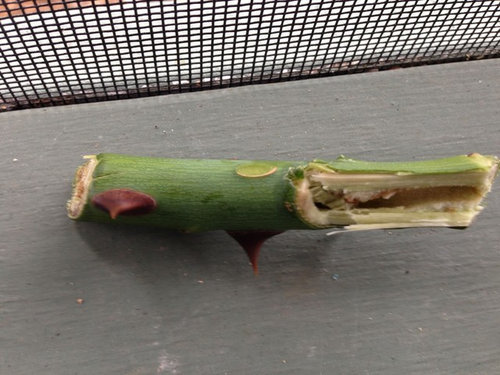
I came in today from pruning to post this same question. I have a Parade climber that is growing gangbusters. In an attempt to "train" i.e. KILL a soft cane it snapped and then I cut it back and I noticed LONG tunnels of borer type. But, like Kippy, there was growth beyond the tunnel...
I see lots of holes in the canes of my grafted roses after dieback. Do I have a borer issue?
Can anyone point me to a treatise on borers? I just wonder if that's whats causing lots of dieback for me...
Could just be my rookie pruning skills?
Susan

Comments (11)

  • 13 years ago

    Yes- you have borers.

    Although the specifics vary in different parts of the country, here is information that generally applies in the eastern parts of the US.

    There are two "borers" that attack roses.

    (1) Raspberry cane borer. The raspberry cane borer is a slender long-horned black and orange beetle measuring about 1/2 inch long. . The larva is white, round and legless and may be up to 3/4 inch. it has a two year life cycle. The adults appear about June. They puncture two rings in the rose canes, then lay an egg between the rings. These hatch in July. The larvae begins burrowing towards the base of the cane and overwinter about 2 inches below the rings. During the second year, the larvae continue to burrow downwards to ground level where they spend the next winter. They emerge as adults the following June. These insects generally prefer roses with thin, bramble-like canes but they will use other types if they have to.

    (2) Small carpenter bees: Small carpenter bees are small thin, and metallic blue-black bees. Roses are just one of the plants they use for nesting. In the spring, the adult carpenter bees tunnel in canes to provide rearing cavities for their grub-like young. As they continue to tunnel into live parts of the cane, those parts die. They prefer larger canes and freshly cut or broken ones.

    Controls: I do not recommend using insecticides to control either on your roses.

    For carpenter bees, the control is simple. The bees prefer nice, fresh cuts to tunnel in. Seal your spring pruning cuts with white glue and the bees will look elsewhere. They aren't particular and have plenty of other host plants.

    For raspberry cane borers, the control requires more vigilance. Examine your roses weekly during June and July. If you see wilting tips look for the two rings described above. Prune out the infested canes by cutting a few inches below the rings. If the larva has already gone past that, continue cutting until below the tunnel.

    I don't know of a comprehensive reference on both types, but here is a one on the small carpenter bee

    Here is a link that might be useful: Featured creatures: small carpenter bees

    This post was edited by nickl on Sat, Aug 17, 13 at 9:46

  • 13 years ago

    Thanks Nickl! I saw the oddest insect yesterday near my ramblers and I realize now it was a carpenter bee. Are these the ones who also make the perfect circles in foliage?
    Anyway, I'm going to start sealing my pruning cuts.
    Susan

  • 13 years ago

    Susan, Nicki's information is excellent but for one point. The carpenter bees don't normally "continue to tunnel." They make shallow nesting tunnels to raise their young, which they feed on pollen. Neither adults nor larvae eat the rose tissue. This is very different from the raspberry stem borer and raspberry horntail (sawflies), where the larva tunnels aggressively down the pith and destroys the cane.

    The latter type is what you show damage from. Reread Nicki's information about that, and don't fixate on the small carpenter bee. Sealing cuts will do nothing to prevent the sawfly larvae. You have to be alert and prune them out in order to break the reproductive cycle.

    About the carpenter bees, informed opinion differs. But I can tell you I stopped sealing canes twenty years ago, I have plenty of bees' nests in cane stubs, but the actual damage to my roses is negligible. Roses will make healthy blooming shoots above the nests. I prune them out in spring if I notice them. The great authority on rose pests Baldo Villegas recommends ignoring carpenter bees. So I think it's fair to say you can seal or not as you wish.

    There are also tiny beneficial wasps that drill in cut cane stubs to nest and feed their young with aphids. Their burrows are about 1/8" diameter by 1" deep.

    In the interest of fairness I'll admit that once in 35 years I found a cane ruined by carpenter bees who drilled 14" deep instead of the usual two or three inches, so it can happen.

  • 13 years ago

    hello Michael:

    The Ceratina Bee females WILL continue to tunnel into the plant to accommodate multiple rearing cells. They don't stop at just one cell. The general range is two to twelve cells, although many more than that have been observed. At a minimum size of 3 cm. per cell, twelve cells means the females will have excavated well over a foot into the plant.

    I'm not saying they will go that deep all the time on every rose they nest in, but as you have already discovered, they may certainly go more than just an inch or so down the cane.

    Please check out the article I provided and the references there.

    I'm glad that you don't see much Ceratina bee nesting where you are. Baldo lives in California where these bees are also apparently uncommon. However, Ceratina Bees are quite common around here, and they will nest in rose canes if one doesn't seal the cuts.

    To speak generally, if you don't get the bees where you are, you don't have to seal the cuts. If they are present in your area, it's a very easy preventative.

    Actually, garden roses aren't even their preferred nesting plants. They much prefer native species - roses and otherwise. So it doesn't take much to convince them to move on and look for better sites elsewhere.- just a blob of glue that disappears in a short time.

    And Susan - No these aren't leafcutter bees. In fact, they are so tiny that you might not even recognize them as bees at all. To the naked eye. they do look more like gnats They are considered beneficial pollinators, however, which is why I don't recommend insecticides.

    This post was edited by nickl on Sat, Aug 17, 13 at 13:19

  • 13 years ago

    All good info from Nicki and Michael. I'll just add that no, carpenter bees are not the ones that cut the little circles out of the leaves. Those are called leaf cutter bees and they can nest in rose canes but prefer soft rotting wood. They do not destroy the entire cane they way borers do but only excavate a few inches to build their nests.

  • 13 years ago

    Thanks, Nicki. I'm sure you are right about the multiple cells.

    I do have small carpenter bees, lots of them, drilling into my cut rose canes. It's just that they do so little significant harm to my roses that I found sealing canes not worth the trouble. Usually there is a shallow nursery chamber that does not keep the plant from making a good flowering shoot from the upper bud site next to the chamber. Often this is an area that I would prune off next spring anyway, and that's when I'll get rid of it, if I even notice.

    I'm sort of fond of the SCB. They are important native pollinators and such good parents. I have seen them drilling into small bamboo stakes, kicking out green-dyed sawdust. Sometimes after cutting some brush I will plant sticks with pithy centers in the garden and the SCB will nest in those. As Nicki says, they have no particular preference for rose stems.

    The typical small carpenter bee looks exactly like a winged black ant, maybe 1/4". See the link.

    Susan, on rereading your post, I might have been wrong to say you are describing an attack by the rose stem sawfly larva. But if you find a good sized worm, white with a black head, that's him. These tunnels start near the tip of a cane and can run down six feet.

    Here is a link that might be useful: bee pic

  • 13 years ago

    I had them back in my old zone. They could really injure a young plant that didn't have canes to spare.

    Although I didn't spray, a couple of times I did mix up a few drops of poison, fill up a syringe with it, & shoot it down the hole. I always sealed cuts with glue but not sure if that helps. After I killed a grub in a cane I would seal up the cavity with glue. Killing the grub & sealing the cavity often preserved the cane. Some of those grubs would work down several inches to the graft.

  • 13 years ago

    Ok you all. I am appreciative of your knowledge. I'm more confused than ever! LOL
    This was a thick cane of Parade that I was attempting to wind around a trellis. The cane bent. I snipped off likely 18" of the cane above the bend. Above the bend (and below) was very healthy, putting on new growth...a happy critter.
    When I go around to my Huey grafted roses I see lots of borer holes in the dead stems and yesterday I saw some kind of electric blue fly type insect near my climbers...
    I'm wondering what, if anything, I need to do for Parade because she is growing like nuts, thriving and blooming and I want to keep her that way.
    Thanks you all.
    Susan

  • 13 years ago

    When I find a deeply hollowed cane, usually from a stem sawfly larva, I snip up and down and split the sections to track the critter's progress and discover him.

    If there is an external hole connected with the tunnel and the tunnel is a few inches long, it is a carpenter bee nesting chamber. If it is active, there are small white larvae that are not eating the rose plant. The rose will continue to grow and bloom off this cane. If you want to reduce the frequency of these, you can seal every pruning cut of stems around pencil thick and thicker. But these bees are not a big deal. They are in every rose garden in Tennessee and most places. Believe me, no one is sealing the canes of the KOs you see blooming heavily all over town.

    If the cane goes blind, tip wilts, girdling cuts are visible below the top leaf, cane is hollowed for feet or yards, then it is a raspberry stem sawfly, which can be a very destructive pest.

    Susan, by your account, 'Parade' is doing great and the cane was functioning until you broke it. I don't think you should be alarmed. Seal the pruning cuts if you want to.

  • 13 years ago

    I was just looking at a planting of 'Bonica' that for some reason had been pruned severely around July 1 and is just coming into bloom. Virtually every cut stem--dozens of them-- had been drilled by the tiny twig-nesting predatory wasps, but new shoots are growing out normally. These wasps make smaller holes than the small carpenter bees, 1/8" diameter or usually less, very cleanly cut. Like the SCB, they are making nursery chambers for the young. They feed the young with aphids or other tiny insects.

    The SCB are probably not excavating this time of year. In fall, they make small chambers to hibernate in. They make the nesting chambers around mid-spring. Young of the year emerge at midsummer.

  • 13 years ago

    Ok great! Thanks Michael, I really appreciate your help.
    Susan