Software
Houzz Logo Print
phyl345

amur maples for screening?

19 years ago

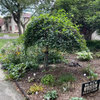
i want to plant amur maples to screen out (a little bit) street traffic ... i have 2 in my back yard that are about 5 ft. apart ... could i plant the new ones (in front yard) even closer?

any suggestions for something else (besides the amur) would be appreciated ... thanks so much, phyl

Comments (18)

  • 19 years ago

    why not something evergreen? amur maples will lose leaves in the fall and won't grow new leaves till spring.

  • 19 years ago

    thanks lou, evergreens would seem the logical solution ... however ... i don't want something as *dense* as evergreens ...

  • 19 years ago

    Keep in mind that there are two types of evergreens: needle type evergreens and broadleaf evergreens.

    There is also the concept of a mixed planting so you could have some evergreens and some deciduous plants.

  • 19 years ago

    The branching on Acer tataricum (or ginnala, whichever) is pretty dense, very twiggy. In time, it'll make a decent all-year screen. Tends to be a bit invasive in some locations however.

    Scott

  • 19 years ago

    esh ... i am not familiar with any evergreens that aren't the *needle-type* that will stay green in our chicago winters (???)

    scott, the 2 amurs i have in the back yard are, just as you say, very twiggy & actually *do* provide a fairly decent screening effect ... i seem to recall reading in a book about using amurs for screening, that they could be planted *really* close together cuz they can be pruned a great deal ... wish i remembered what book, cuz it *seems* like it said they could be planted as close as 2 &1/2 ft. apart ... does that sound possible???? thanks, phyl

  • 19 years ago

    Phyl, I don't really know about Chicago winters, but what about hollies?

  • 19 years ago

    Broadleaf evergreens are iffy in windy zone 5.

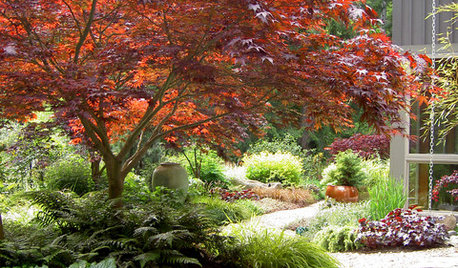
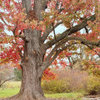
    The idea of a mixed planting of some smaller, needled evergreens is a good one. One of the most beautiful plantings is mix of white and balsam firs with bright maples. Amur just glows in the fall. Another bonus are amur maple's flowers. Most people don't know they are fragrant. For a week, a wonderful scent hangs about these trees.

    Amur maple makes a good screen, but be careful of the selection. The plain old species turns into a small tree and over time it will open up at the bottom. There are dwarf types that stay twiggy at the base aand will be a better top-to-bottom screen.

    And one other caution: Amur maples are efficient reseeders. You will be pulling seedlings from your garden if these maples are nearby. If you have any woods, please keep amur maple away; they will spread into those places and displace the native woody plants therein.

  • 19 years ago

    I grow acer campestre. I have not trained them into a hedge, but given they are also called English Hedge Maple, assume they can be. I'm also of the camp that a mixed hedge, not necessarily planted in a military line can be very natural and effective, giving a much softer and natural impression. That's given you have the room to do it.

  • 19 years ago

    "I grow acer campestre. I have not trained them into a hedge, but given they are also called "

    Field Maple, actually. "Hedge maple" is an error.

    Resin

  • 19 years ago

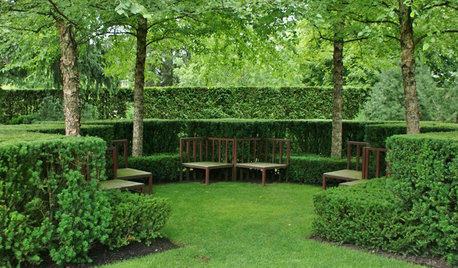
    Don't mess with those invasive plants. Look into european hornbeam. It's a deciduous tree that can be hedged and even with no leaves the dense branching offers some privacy. Sorry, no showy flowers and the fall color isn't to die for but they are very desirable none the less.

    Another suggestion would be hemlock which you can use in your mixed planting. And you shouldn't have any trouble finding dwarf pines to use there are a million of them out there.

  • 19 years ago

    esh ... so far i *have* purchased 4 hollies ... 2 are goners; 1 is still *hanging* on, & 1 looks pretty good ... hollies aren't crazy about our brutal winters!

    i do have a canadian hemlock near where i want this *screening* to go (trying to make a bit of a *garden room* in my front yard) ... the area also will encompass a birch & some yews ... still wondering how close i could plant the amurs???? ...

    i really appreciate all the suggestions so far ... thanks ... phyl

  • 19 years ago

    You can space the maples as close together as you want. They will grow. However, for screening purposes, you probably reach a point of diminishing returns. The closer they are together, the more they'll compete with each other, and also grow strangely. I would think than anything closer than 4' apart is wasteful, and probably anything less than 6' together is unnecessary.

    All that said, I really like the suggestion of the column form of hornbeam. These make great screens and I've never even seen one set fruit, let alone spread invasively. And they'll grow anywhere that Acer ginnala will. If the site is perpetually damp, however, skip either Acer ginnala and Carpinus betula and go right to river birch, which is also a dense, twiggy and a decent deciduous screener.

    Oh, and regarding Acer ginnala, fall color is highly variable on this one. Many seedlings fail to show any decent fall color. Therefore, it is far better to seek out proven cultivars such as "Flame," which will produce known results.

    Scott

  • 19 years ago

    Resin, how can any "common" name in typical use be an error? I'm aware Acer Campestre is commonly (and correctly) called a field maple in the U.K., but the more common term for it in the States is hedge maple. One is more likely to get clerks in nurseries to cough up what they want if they use the name common in their own area.

  • 19 years ago

    Hi Calliope,

    Because it's an example of unacceptable cultural imperialism to re-name other peoples' native plants for them. Fine if you want to call it something else "between consenting adults in private", but using it public in an international forum is in effect, ordering the natives to change over to using the foreign re-naming.

    Resin

  • 19 years ago

    No, would never suggest you do such a thing....I was practically raised outside the United States and am also sensitive to what we have done to the English language. But, if that is cultural imperialism, then I demand you start referring to zucchini as such and not courgettes, OK? They are native to the Americas and we call them zucchini. At least you could have given it a more Anglo moniker and not stolen, I mean borrowed the vernacular from the French, like we did from the Italians. LOL.

  • 19 years ago

    It's only cultural imperialiasm if you accept it that way. I doubt anyone here aims for cultural dominance via renaming trees.

    Germans call it 'Feldahorn,' Poles 'klon polny' and Italians 'Acero campestre.' it seems the Romantics are the least guilty of us all. 'Campestre' means 'rustic' or 'rural.' 'Field; is a bit of a stretch, yes? Perhaps those Germanic Saxons preferred 'Feld.'

    Local dialect and culture always divert words. That's how language evolves. And that's why we use a dead language, Latin, to correctly identify a species.

    Nyssa sylvatica, a North American native, is called Tupleo, Sour Gum, Black Gum and Pepperidge here in the US. It varies by region. Who is guilty of 'cultural imperialism?

  • 19 years ago

    sooooooo ... that's a *yes* on the 2 1/2ft. apart then??? (GRIN) ... phyl

  • 19 years ago

    I am laughing out loud. I'd say that's pretty close, Phyl. This forum is sometimes noted for chain pulling, with tongue planted firmly in cheek. At least I assume Pine was as well, because to me it's Acer Campestre and I really couldn't care much less what anyone else calls it as long as they can demonstrate somehow it's the plant they are referring to. He/she gets teased occasionally and I hope good-naturedly for using Britspeak, with which I am just fine, since my daughter married one and I worked for one, and I hear it on a daily basis. Both of them murder our local names, most of which are Amerindian, and I'd never think or thought of accusing either of trying to culturally revert us back to proper speech. Then again, I live in Appalachia and many Americans don't understand us, either.