Software
Houzz Logo Print
acer_gw

How does a tree trunk DO this? See photo...

14 years ago
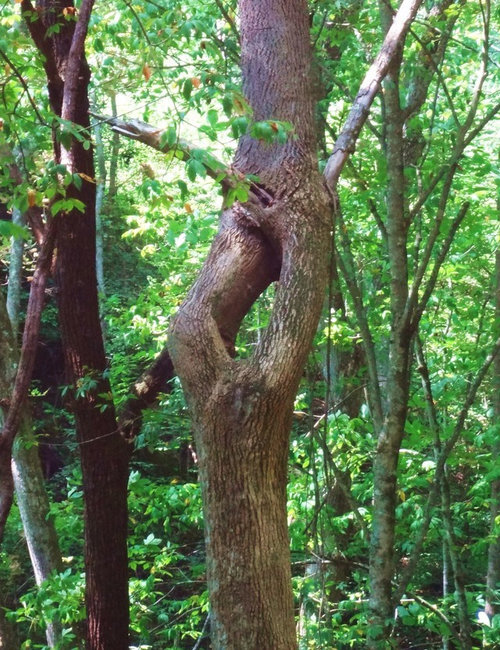
This is growing wild near my house. I think it's a tulip poplar (Liriodendron tulipifera). I'd like to have something like this in my yard for a conversation piece - well away from the house and with nothing valuable underneath, of course.

Comments (18)

  • 14 years ago

    Wow nice lol... I wonder if at some point when it was young the top broke off leaving a split down the center. From there it just grew larger?

  • 14 years ago

    I forgot to add something: Other than the two dead branches you see, the tree is alive and well, and probably at least 80 feet tall. This feature is about 40 feet up.

  • 14 years ago

    Yeah, that's cool. Maybe as ricksample offers.....I don;t know. But it's cool!

    +oM

  • 14 years ago

    That's interesting for sure.

  • 14 years ago

    The term is bridge graft. Ain't the adaptability of nature grand?

  • 14 years ago

    Can't say exactly how it happened, but could have been an adjacent branch/trunk from a tree against the tuliptree trunk. The tuliptree could have grown around the offending branch, and eventually that offending branch/trunk died, rotted & fell away.

    Then again it could have been something else....

  • 14 years ago

    My neighbor has a sugar maple with two odd interior crossing branches. They are rigid enough one has and the other is beginning to do something similar.

    It is neat and a conversation piece. Your find in the woods is considerably more visible.

  • 14 years ago

    welcome to the weirder the better club.. i am the founding memeber in the conifer forum .. who needs everything to look like a perfect xmas tree shape

    most of my oaks are 12 years old.. from 1.5 inch transplants ... over the ensuing winters.. we have have many an ice storm.. and i have seen flopping limbs.. only to make it out the a few days later... after the ice is gone.. to wonder how they all snapped back to position ...

    then.. come years later.. i go to lift the canopy ... and find bizarre wounds.. where.. as the limb extended.. and gained weight.. it caused the wound to open and sag ...

    people often think.. that if the bark 'heals'.. that the tree is healed.. but one thing for sure.. the crack in the old dead interior wood.. will NEVER mend together ...

    so if i simply had to give you a WAG .... a decade or two ago.. ice or severe wind storm.. broke the tree ... and the tree just took care of business ...

    also. historically ... and i am blanking on the term.. settlers and bandits.. after the civil war.. marked trails.. by injuring trees.. the hoot owl trail .... i doubt that tree is old enough..but its a cool history tidbit ...

    also.. if we could perhaps guess an age range.. e.g. we might find that some hurricane or tornado rolled thru there 30 odd years ago.. when your tree was a babe ... who knows ... i am thinking odds are high we can rule out an ice storm in carolina ...

    thanks for sharing ...

    BTw.. anyone have a link to that guy who did this purposely.. he 'made' all kinds of forms and shapes.. but i must have damaged that brain cell ... just a vague recollection ...

    ken

    Here is a link that might be useful: flip to the IMAGES for a couple examples

  • 14 years ago

    I can hear the circus music playing in my head.

    Here is a link that might be useful: Tree Circus

  • 14 years ago

    I like beng's idea. What I take from it is that maybe those two dead branches aren't from the tuliptree at all, but somehow "captured" from an adjoining tree? I looked into bridge grafting (as suggested by strobiculate), and perhaps a smaller tuliptree fell against this one after it was damaged, leading to this...? I love science. I also wish I could go back in time (temporarily) about 20 years to look at this same tree. Ricksample's idea is good too.

  • 14 years ago

    at this link .. kinda funny ... its is a humor site ... got me the guys name

    http://www.saynotocrack.com/index.php/2007/02/22/how-to-embarrass-trees/

    it says:

    "In the 1920â²s, a farmer in Hillmar CA began humilating some sycamores on his property. Axel Erlandson continued his mad arborist experiments for 40 years. 75 trees later, God nailed him for being a wise guy."

    more general link below ...

    ken

    Here is a link that might be useful: link

  • 14 years ago

    Hey Ken,
    My last post crossed yours in cyberspace. We do get ice storms here in the Carolinas, and I'm in the mountains anyway. So, yes -such damage is a possibility.

  • 14 years ago

    I can hear the circus music playing in my head.

    Here is a link that might be useful: Tree Circus

  • 14 years ago

    I can hear the circus music playing in my head.

    Here is a link that might be useful: Tree Circus

  • 14 years ago

    I can hear the circus music playing in my head.

    Here is a link that might be useful: Tree Circus

  • 14 years ago

    I can hear the circus music playing in my head.

    Here is a link that might be useful: Tree Circus

  • 14 years ago

    Love the pic, what a neat tree!

  • 14 years ago

    Ken, this 'tree circus' is the result of a steady grafting hand using basically two techniques; pleaching and bridge grafting. Also, close observation indicates a seldom mentioned method, not used on conifers, which I learned about several years ago and have been practicing. Very useful for the bonsai addict who wants to add a branch onto a bare space in a tree trunk. Give this a try on a young sapling...

    In the very early spring (important) using an exacto knife quickly make/pound one vertical slice through the sapling's trunk and out the other side. Do not withdraw the knife. Instead, find another young, supple branch on the same tree that you can bend around and insert its tip end bud through the cut forming a new branch about 1" long. Remove knife carefully. Leave all in place until you are certain the graft has taken and the new branch is growing. Then, using sharp shears, cut the 'donor branch' cleanly next to the trunk which frees it to continue growing as before and the new branch continues normal development. A good way to practice this graft is on a shrub, making a cut in a branch, inserting the tip end bud of another branch which is still attached to the mother shrub through the cut, waiting for the graft to heal and then separating the two. Hope you can follow my explanation as interesting tree shapes can be developed with this grafting technique.