Software
Houzz Logo Print
cemeteryrose

Bengal Fire

18 years ago

I ran across a posting where Sanguinea/Bengal Fire was being used synonymously. I know that Sanguinea/Bengal Crimson are synonyms, but I'm not so sure that Bengal Fire is the same rose. A few of us are growing BF, which came via the Huntington from Heronswood, who got it from England.

Roger Phillip's picture of Sanguinea/BC in his book "Roses" shows a white stripe and a bit of white at the center. We've only been growing BF for a couple of years, but have never seen a stripe.

BF is nearly thornless. I don't know that is so unusual, since Redoute has a single red china under 'Rosa Indica,' or China Rose, which is described as "branches nearly always unarmed." The pistil on his rose is green - it's red on my Bengal Fire.

If anyone knows more about these roses, and any of the other single red Chinas, I'd be very interested. Jeri and I have a dream of growing every cultivar that we can find in a row, and seeing what they do. In the meantime, I'm fussing over my little pot of Bengal Fire, and trying to get cuttings rooted for next spring's Open Garden at the Sacramento cemetery.

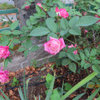
I'm posting some photos - the bright red pix are from this summer, with newly opened flowers - the darker red are this fall, showing older flowers, autumn tones, and some blueness from the light.

Anita

Here is a link that might be useful: Bengal Fire Pix

Comments (19)

  • 18 years ago

    Maurizio, your Sanguinea certainly looks like my Bengal Fire - except in size! It has the red pistil, it appears. What about prickles? Is it nearly smooth, except for some scattered prickles on the older canes?

    Looks like we'd better clear a big space for this rose! It looks as vigorous as Mutabilis.
    Anita

  • 18 years ago

    Maurizio -- Your Sanguinea also looks very much like my "Single Red China," which Rozanna got from Chamblees.
    It's clear that yes -- my SRC will be something in the mold of Mutabilis.
    It's also disease-free here, and a continuous-bloomer.

    There's just one difference.
    Rozanna tells me that once fairly mature, "Single Red China" can throw off a random cane that blooms in pink or white.

    (I am also very anxious to compare these roses to the "Castro-Breen Single Red China," which we collected [with permission] in the San Juan Bautista State Historic Park.)

    Jeri

  • 18 years ago

    That looks like the 'Bengal Fire' here, too. I'll agree that there is a similarity in vigor to 'Mutabilis' (other than single flowers, the similarities end there) - one particularly exciting difference is that the disease resistance of 'Bengal Fire' seems to be 100%, which 'Mutabilis' cannot quite claim even on the very best site. The one here is completely thornless, even on older/larger canes.

    All you need to do is feed and water this thing and it will grow by leaps and bounds - in huge, burgundy candelabras. The new shoot material is so fat and at such angles that sometimes it almost looks as if it might just snap off before it has a chance to harden, though it never does. I'd say it grows more like an extremely vigorous tea than your typical red China. I hadn't considered anything like 10' before morrisnoor's picture, but now I'm pretty sure I will have to plan for that. This is a tough rose - bomb-proof, even. Its foliage is almost artificial looking (it's matte, and seductively grey-green), it's that good.

  • 18 years ago

    Stefan, you had recommenced 'Bengal Fire' to me in my china thread- where did you purchase yours? I really don't care if it's Sanguinea or not, I love the watermelon red and would like to know where it is available if I decide to purchase it next year. It seem really really special.

  • 18 years ago

    One sure source for this plant is Niche Gardens - I believe it originally came via Heronswood, but I doubt it's still being sold there after the whole Burpee takeover debacle.

  • 18 years ago

    No, it's not. But I did get one piece of information on that.
    The Heronswood people obtained it from "a man" in England, but they had no idea of its provenance further back than that.

    I did find a list indicating that Bengal Fire was in the inventory of the Huntington Botanical Gardens in 2005, and I think I will ask Clair about it.

    Jeri

  • 18 years ago

    So either way Sanguinea or Bengal Fire, you'll receive a rose that resembles morrisnoor's pictures- that's all I care about. That red is beautiful.

    Therefore; are there any differences that we can find, or have we decided that they are probably one in the same?

  • 18 years ago

    Yes, Anita, 'Sanguinea' have very few -big- prickles on older canes. When the plant is mature, it's almost thornless. I think 'Sanguinea' it's a very different plant from 'Mutabilis', in many ways. In my opinion, the overall impression of the plant, shows much more a gigantea than a chinensis influence. The buds, so elongated and pointed, the floppy young foliage with yellow-bronze (not purple) undertones, the flowers whit reversed petals, and especially the hips, that are big, rounded, with persistent sepals. The plant can be easily trained as a climber, up to 6 meters high. 'Mutabilis' is much more similar to Rosa chinensis 'Spontanea' in all flowers, foliage, stems, hips, and it's a compact, thinier grower than 'Sanguinea'.

    Maybe 'Sanguinea'-'Bengal Crimson'-'Miss Lowe' are all related to Rosa gigantea f. erubescens, described by Rehder and Wilson as a shrub form of R. gigantea, with pink-red flowers, growing in Yunnan near Dahli and Lijang?
    I would like to read other people impressions on that, it would be an interesting thread to discuss.

    Ciao!
    Maurizio

  • 18 years ago

    Hmm. 'Bengal Fire' definitely has a very purple-red new growth and so far, I would have sworn that it is completely sterile regarding the formation of hips - there have been absolutely none, in contrast to 'Mutabilis' which sets plenty here. I also haven't noticed a white reverse on the petals. Otherwise, from the pictures, you would swear they were the same rose.

    I fully consider 'Mutabilis' a variety of tea rose, rather than a China, as many people have done (only as a matter of habit, I think). Its botanical features are clearly those of Rosa x odorata.

  • 18 years ago

    Sorry Stefan, my poor english... :o/ "flowers with reversed* petals" I hope this is correct. No white at all!

  • 18 years ago

    What I really want to do is to grow "Bengal Fire" and "Single Red China" side-by-side -- to see if they are one and the same.

    It's quite possible of course, that they are similar, but not identical.

    Jeri

  • 18 years ago

    Hi, Maurizio,

    Once again you have given us a wonderful picture of the Asian-derived roses that excel in our Mediterranean climate. Thank you so much.

    I quote Rehder and Wilson's description of Rosa odorata var. gigantea f. erubescens from Plantae Wilsonianae, p. 339 which we now have available to download courtesy of the Missouri Botanical Garden at botanicus.org:

    "Rosa odorata var. gigantea f. erubescens Rehder & Wilson, n. comb.
    Rosa gigantea f. erubescens Focke
    Yunnan: Lichiang valley, alt. 2500 m., May 1906, G. Forrest (No. 2049); Tali valley, alt. 2000-2400 m., May 1906, G. Forrest (No. 4452).
    This form differs from [Rosa odorata var. gigantea] in its pale pink often somewhat smaller flowers."

    I haven't read Focke's description, but Rehder and Wilson describe the color as pale pink, nothing reddish. I'll check a later Rehder description in Bailey's to see if he shifted to a darker memory of the rose.

    But you point out what I think is the importance of this form of Gigantea: its smaller, shrubbier size at the extreme northern range of the species. This is nicely summarized in Bean's Trees and Shrubs Hardy In The British Isles:

    "R. gigantea, in its typical state, extends into the southern parts of the Chinese province of Yunnan. But of greater interest are the forms collected by Forrest in central and norther-western Yunnan, which are of smaller stature than R. gigantea of Burma, even shrubs no more than 5 ft high, with fragrant flowers in shades of pale yellow or rose....It is perhaps these Yunnan forms, which Forrest found both wild and cultivated, that gave rise to the tea-scented roses of Chinese gardens...."

    This helps explain why so many of our Tea roses bear so many Gigantea characters, from drooping, mahogany colored foliage to evergreen foliage.

    Sorry for the diversion. I agree that Bengal Fire resembles Sanguinea, something unique in the blooms that reminds me of Dali's Persistence of Memory and those long, narrow, extremely graceful buds that are unmistakable.

  • 18 years ago

    The GRIN taxonomy database also notes that in addition to having smaller, pale pink flowers, R. odorata var. gigantea f. erubescens (Rehder & Wilson were responsible for moving gigantea into odorata, which makes me cringe a little) is supposed to have double flowers. I think that lumping gigantea as a subspecies of a supposed species "odorata" might have been premature - I'd really like to see the genetic analysis of this group before buying into this idea; I have a feeling that some of the botanical varieties and formas they found were really anthropogenic and possibly hybrids, and that they may have had the records all backwards and otherwise catywumpus. It's obvious that botanists of yore were not so good at assessing double-flowered and sterile forms of plants as mere horticultural selections (or they were in such a mad rush to name them that they stopped caring about the implications), or there would not have been species named based on type specimens like the all-sterile versions of Viburnum plicatum and macrocephalum, or the double-flowered form of Rosa roxburghii, which have forever onward had unhappy-sounding Latin names to differentiate their fertile, simpler-flowered forms that were discovered after the fact.

  • 18 years ago

    Forgive me, I'm getting my sources all mixed up (blame it on the wine); let's try listing the names exactly as they were, from the correct sources. There has been one more interesting change that slipped by me somehow - Chinese botanists took the f. erubescens out of var. gigantea and threw it in under odorata. The issue of odorata being variously considered a hybrid and a species is confusing in the extreme, I haven't figured out where the problem actually is or which one is actually more correct (taxonomically correct, not necessarily genetically correct).

    Rosa odorata (Andrews) Sweet var. gigantea (Crépin) Rehder & E. H. Wilson
    - Flora of China

    Rosa Ãodorata (Andrews) Sweet nothovar. gigantea (Collett ex Crép.) Rehder & E. H. Wilson - GRIN

    Rosa odorata (Andrews) Sweet var. erubescens (Focke) T. T. Yu & T. C. Ku - Flora of China

  • 18 years ago

    I continue to fixate on Redoute's painting of a single red China (or whatever it is), simply labeled Rosa Indica, or Rosier des Indes. I found this website discussing China roses in general, including this rose. It says that Krussman believes that Redoute's rose is R. chinensis 'Sanguinea,' also known as 'Bengal Crimson.' Other than the green pistil in Redoute's rose, unlike the red one in 'Bengal Fire,' they certainly look alike. Any thoughts on Redoute's rose?
    Anita

    Here is a link that might be useful: China Roses

  • 18 years ago

    What Redoute has painted as Rosa indica (Rosier des Indes), the single-flowered red China, is certainly not the same rose we are talking about here; the foliage is all wrong. It is much too delicate and China-like to be 'Bengale Fire' (or whatever other name it might have). On a slight side note, the Rosa indica (La Bengale bichonne) is the spitting image of my 'White Pearl in Red Dragon's Mouth'; I understand that Graham Thomas stated that this plate might well depict the real 'Slater's Crimson'; has anyone yet uttered suggestive whispers that these two roses might be identical?

  • 18 years ago

    Yup, Stefan, I'm behind on the wine but I'll join you on the whine about Rosa gigantea.

    No one wants to ignore the impact of Rehder and Wilson and Flora of China, but I don't think their taxonomy has universally supplanted Crépin. China needs to start sequencing these species.

    Good catch on the new combination for erubescens and double blooms. I'll scrounge around for a real live photo.

  • 18 years ago

    Rosa indica (La Bengale bichonne) is the spitting image of my 'White Pearl in Red Dragon's Mouth'; Graham Thomas stated that this plate might well depict the real 'Slater's Crimson'; has anyone yet uttered suggestive whispers that these two roses might be identical?

    *** Stefan -- Yes. I have seen this suggested -- but I have never seen a conclusion.
    Another connection I have seen suggested is our White Pearl In Red Dragon's Mouth (Chi Long Han Zhu) and "Otahite."

    Anita, do you recall Barb's story of meeting the Chinese lady who, touring the cemetery, recognized "White Pearl In Red Dragon's Mouth" from home, and told her the legend about the red dragon?

    Jeri