My builder uses Houzz Pro to plan the timeline and give detailed estimates and daily updates with photos of progress, and provide invoices at pre-agreed key points in the build. This made the whole experience much more efficient and stress-free.
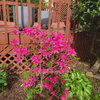
I haven't seen this before, but it looks like it could be the result of a gall. Some insects inject a chemical into the plant that causes it to form a natural pod around the eggs the insect lays. If the insect layed the eggs in a bud, it could cause this type of growth. The insect is the Rhododendron Gall Midge, Clinodiplosis rhododendri. Clinodiplosis rhododendri usually over-winters in the soil as a prepupa. Pupation occurs in spring, with the adult midge emerging just as the hosts begin vegetative growth. There may be two additional generations yearly corresponding with flushes of rhododendron growth. Eggs are laid in clusters on the undersurfaces of leaves that are emerging from buds. Larval feeding causes a downward and inward rolling of leaf margins. Larvae mature in about seven days, drop to the ground, burrow in and make a cocoon.
There is also a fungus that can cause this. Exobasidium Leaf and Flower Gall, Exobasidium vaccinii: Exobasidium vaccinii is a very common fungal disease in the spring during wet, humid, cooler weather on azaleas and occasionally on rhododendrons. Some of the native rhododendron species (azaleas) are more susceptible than hybrid rhododendrons. In April and May leaves and buds of infected plants develop distorted growth. The fungus invades expanding leaf and flower buds causing these tissues to swell and become fleshy, bladder-like galls. Initially, the galls are pale green to pinkish. Eventually, they become covered with a whitish mold-like growth. Fungal spores are produced within the white growth and are spread by water-splashing or wind to other expanding leaf or flower buds, or they adhere to newly formed buds, over-winter, and infect these buds the following spring. Older leaves and flowers are immune to infection. As the galls age, they turn brown and hard. The disease does not cause significant damage to affected plants. It just looks unsightly. If only a few plants are affected, pick and destroy galls.
Fasciation (also: cresting) can be caused by a mutation in the meristematic cells, bacterial infection, mite or insect attack, or chemical or mechanical damage.
It is a condition of plant growth in which the apical meristem, normally concentrated around a single point, producing approximately cylindrical tissue, becomes elongated perpendicularly to the direction of growth, producing flattened, ribbon-like, crested, or elaborately contorted tissue. The phenomenon may occur in the stem, root, or flower head.


rhodyman
jean001
Related Professionals
Saint Joseph Landscape Architects & Landscape Designers · Memphis Landscape Architects & Landscape Designers · Mansfield Landscape Architects & Landscape Designers · Durango Landscape Architects & Landscape Designers · Amherstburg Landscape Architects & Landscape Designers · Zanesville Landscape Contractors · Charleston Landscape Contractors · La Crosse Landscape Contractors · Santa Fe Landscape Contractors · Hannibal Home Additions · Lynchburg Home Additions · Chicago Home Additions · Saint Marys Home Additions · Brattleboro Home Additions · Gillette Home Additionsbotann
monkeytreeboy15Original Author
rhodyman
botann
monkeytreeboy15Original Author
botann