Software
Houzz Logo Print
bob740

March blooms at the BBG

19 years ago

Hi all,here are some hints of Spring (for us northerners).Seems that the longer daylight days are triggering more plants to blossom. Enjoy.

Bob

Guzmania hybrid group

{{gwi:454345}}

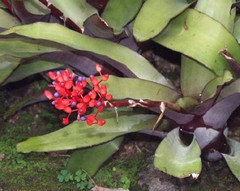
Aechmea fulgens discolor,/berries turning blue as they ripen

{{gwi:454346}}

Cryptanthus 'Elaine' /about two foot wide

{{gwi:454347}}

Vr.'Bananas'

{{gwi:454348}}

Guz.hybrid and two Vrieseas,poelmanii,and'Mariae'

{{gwi:454349}}

Quesnelia liboniana /in early bud

{{gwi:454350}}

Guz. 'Torch'

{{gwi:454351}}

Ae.chantinii 'Black' /aging infl.

{{gwi:454352}}

Vr.glutinosa

{{gwi:454353}}

Till. tectorum / two new pups on the lower right

{{gwi:454354}}

Another Vr.'Bananas' pic

{{gwi:454355}}

Till. assortment made up for sale at the Gift Shop (good job Terri)

{{gwi:454356}}

Some Cactii in bloom...this one should be named 'Bananas'too.(could not resist the pic here)

{{gwi:454357}}

And this one also...a Century plant putting its bloom scape 'thru the roof'! (glass was removed,and a slit rubber filler was put in its place. Some times Mother Nature needs a little help) ;)

{{gwi:454358}}

Comments (17)

  • 19 years ago

    We had a century plant bloom here at the Cleveland City greenhouse last year, you are in for a treat! Here is a link to a thread I did on another forum.

    Here is a link that might be useful: Blooming Century Plant

  • 19 years ago

    Bambi...that link is to a members only site

  • 19 years ago

    Hey Bob, your 2nd photo? Looks like a Billbergia 'Bananas'. Mmmmmmm. Interesting bi-generic hybrid. ;-)

  • 19 years ago

    bambi, thanks for the link for the Century plant.Looks like the two are about the same age. Not your average 'house plant',for sure.

    Gonzer..good idea! what a show stopper that hybrid would be. did you do a double take when you first saw the pic?

  • 19 years ago

    HDD,
    You should be able to look at it, you won't be able to post. It looks like Bob got in.


    Bob,
    It is impressive, I was later given a seed pod, which has 5 seeds in it, I'll be starting them soon.

    John

  • 19 years ago

    I couldn't access your link either, bambi.

    Bob, I thought we decided that the second one was 'Burning Bush', or did I just imagine that whole conversation? You might check and see if there's any viable seeds in those berries. Usually they don't turn blue unless there is. Also, isn't the next one Crypt. 'Nivea'?

    What's the little blooming Tillandsia? Looks like an ionantha, but with unusual coloration. I like the xVriesbergia too! ;-)

  • 19 years ago

    Not exactly the same 'fulgens' discussion we had Lisa.The second pic above is definetly Ae. fulgens discolor.(I got it from Tropiflora,raised a bunch of pups from it,and donated some to the bbg,and thats one of them).The previous pic posted, and that you recall, was called 'fulgens'by me,and you rightly corrected as
    'fulgens x ramosa',or 'Burning Bush'.[That pic is shown below.]

    That little Til.is an ionantha,but I don't know the name.
    ID tags were tossed before I got to take pictures.
    But it could be 'Rosita' or rubra,or Guatemalan form. Gonzer posted 18 pics of Tils on Mar.18th ,and you might find an id there.

    And that crypt might be 'Nivea'...I'll check the tag next visit. But I kind of recall it being 'Elaine'.
    Looking at both on fcbs,what is the difference in them ?
    I'm not seeing it.

    The 'Burning Bush'photo
    {{gwi:454359}}

  • 19 years ago

    Okay, I guess that was a different conversation, Bob, but I still say the one in your pic is a hybrid. Ae. fulgens discolor is a smaller plant. The inflorescence is only about 6" long (not counting the stem), is not as heavily branched, and the berries are red, not white. The underside of the leaf is violet with a white powdery coating. Are you sure that fulgens discolor wasn't just the first name on the tag, followed by an "x"?

    Here is a link that might be useful:

  • 19 years ago

    As far as the difference between Nivea and Elaine, the first is C. zonatus and the second is C. fosterianus, so Nivea has a thinner leaf, a flatter rosette, and the coloration is black to dark green with pale pink margins. Elaine, being a fosterianus sport, has the typical thick brown leaves that are often more upright-pointing, and the margins are a deeper reddish pink. It is also much more unstable than Nivea, the margination tends to fade easily (at least for me).

    Here is a link that might be useful: C. fosterianus 'Nivea'

  • 19 years ago

    Whoops, the link above should say C. ZONATUS 'Nivea'. I've just confused myself again! ;-)

    Here's Elaine:

    Here is a link that might be useful: {{gwi:454344}}

  • 19 years ago

    Your photo did give my head a spin there Bob. Excellent pics! Your small ionantha looks like 'Peach'.

  • 19 years ago

    I have watched the plants n the photo grow for 23 years. I have photos of my nephew standing beside it from about age 5 to age 15. He went and saw it bloom and had is girlfriend take a photo of him next to it now, but I don't have a copy yet. He always wanted to go there, and always had to have his picture take next to that plant. If I get any started I'm going to give him one.

    {{gwi:454360}}

    {{gwi:454361}}

    {{gwi:454363}}

    {{gwi:454365}}

    {{gwi:454366}}

    {{gwi:454367}}

  • 19 years ago

    Hi Lisa,
    thanks for the 'Elaine' vs 'Nivea' descriptions.Now I can see the differences. I'd like to obtain a 'Nivea,does anyone knows where its available ? (don't see it at Michaels)
    And I did some research on where I obtained the 'fulgens' in question. The fulgens discolor I got from Tropiflora back in the 90's,is no longer in my collection,but I do recall it being a small plant with a few red berries,and have some old pics of it.[pre-dig. cam.]. So you are right,my pic above is Not fulgens discolor,and my tag for it is wrong. Further research uncovered an old tag from a local nursery that reads, Ae.fulgens discolor x Ae.mimiata discolor, and has the name Ae.'Maginalli'. I'm not sure that the plant in question is this one for sure,but it does seem logical that it is. Misplaced tags and poor memories = wrong ID's.
    So,in that I've had Ae's fulgens,fulgens discolor,miniata discolor,'Maginalli','Burning Bush',and farinosa all growing during the same time period,I think that I goofed up the tags somewhat.
    So thanks for the 'heads up'.
    And the plant in my pic above had white/pinkish red berries to start,then turned white,now going blue.
    Photo of it.Seeing that,are there any other name possibilities?
    Bob
    {{gwi:437807}}

  • 19 years ago

    Have you ever use the cultivar database search engines on FCBS, Bob? Very handy, and I wish I could give you a link to the results for hybrids of Ae. fulgens, but as you know the URL on FCBS never changes unless you use a roundabout method of accessing the pics, and I don't know how to do that for the database results.

    At any rate......... I guess the conversation I was thinking of had to do with the other fulgens x ramosa cvs, 'Fulgo-Ramosa' and 'Shining Light', which both look about the same to me, and do resemble the one in your picture. Ae. 'Festival' also has a similar look. It's a cross with araneosa, but I'm leaning more towards one of the ramosa crosses.

    Ae. 'Maginali' is smaller and has red berries, like both its parents. In fact, I don't know why anyone would even bother to cross fulgens discolor and miniata discolor, they're so similar already. Just something to do, I guess.

    BTW, if the plant came incorrectly labeled from Tropiflora it wouldn't be the first time.... ;-)

  • 19 years ago

    That's a sibling of the Ae. fulgens x ramosa that produced the 'Burning Bush' pictured near the top of this thread. The discolor selection is registered as Ae. 'Shining Light'

  • 9 years ago

    I came upon this page looking to ID a plant I collected in Northern Costa Rica that seems to be the same as what you have labeled as Ae. fulgens discolor. I agree it's mislabeled. After searching for a while I think I identified it as A. angustifolia.

Sponsored