Software
Houzz Logo Print
xoxosmom_gw

Drip irrigation or sprinkler system?

18 years ago

Hi, I hope you don't mind I am cross-posting. I found this board to be so friendly and helpful when I was looking for plants. We built a house a little over 6 months ago and are now finally getting around to landscaping. To cut costs we are doing as much as we can ourselves.

We have an area under the front windows and along the front of our house that we will be planting some shrubs and flowers in (bouganivillea or firebrush or ???). It faces the west/full sun and in our area that wall takes a beating with our 100 deg plus summers.

The flower bed is a narrow 3 x 15 feet flower type bed. I was wondering which would be the best irrigation system? Sprinkler heads or drip? We already have pvc pipe laid to tie it into the sprinkler system we are installing on the other side of the driveway.

Thanks for your help.

Comments (13)

  • 18 years ago

    I agree that the drip emitters aren't ideal for all situations, especially with seedlings. I've found that a combination of emitters - for individual large plants, and soaker hose works well for my vegetable garden beds. I run the soaker hose back and forth across the garden bed, about 18" between passes and have this hooked up to a zone specific for this bed. 50ft rolls of 1/2" soaker hose are available. One note though, after two years these hoses emit much less water and I've had to replace them.

  • 18 years ago

    I have a great deal of experience with irrigation. In my opinion its really a matter of specifics as to which is best. On a long thin bed like the one you are describing, I'd say drip, as you're going to have a lot of overspray going everywhere, OR you're most likely going to have plants blocking other plants, OR you're going to be spraying your house if it's too close. If you mulch heavily (3-5" thick) drip will work well, and will give you far less weeds than spray.

    A few caveats though-- if this is on the same valve as a sprinkler system, then it won't be such a good idea to mix drip and sprinklers, as they water very differently and need to run for very different lengths of time. Also, if you're going to put in drip you need to put a pressure reducer (normally down to 30 psi) on the valve that feeds the drip-- this will greatly... greatly improve the life of your system.

    I can't refute westelle's personal experience, but I work with drip on a nearly daily basis, and it generally has worked fine for me. Having said that, it DOES require more maintenance than spray, and you have to go and look at the base of the plants themselves, etc. to see if something is broken, versus, say, looking at just each sprinkler head. Basically, there's just more points where water is emitted by the system.

    Still, drip uses significantly less water, and that's usually good for ones bills. It also promotes less weeds-- particularly if you mulch appropriately.

    I hope that was helpful.

  • 18 years ago

    My experience mirrors westelle's. We have replaced the drip with pvc and various sprinkler types, but we run it above ground and paint it dark brown to avoid some of the problems Steve points out. Mulch and plants cover the pipes.
    Renee

  • 18 years ago

    I live in an area with highly mineralized water, and drip emitters clog almost immediately. Zone 13 is a desert zone, so I'm guessing you would have a similar problem.

  • 18 years ago

    I have over a thousand feet of drip system here for the last 15 years. Nothing is perfect or maintenance free. Our well water is so high in minerals we can not drink it, and have to use an ozone system to be able to drink it and use it for household use. We can not use it for our garden however because of the quantity needed. A separate system using a MacClean Iron filter which automatically back washes itself is used for the garden. Enough iron is removed to make drip system usable. I use Agrifim internal emitters as these will take years to fail with my water. Once a week I open the end of each line to flush it out and walk each line to be sure the emitters are OK. It is true that the root zone is not equally watered, but the roots grow where the moisture is. The weed problem is virtually eliminated. What ever system you install will probably undergo many modifications as will your choice of plants. Al

  • 18 years ago

    Why not consider soaker hoses? Good ones can last for years, you could buy a 25' length which would be perfect for your bed, and plants love them. They save water very well. I water over 2000 sq. ft. of cottage-style garden beds twice a month on soaker hoses - good soil and mulch also help.

  • 18 years ago

    My backyard has a new 5 valve sprinkler system on a timer. In areas where plants don't like being watered from above, or are big enough to block the sprinklers from covering, and near groupings of potted plants, I have retrofitted Orbit Quad manifold drip heads on top of the risers. I am switching back and forth between sprinklers and drip whenever it suits me. Consider installing sprinklers before planting and adapting it to your changing circumstances later. I am currently swapping in more thoughtfully distributed drip emitters in an effort to lower my water consumption in a mostly tropical garden, by putting the water exactly where I need it. I mostly use the flag emitters and have not yet had any problems with clogging.

    Last year I removed all the drip in the frontyard borders and re-installed sprinkler heads on the risers for better coverage after removing a lot of cannas. I am slowly switching to Australian and South African natives and will revert back to drip.

  • 18 years ago

    I'm totally sold on "drip pipe" with a really good, big filter. Individual emitters are a pain. Sprinklers only really work well for lawns. dripirrigation.com has drip pipe.

  • 18 years ago

    Thanks for the tip, fruithack. How long have you been using it, and in what conditions?
    Renee

  • 18 years ago

    Hi,

    I don't feel I know enough to recommend one system over another, but I CAN recommend a local knowledgeable supplier:

    http://www.urbanfarmerstore.com/drip/drip.html

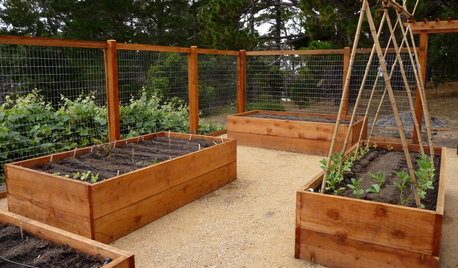
    The Urban Farmer (in El Cerrito/Richmond) walked me through all the details I needed to resolve in order to set up my drip system for my raised vegetable beds....we have the 1/4" line with internal drippers every 6" strung through-out the beds and it has worked really well for us for about 3ish+ years..... we DO have it all attached to the filter that the urban farmer recommended also...don't know how big of a diff. it's made...but it all works pretty well...

    good luck!
    ----lucia in CA

  • 18 years ago

    Been using it since 03, laid on surface of ground, both short curved runs under trees and long straight runs under grapes. Very reliable, cheap, minimum of parts, just be sure to filter the water like any other drip system.

  • 18 years ago

    You have to bear in mind that the decision on what type of irrigation system you choose ought to take into account both soil type and water quality. If you have very high levels of dissolved minerals in your water, you will need to find a way to deal with them. If your soil drains quickly, you will need more emitters for each plant in order to assure that the entire root zone is watered (in places where there is extremely limited rainfall the effects of failing to do so can be quite dramatic: wind throw due to a root system confined to a four square foot area).

    Ryan

Sponsored
Peabody Landscape Group
Average rating: 3.5 out of 5 stars8 Reviews
Columbus' Reliable Landscape Design & Contracting