Software
Houzz Logo Print
woosan

Fruit Trees Bad Condition

16 years ago

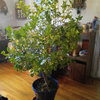
I planted some fruit trees a few months ago. Now they have tons of fruit and flowers. But the trees are losing all their leaves and one is drooping. I have removed some of the fruit and flowers in an attempt to reduce the strain on the trees in hopes the tree will divert more energy to growing since this began happening.

What is wrong with them?

Here is a link to a picture.

http://www.thirstyrock.com/Citrus-Trees.html

Thanks

Ted W

Here is a link that might be useful: Picture of Problem with trees

Comments (28)

  • 16 years ago
    last modified: 11 years ago

    Woosan there is likely more than one thing going on thats contributing to your problem. They look like they are either getting to much or too little water or suffering from heat stress or some combination.

    First off they are not planted properly. Planting in a basin may seem like a good way to keep water near the tree and near the root zone. However roots do not seek out water. Instead they are attracted to the most available water source be it water/moisture or humidity. When a tree is planted in a basin the roots tend to grow in and around the basin. The roots are attracted to the easiest available water source. In this kind of situation the roots stop growing outward which really is not a good thing.

    When roots grow in such a confined space when they are watered its easy to over water. The flip side of this that missing a single watering can cause the tree a lot of stress.

    This was discussed and described in much greater detail in the Arizona Gardening forum in this thread about fig tree planting and I think you would be well served to read it. http://forums.gardenweb.com/forums/load/azgard/msg031001526893.html?15

    If the trees were mine I would re-plant, compost them as our soil here low in Nitrogen and mulch them to conserve water and treat them as newly planted tree.

  • 16 years ago
    last modified: 11 years ago

    Ted, just for info sake.

    When you planted them, did you water them in well?

    Are you continuing to water them thoroughly while the roots get established?

    Are they in full sun? How many hours of it?Is it HOT?

    Have you ben fertilizing and with what?

    What is the soil comprised of? Did you ammend it with compost and materials that make the soil drain well?

    Are you having a drought, or does it get fresh rain often?

    Are you using alot of hose water?

    Do these trees have bugs?

    The more detail about the way you care for these trees and the enviroment will help us help you.

    By the way, what did you use to kill the grass around your trees with?

    If you mulch, make sure the mulch does not go up to the stumps if you are going to put down more than 2-3 inch thick of it.

    Mike..:-)

  • 16 years ago
    last modified: 11 years ago

    Actually, the temporary use of a berm after planting is SOP (standard operating procedure). It's known that watering the root ball of a newly planted tree is very important for the plant's survival, and that watering a large area is a waste of resources. Exceptions to this would be in arid locations (such as Arizona), where the berm should be constructed outside of the root ball area instead of right above it.

    Here's the reason:

    Roots will grow out into the surrounding soil system regardless of the berm. Contrary of what some people think,the water does not stay in a vertical column under the 'moat', but spreads out horizontally via capillary action. The use of the berm simply ensures that the original root ball and its mass of roots DOES get plenty of water, instead of it (water) being pulled away. Capillary action moves water up, down, and sideways within the soil. Unless you are planting in what amounts to pure sand, then capillarity is an important characteristic of your soil systems all over the world.

    Some things I cannot tell from the images, however: have these trees have been planted too deeply in their holes; have soil amendments (of any kind) been added to the hole or backfill upon planting; and were these trees containerized plants or B&B? Believe it or not, container grown trees have a more difficult time becoming established than B & B trees. The use of a berm system is essential to such plants.

    It might be time to remove the berms (after several months), and cover that entire area with a 2 to 3 inch layer of mulch (organic material, not stone). Don't mulch the very top of the original root ball.

    If you can provide some more information about your specific planting techniques, I might be able to be of more help.

  • 16 years ago
    last modified: 11 years ago

    I forgot to comment on those ties I see on the trunks in some of those images. (And do I see a stake?) They should be removed.

    I, too, wonder about what might have been used to get rid of weeds. Many herbicides can cause real problems for woody plants, especially when they are very young. Even RoundUp, which some people think can be used as long as you don't get anything on the trunk, can cause significant damage.

  • 16 years ago
    last modified: 11 years ago

    rhizo 1 both the poster and I live in AZ and what you said goes against everything I have read posted on tree planting in our county extension and on our Master gardener sites. His tree is planted too deep. Its sitting in a basin and that is not going to change as the tree matures. Planting like that is not recommended and it can cause a lot of problems later on and may be a contributing factor to what is happening now.

    Planting in a basin can cause problems with the graft and with root rot and encourage the roots to stop reaching for less available water sources. All of which are bad and should not be encouraged. If you read through the link I posted to the other thread you will see that I site both links and examples to what I am saying.

  • 16 years ago
    last modified: 11 years ago

    thisisme, perhaps we are talking about two different things, and that may be my fault entirely. Planting in a basin and constructing a berm around the root ball after planting are two completely different subjects. You are referring to what I would call 'below grade planting'. I think. I am not. Planting too deeply in the hole is always a bad idea, but it has absolutely nothing with the utilization of water berms.

    I hope that our original poster gets back to us to solve the mystery as to whether these trees are planted too deeply or not. The berms may simply make them look that way.

    The utilization of berms after planting (usually made of the backfill) is a highly beneficial practice and a very common one, especially in those locations where sandy, silty, or loamy soils are the norm. It can certainly be done with clay soils, as well. You'll find many edu sites with planting berms illustrated. Including one from the U. of Arizona. They were called 'irrigation wells' in the publication.

    Irrigation wells can be constructed around those trees that need to be planted higher than the existing grade, too. that's what I see done quite a bit in my area, where red clay soil is what we have to deal with.

    So, I think we are talking about two different things. Am I right?

    Forgive me if I don't wade through that other site, and the links, and the youtube sites. If you reeeeaaaalllly really want me to, I will. Please don't make me. ;-) (I might have to get even.)

  • 16 years ago
    last modified: 11 years ago

    rhizo 1 I wish I had time to go over this in depth right now but I don't. I have to be in court tomorrow morning and all my time and brain power is on the big day. Perhaps day after tomorrow.

  • 16 years ago
    last modified: 11 years ago

    I'm sending strong, good thoughts in your direction today. Good luck in court.

    Here is one link from the University of Arizona extension.

    http://ag.arizona.edu/pubs/garden/mg/arboriculture/planting.html

    THIS link will lead you all to a U.of F. site by Dr. Ed Gilman, who is a leading expert in the culture of woody plants, especially trees. I've attached the 'quick read' version, but I strongly suggest that everyone click to the Power Point version at the top of the page. It's a terrific step by step tree planting program with great pictures. The Power Point presentation is well worth everyone's time.

    http://webcache.googleusercontent.com/search?q=cache:OQio9G5FqQ0J:hort.ufl.edu/woody/powerpoints/rootsinplanting.ppt+proper+tree+planting+guide+irrigation+berms&cd=9&hl=en&ct=clnk&gl=us&client=firefox-a

  • 16 years ago
    last modified: 11 years ago

    Ted, I hope you are taking all this in since you are the one that came here and started it..Hopefully you will save your trees in time..

    :-)

    Mike

  • 16 years ago
    last modified: 11 years ago

    I think once Ted answers some of your questions and describes the decline (such as time line and possible triggers) it will be easier to help. And possibly if pics can be taken from side views (instead of downward) that will help answer some of the too-deep and grading questions.

  • 16 years ago
    last modified: 11 years ago

    Thanks for the feedback. I hope I can answer all questions asked prior here in this post.

    1) The trees were planted at the same level as the yard.
    I planted them as deep as they were in the container when I bought them to insure the tree could breathe. Berms were built around the trees higher than ground level to allow deep watering and let the water soak fully in the ground.

    2) I mixed 50% OMNI planting mix with the soil and maybe in some instances more to help loosen the compact soil of Arizona.

    3)I left the stakes that were in the pots on the trees.
    I used tree trunk paper wrap to protect the trees from the desert sun since I was told that citrus trees with exposed bark to the direct sun would cause the bark to burn and fall off.

    4)When I originally planted, I did use some miricle grow fertilizer which shortly after that they all began blooming to my dismay. I was was more concerned about them growing the first year than producing.

    5) I have recently been removing some of the beginning fruit to help take the load off the trees. By picking off the blooms, well at least some of them.

    6)I was careful not to spray the trees when spraying the grass killer. I used Spectricide grass and weed killer.

    7) No bugs

    8) Applied Celeted Iron a few weeks after planting since leaves were turning yellow with green veins.

    9) Have posted side views of trees at link below as per request.

    Note: I have seen some curled leaves on one of the trees prior to falling off.

    Thanks for the feedback and everyones help. If I screwed something up, I want to correct it as soon as possible.

  • 16 years ago
    last modified: 11 years ago

    Hi Ted,

    So they were planted in January of this year?

    If I understand it correctly, the entire circular "tree area" we see was dug up about 12" deep and you added the OMNI in approx. 50% ratio and bermed it. (Looks nice BTW). You basically loosened and tilled in about 1 cubic yard of OMNI to a foot depth for each tree.

    Has there been any watering yet?

  • 16 years ago
    last modified: 11 years ago

    Yes, I added approximatly 1 bag per foot depth. Actually I dug about 2 feet deep though the tree was planted at ground level but I wanted to insure good soil underneath. Yes, I have been watering by filling the the bermed area full to the top and letting soak in. Once a week.
    Yes they were planted in January.

  • 16 years ago
    last modified: 11 years ago

    I'm with Rhizo and Univ of AZ picture on the planting. That's exactly as I'd do it. There is no problem having a berm around the planted tree. I've been doing it for 40 yrs. I enlarge the berm as the tree grows. Nearly all my outdoor fruit trees are inside berms and have been since planting. The berms are large now and the soil drains very well.

    If anything watering once a week probably isn't enough. They are basically still rooted only in the original rootball. I'd water as if the trees were still in the original pot. That's probably 3-4 times a week. Don't drown them each time. You are just trying to rewet the rootball.

    Sounds like you didn't put fertilizer in the planting hole. But may have shortly thereafter. Next time don't fertilize until they are growing. I've seen trees killed by placing fertilizer in the planting hole.

    It is possible that your soil drains very poorly and that is causing a problem. We can't tell that from afar.

  • 16 years ago
    last modified: 11 years ago

    The primary problem that I see is the use of all of that planting mix in the hole. (I don't know what OMNI is, by the way. Is it a brand name?) The use of amendments in a planting hole has long been concluded to have a negative impact on woody trees and shrubs.

    Several things can happen: the amended hole can become something of a bathtub during irrigation or rainfall limiting new root growth and maybe causing root death; the plant roots may decide to not leave that 'improved' planting hole, limiting drastically the far-reaching tendency of roots, even in compact soils; a soil that has been amended may end up holding on to fertilizers in a way that can cause burn.

    Here's the recommendation for planting: when planting hole by hole ( as you have done), do not incorporate any amendments into the backfill. Even in compact soil, even in sand, even in clay. If, however, the soil is hopeless, it's recommended that an entire planting bed be prepared (not just a hole). Amendments can absolutely be used for that purpose.

    And the planting holes should not be dug any deeper than required for the plant to sit on NATIVE soil. If you root ball measures 12 inches (or whatever), the hole should be dug to 10 or 11 inches (so it sits a bit high). I mentioned capillarity in an earlier reply to thisisme. Allowing a plant to take advantage of a soil system's natural capillarity is very important. Besides, a plant that is sitting on several inches of amended backfill will eventually settle, leaving the tree below grade. So, dig a shallow, but WIDE hole...no amendments.

    I still worry about the herbicide. There are several Spectricide herbicides. Would you mind looking at your label and letting us know what the active ingredients are? You'd be shocked at how much drift can occur, even if you were very careful.

    Remove the stakes. The ties or tape holding them to the plant stem look too tight. Stakes shouldn't be used, in most cases, anyway. If a young tree needs a stake in order to remain upright, then something is wrong. If, for some reason, your trees must be staked, replace the ties with something that has some leeway. It's important the trunk be able to sway with the wind....makes it stronger.

    I can't really address the paper tree wrap. I've never seen pictures of it used in Arizona, but that's a limited exposure to base an opinion on. I will tell you, in most cases, that tree wraps are not recommended.

    Now that we know your trees were container grown, I agree that you might not be watering frequently enough. The root ball of a container grown shrub or tree dries out soooo easily, and may even repel water once it is dry. My suggestion would be to fill the basin once a week as you have been doing, but add two or three extra visits in order to give it a gallon or two each time. Only on the root ball. Every day wouldn't hurt, but only on the root ball. Give it a good soak as you have been doing.

  • 16 years ago
    last modified: 11 years ago

    I don't see anything wrong with a very short berm short term, say for the 2-3 months after planting. A berm that close to the tree is not meant to be a long term fixture because it can cause lots of problems for the tree.

    Here is an excerpt from the 5th point in the planting instructions from the University of Arizona.

    "Expand the irrigation well or adopt another method of irrigation once roots are growing into the surrounding soil."

    It does not take more than a few months for the roots to start growing into the soil surrounding the rootball. And before you ask the answer is YES the rootball is the subject of the sentenced preceding the above quote.

    I realize this is not a saucer/basin type planting as the tree is planted even with the soil grade. It however the berm in the instruction is not meant to be long term because it can produce the same results in some respects. What changed everyones minds about such plantings was what results were found during the drought in California during the 1970's. Trees planted in a basin/saucer died while trees planted at grade or above grade without a basin a saucer or berm lived.

    Roots do not seek water. They are attracted to water/moisture/humidity and grow roots where water is most easily available.

    As stated above roots are attracted to moisture/water/humidity. If plenty of water is present the roots will grow where its at. In this case inside the berm and a little around it. If the berm is continually expanded or done away with root growth will for the most part stagnate.

    Let me illustrate the problem from a historical perspective.

    Long ago gardeners were told a basin/saucer/berm type planting was a good way to go for what seemed like many obvious reasons. The tree thrived and all seemed well. Then came drought situations in California and home owners where told to stop watering their yards and trees. As a result in short order long established trees with a basin/saucer/berm type planting quickly died. Often within just a few weeks which surprised everyone. At the same time it was observed that trees without this type of planting continued to live and thrive.
    When the trees were replaced it was found that the trees with a basin/saucer/berm plantings had much smaller root systems that were confined to small areas around the basin. When water delivery was interrupted to this small area the mature trees were unable to grow roots quickly enough to sustain them and they died. Mature fruit trees should have wide ranging root systems that reach out 20-45 in all directions depending on rootstock.
    Left on their own feeder roots grow/spread out much more quickly than many may think. The feeder roots of a small tree planted in the ground should grow into the surrounding soil rather quickly. Something like 1-3 months not 1-3 years. If someone wants to use a berm like this I suggest they do away with it or continue to expand it and expand it and expand it. Currently most just do away with the berm and continue to mulch around the tree and it works very well is most cases

    On a side note my brother lost 8 trees in Southern Ca do to this very issue in the 1970s. I had a role in planting them and digging them out. It was shocking how small the root systems were on the 4 year old trees we pulled out.

    The links below are of two videos posts by a UC Davis Professor well and respected author and Master Gardener. In it he covers this subject and many more and I highly recommend them.

    The Home Orchard Part 1
    http://www.youtube.com/watch?v=LcB10xujAIU&feature=channel

    The Home Orchard Part 2
    http://www.youtube.com/watch?v=xflTYwWvmos&feature=channel

  • 16 years ago
    last modified: 11 years ago

    thisisme:

    You make a good point and it is well taken. But the stunted root system will only apply in a very dry climate where natural rainfall never wets the soil outside the basin. If the basin is continually expanded it won't even happen in a desert.

    I like my basins. They are very efficient. No irrigation or rainfall leaves my orchard. But adjoining basins cover the whole orchard. All the soil is wet when I irrigate. It works great.

    The case you mention or excessively poor drainage are the only cases where I see a potential problem.

  • 16 years ago
    last modified: 11 years ago

    Remember, berms are to be used on a short term basis to provide water TO THE ROOT BALL. The root ball on newly planted trees, container grown (more so) OR B&B require special care for the first several months.

    Your use of the term 'basin' leads me to think that you are still thinking of this planting technique as being below grade. I hope that this is not the case.

    Berms should not be expanded and expanded. They need to be removed after several months, not expanded. The root system will have grown far and wide beyond that berm by that time and the continued 'babying' of the root ball will not be necessary.

    Again, the proper use of a water holding berm does not limit root growth and development to the outside environment. This practice helps the plant become established, rather than hinder the process.

    I skimmed through the Utube videos. I'm glad that you were able to get so much out of them. They are, indeed, useful to anyone beginning fruit tree culture. Though he said very little about soil/root systems, I did agree with most of what I heard. The glaring problem is that a hole should simply NOT be dug deeper than the root ball is high. Wider, but not deeper. Disruption of the existing capillary pathways can create a dysfunctional movement of water in and out of the site. He also mentions pedestal planting, something that was once recommended but not any more, at least not by experts.

    I was very glad to hear him emphasize the distance that the roots will grow. They will do that very happily underneath the berm.

    If plants have been lost, as you say, it was due to other factors than the utilization of simple berms. I've seen more trees killed due to being planted too deeply than any other reason. I can't say that I've observed any problems solely due the utilization of an irrigation berm. There is simply no reason for it. Other factors were involved.

    Evaluating tree problems has been my professional specialty for many long years. Attached are some planting specifications I've always thought useful. They recommend that the 'moat' be constructed of mulch rather than soil because the soil sometimes ends up washing down onto the top of the root ball. I've seen that occur. You never want to cover up the natural surface of the root mass.

  • 16 years ago
    last modified: 11 years ago

    rhizo 1 just so we are clear the berm needs to go a few months after planting. By the way you have some skill if you put that planting page together in the link.

    However I think its funny that you think the guy doing the youtube videos is out of date. Hes one of the top professors and researchers in the UC Davis Agricultural department which is one of the top programs in the country. He is a much sought out lecturer. His lecturers and recent videos are part of the Master Gardener program. He also does other videos for the UC Davis Agricultural department including the ones on pesticides, irrigation and gardening. The next generation of professionals are graduating from his classes in the UC Davis Ag department. Not to mention he has written two books for the USDA and you think he is out of date? lol

    Fruitnut you may be right about trees planted with a berm not being a problem in areas that get more water. Drought is what killed the basin planted trees in the 1970s. With so many of them close together I can see how moisture zones would overlap causing root systems to spread as you suggest.

  • 16 years ago
    last modified: 11 years ago

    Interesting suggestions and appreciated. I think I need to find a moisture probe and see what that moisture level is below ground. I did dig the holes deeper to make it easy for the trees to grow out at first. So now my concern is they are retaining water. I may even make a 2nd berm. Like a double berm so the water goes in the middle of the berms along the root zone area and waters out from the roots. This will have the roots going outward to get moisture.

    Thanks

  • 16 years ago
    last modified: 11 years ago

    It's very difficult to keep up with the newest information regarding proper planting procedures. It is also difficult to put aside information that you've been thinking was fine for years and years. I've been in that position plenty of times.

    I did not say that your expert is out-of-date. I did say that the hole depth issue was a problem and that planting on a pedestal is no longer recommended. You would probably be quite surprised at how difficult it is for new technology to reach 'the masses', and how loooong it takes for old techniques to be left by the way side. Heck, I remember standing in front of my classes or my audiences and saying MANY times, " we used to do so and so, but we've learned that that's not in the best interest of the plant. Here's why..."

    I still work with 'so called' experts who insist that adding peat moss to the back fill is important, and that staking every single tree upon planting is an important part of the process. Those are just two examples, there are many, many more. (grits and fire ants, juicy fruit gum and moles, gypsum and clay soil, lol)

    Judging by the quality of the information presented by Chuck, he would certainly agree with the science behind these two issues. He's performing an important service, especially in today's world with its renewed interest in home food production. I would expect his attitude to be much like most well-informed professionals....excited about the information, enthusiastic that the field we work in is never stagnant, happy to move forward with new information and research instead of sitting in the comfortable past.

    I didn't have anything to do with the Kern planting specifications. They just set a good example for urban forestry.

    woosan, I don't think that I would add another berm to your situation. But it's a good idea to test how moist the soil in the planting hole is from time to time. I'll suggest that moisture meters are notoriously inaccurate, however. You'll probably get a better 'feel' for the moisture level by inserting a long (thin) dowel into the hole and testing that with your fingers. If the dowel comes out moist or even cold, you'll know that there is moisture. If course, you can dig down a bit, too, and test the soil with your fingers.

    Don't forget to get that mulch layer down. A 3 to 4 inch layer of a good organic-based (once alive) material will do more to foster a good soil/root system than almost anything else. As BIG an area as you feel like you can devote to your trees, the better the roots and the soil will like it.


  • 16 years ago
    last modified: 11 years ago

    rhizo 1 Am I misunderstanding you again? If you look at the planting on the right in the University Of Arizona diagrams in the link posted by another member. You will see that they still recommend planting above grade which I think is what you are calling a pedestal type planting. Planting above grade is still used in areas where soil is shallow or does not drain well or in low areas where water pools. Its just a cheaper form of a raised bed.

  • 16 years ago
    last modified: 11 years ago

    I don't know which link you are referring to.

    Pedestal planting is when a big hole is dug, then a little mound is built up in the hole for the base of the plant to sit on. (I've attached a diagram.)

    The tree is planted at grade, but not on the native soil surface at the bottom of the hole. See what I mean?

    Planting above grade is called....planting above grade.

  • 16 years ago
    last modified: 11 years ago

    Here's the link. I have seen trees planted much higher than the diagram depending on soil depth. Its still done with good results where needed. I have even seen commercial orchards planted on elevated rows where soil conditions offer poor drainage or where the soil is very shallow or apt to pool water.

  • 16 years ago
    last modified: 11 years ago

    I see what you mean. The diagram on the right has been made into what ( I thing we might agree on this) we would call a raised bed. It says that extra soil has been added to increase the root depth because of the hard pan layer they've illustrated.

  • 16 years ago
    last modified: 11 years ago

    Basically you have to do what you have to do to create an environment conducive for the tree to grow in based on existing conditions. Sometimes a raised bed or even creating a mound to plant in is the best option even if its not generally ideal. Sometimes the land we have to grow in is a lemon and we have to roll with the punches and make lemonade as best we can. The same goes for adding some well composted organic matter into the mix or sand to the soil under some extreme conditions. Not at all textbook but sometimes necessary under native conditions that are hostile to growing fruit trees and of course mulching is always encouraged.

  • 16 years ago
    last modified: 11 years ago

    Thanks,
    So has anyone ever had this problem and resolved it.I would think that someone would see the pictures and say "Hey that what mine was doing and this was my problem and I resolved it"
    I know there are many elements that could cause things, but surely someone must have had this problem before and when looking at the pictures would have a solution that worked for them.

    Thanks
    Again

  • 16 years ago
    last modified: 11 years ago

    It's possible the problem was originally under-watering. As was said earlier, when initially planted you have to water almost as much as when it was just in the container itself (a few times per week when it gets warm). I was so afraid of overwatering I nearly killed an Acer within two months this way -- and it had a watering basin also.

    Although a lesser concern, spraying with Roundup very likely contributed. It is not wise to spray roundup around young, drought stressed trees vs. it being OK to spray around healthy mature trees.

    At this point, I would remove the berms. Definitely buy some mulch and put it around the entire distance where the berm currently is -- but not against the trunk. The mulch adds other value besides just water retention.

    Now the big question: has there been any root growth BEYOND the initial rootball. If the tree has been struggling along, it's possible it hasn't.

    The leaves hanging off branches shows the weakened state of the tree -- it is familiar for under-watered trees but also for over-watered. The over-watered will show yellowing of the leaves, probably starting from the bottom up. The under-watered will show more crinkling and feel dryer.

    This is essentially what is being "argued" above: was the soil prep you did initially problematic or is this all just from under-watering and roundup or something else?

    To answer that, I would remove the berms and start digging up the soil (not the tree). Start in broad daylight so you have good vision, b/c you are 1) measuring the moisture of the soil (is it obviously sopping wet or average or on the dry side) and 2)have the roots extended beyond the rootball?

    The only real way to answer this is to start carefully digging far, ie from outside where the berm WAS. Dig down 12" and place soil aside. If you don't see any TINY, WHITE ROOTS, then start digging inward more and place the soil in a different pile. I would keep this process going until either the first sign of root or you're within 12" of the tree. Feel and smell the soil as you dig it out. Again you are doing this so 1) you learn about the soil moisture and 2) whether the tree roots have thrived at all in the past 4 months.

    I'm not suggesting you remove all the soil around the tree, just start on one side and go inward. I would also do it from the opposite side, too.

    I have done this twice, back when I was a beginner and planted citrus in ground and had struggling trees. One time I found the rootball had not grown at all. The other time, the roots had extended a few feet outward in 9 months of growth.

    You've done a great job taking pics so far, so I would keep it up during the dig out process. I would suggest you do this ASAP but as long as this thread has taken maybe your trees are improving so far? Feel free to send me email via this forum if you start the process and nobody has replied.

Sponsored
NME Builders LLC
Average rating: 5 out of 5 stars2 Reviews
Remodeling Company in New Albany, Ohio