Software
Houzz Logo Print
christine283

Can arborvitae be saved?

17 years ago

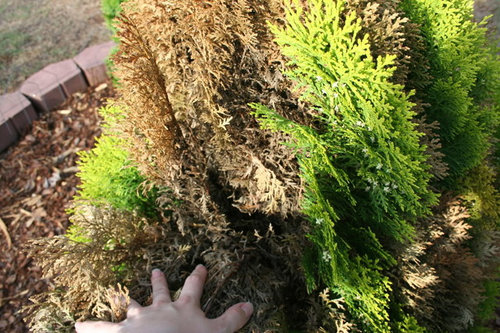
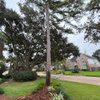
We have some arborvitaes planted for a sort of privacy screen, and they've done well the last two years. I honestly can't believe how tall they've gotten and how much they've fluffed out since we got them. But about midway through the winter, I noticed one where the browning on the inside was starting to make its way to the outside, and now it just looks scary. I've searched on this and the shrub forum but can't find anything similar to my situation, at least another post that has pictures.

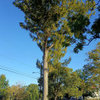
This is a pic of the other -- it's brown on the inside but I had read that it's normal?

I'm just really nervous because of the way the brown has crept outward, and I have a feeling pruning may not be enough, plus it would look horrible. And it's just weird how it's just the one that is affected. What are your guesses? Water, drainage, mites? I have no clue.

(The skinny ones in back are Emerald, I'm afraid I can't remember the type of the one I'm having problems with -- Golden Globe?).

Comments (14)

  • 17 years ago

    Hhmmm...I know we've had some moles because we have the tunnels in the yard to prove it. I'll have to look in the morning. I could go out with a flashlight, but I saw slugs earlier when I took the pics and....well, I don't particularly like slugs. ICK! :-)

    My husband thinks it might be due to a lack of top soil -- or it may at least play at part in it. It looks like part of the root ball may be exposed? I'll have to get a better look in the morning.

  • 17 years ago

    That middle one is basically done for - although the green parts at the side might live, they'll never make a nice-shaped plant. Remove and replace, unless you're willing to put up with a strange-shaped tree.

    BTW, the middle one (a Platycladus orientalis) is a different species to the other two (which are Thuja occidentalis)

    Resin

  • 17 years ago

    he said look for vole damage.. you said you have moles ...

    voles are vegetarians.. eating plants..

    moles eat bugs and worms... not plants ...

    but the issue is .... even if you remove all the ugly parts.. how ugly is it going to look.. and how many years are you willing to look at it ...

    if it were out in the back 5 acres.. i would suggest that you experiment ... but since it seems.. from the pix.. that it is somewhere where you will fixate on it every day ... i suggest you be done with it ...

    i would replace it with the same plant ... at half the size .... just to get a little undulation going.. all plants.. all the same size.. bug me... lol

    ken

  • 17 years ago

    ken, you're right, moles eat worms, grubs, etc. But they'll tear up/undermine a root system trying to get to them. This doesn't hurt a tree w/a big-enough root system, but small seedlings/saplings can be hurt or even killed.

  • 17 years ago

    With that middle tree, I would cut out the bad branches to the central trunk (trim and keep the trunk as support) and then tie the remaining good ones to the trunk or together as needed to make as proper a form as possible (with gardeners tape). I would bet that in a three years that tree would be OK again. But I am cheap! For a tree in rehabilitation I would perhaps move it to a less visible spot in the meantime. But as someone suggested as a smaller tree would add interest to the group - by doing the above pruning you would defacto get a smaller tree!

  • 17 years ago

    boy.. i mush have lazy moles ....

    they go straight down the drip irrigation lines in the hosta beds.. but when they hit a plant of any root mass.. they just go around ....

    the biggest problem is the minis.. as they undertunnel.. and the darn things fall into the hole.. and a 2 inch hosta.. planted 4 inches to deep is a problem ...

    anyway ... the reason i came back.. wasnt for that boring story ...

    THE INTERIOR BROWNING IS COMPLETELY NORMAL.... as the branches extend.. they eventually shade out the interior ... and nothing grows in the dark ... so take that part out of the equation ...

    the only part of concern.. is the part you see brown that does not involve sticking your head inside the plant ...

    ken

  • 17 years ago

    Well I'm not going to be able to get out there today, rain all day and tornado warnings.

    Any problems-- mites, fungus, disease, etc. -- that are more than likely NOT a possibility from the looks of it?

  • 17 years ago

    I'll just be up front with you regarding the damage to this plant.

    The heart and soul of this cultivar which I think is Platycladus orientalis 'Morgan' is toast. Any attempt to salvage it is a waste of time. At one time I had 3 of them...now down to one beautiful specimen. I have seen this kind of damage before, not to the extent of yours but similar. Probable cause as to why this happens was never determined by me. I covered all the bases to insure survival. In almost all cases damage occurs over the winter months. In my opinion not insect related. I suspect if not hardened off completely because of mild temps in early winter they are susceptible to damage when sharp drops in temperatures occur.

    Go find a replacement and put that little spot of heaven back on the map.

    Good luck,

    Dave

  • 17 years ago

    I'll admit to feeling a little frustrated here. Having seen many arbs (I know, this is Platycladus) exhibiting this symptom, and having seen that it is invariably caused by stem girdling, why are you, OP, seemingly so hell-bent on finding an insect or disease process to blame? I wish you would at least check out what I said. If this is not the cause, then I and everyone else might be able to learn something.

    I dunno, just seems odd to me.

    +oM

  • 17 years ago

    tom, I'm not hell-bent on finding something other than what you suggested. I was more or less making conversation to see if anybody else had seen the same damage. I was just looking to cover all the bases. And as I said this morning, I haven't been able to get a good luck because last night it was dark, and today it's been raining/tornadoes all over the place. Now that I'm home from work, I'm waiting for the rain to let up so I CAN go look.

  • 17 years ago

    Ok. I pretty much looked at every single branch and the trunk. I don't see any girding or any kind of gnawing marks anywhere. Just lots of slugs on the inside.

    Does it matter the level of browning on the inside? On the very inside it's almost black.

  • 17 years ago

    In any event the Platycladus would get too wide in a few years anyway and run into the others, depending on whether it bothers you if it would ruin their shapes.

  • 17 years ago

    i told you the interior browning is irrelevant ...

    its normal .... for this plant ...

    what it comes down to ... is it worth $20 in chemicals ... for a $15 plant ... if in fact.. you could ever get a proper ID as to whats there... to buy the proper spray ...

    shovel prune it ... be done with it ...

    ken