Software
Houzz Logo Print
ellen_inmo

Mugo Pine, how slow will it grow??

21 years ago

I admit that I did not well research Mugos before purchasing four of them today. I bought 2 gallon shrubs, each about 12 inches tall. I came home did some searching, and found out that they are slow growers.

How long will it take for my Mugos to get about 4 foot tall? Should I have bought a larger pot? If I want them about 4 foot tall in, say, 4 years, is it wishful thinking?

My planned planting site is a southwest facing foundation plant,full sun from 2 pm on,with well drained soil, adjacent to some Holly shrubs.

And one last question--why do I see it spelled "Muhgo" in some catalogs and nurseries??

Appreciate ya!

Comments (25)

  • 21 years ago

    if you study the plant .... you should be able to tell how much it grew last year ... and the year before, etc ... which will give you some clue .. but not necessarily tell you how it will grow in your soil and location ... most conifers prefer full sun .. so your location will probably slow it down ...

    but you dont know how long it was in the pot ... or b&B ... how much fert the seller used, etc ....

    and we would need to know which mugo ... which may impact what we tell you ... any chance you have a cultivar name????

    ken

  • 21 years ago

    Hello Ken, my tag says: Pinus mugo mughus. Says to space 3 to 6 feet apart, and the average height and width is 4 ft. tall by 5 ft. wide. I dont have a clue about how old this plant is, how long it has been containerized. Nor would the nurseryman who sold it to me.

    I have always loved the Mugo pine, and from what I read, it needs a bit of maintenance to keep its unique shape. Any tips on doing this for me?

    Even if this is a really slow grower, I will still put it in the same location. However, I may consider buying larger ones, if I am advised that it will take an eternity for these to grow. It seems that I wish for these to grow a foot a year, that's asking a bit much, right? From any conifer, correct?

    I'm trying to avoid the traditional foundation planting of Boxwood, juniper, yews, cone shaped shrubbery. Yet, I still want an evergreen. I currently have Azaelas, however, full grown Pear tree was removed over winter that shaded this area in the evening, so now this bed is full sun. The Azaelas have got to go, they are not happy at all. Too bad, because they seemed the perfect choice for me.

  • 21 years ago

    Ellen,
    Just remember, if your mugo pines grow a foot a year, they will continue to grow a foot a year for quite a while - not just for the first four years. In 10 years the plants will be 10' tall. It's very possible for a mugo to grow a foot a year, depending on the plant (cultivar vs. seedling).

    Your plants are probably seed-grown and so will vary a bit in growth rate and plant shape. If you want 4' plants, pray that they don't grow a foot a year because then the plants will get way too big for the location that you have chosen for them and require way too much maintenance to maintain that height. You can't maintain the plants at the same height forever, you need to let the plants grow a little larger each year.

    "Mugho" was a spelling error that was printed in some botanical publication and this incorrect spelling is still used today. The correct spelling is Mugo.
    Mike

  • 21 years ago

    I've always wanted a small mugo pine, but from what I researched there is great variability in the mature size of mugo pines. Therefore, I don't want to chance it.

    One website stated "wide variability in size in the landscape, 5 to 20 feet high, but usually less than 8".

    I guess if you plant a known cultivar, you have a better idea of the growth rate and ultimate size, but here too I read to ensure they are from a reliable source, that is, a seller may label a mugo pine as the 'mops' cultivar, but in reality it may not be.

    Glen

  • 21 years ago

    Just a clarification, I meant my quote to say "usually less than 8 feet". I wrote "usually less than 8", and someone might interpret that end quote mark to mean 8 inches.

    Glen

  • 21 years ago

    Thanks Mike. I dont suppose there is any way to know if it was seed grown or not? Some botanical way of finding out?

    What my concern is, the shrubbery I purchased to go in front of the Mugos may grow taller than these in the next couple of years, which makes a foundation planting look pretty funny. I purchased Spirea japonica 'Shibori' (Peppermint Stick). These plants are the same height right now as the Mugos. The tag says that these will grow 2 X 2 foot in 5 years, and I think they will look nice in front of the Mugos, or any evergreen.

    I am so skittish about buying any kind of perennials and shrubbery. I change my mind so often, and suffer anxiety about my choices! I am definitly more of an annual display type of gardener, changing things from year to year, and I focus all my attention on learning and perfecting my seed growing of annual bedding plants. Yet, I am in serious need of some foundation plants. I admit, I am overwhelmed. I forced myself to shop last night and buy "something". Completely irresponsible, I know.

    I am happy to hear that these grow faster than the websites indicated.

    I have another location in need of foundation plants, an east facing full sun until 1 pm, for a total of about 5 hours of full sun. I dont suppose this would be a better location?

    There are just so many choices. I do envy the "artists" of landscape design.

  • 21 years ago

    Ellen, I suffer the same feelings of indecision in planting. I second-guess myself on conifers constantly and have moved things about to the point I'm embarassed and feel the neighbors are laughing behind the windows. My confidence is in perennials, but you to need try new things in the gardening world. Just do enough research first before you plant. I have no problem with buying things on the spot if I feel it will work, but now before I put it into the ground I'm reading about it and its eventual size. One thing I have learned from this conifer forum is that nursery tags are not always accurate on size and habit (that's for sure)!

    I lost two mugo pines (Slowmound) in the same spot and it was because it was over a sand hole and just not getting enough sun and any water was sent to China. I moved them in the spring to a sunnier location and viola! Slowmounds are supposed to grow slow...about 3 inches a year eventually to 3 feet by 3 feet. Yep, I was out there with my wood ruler measuring those candles and it was pretty much the case. I still nip them though the tag said it will never outgrow its spot (right...) conifers will keep on growing regardless of what the tag says.

    Good luck, and I'm sure the spirea will work in front of the mugo's. P.S., if you are an annual and perennial nut like me, the area around the mugo's will have lots of their feeder roots like a web through the soil. It will get harder each year to drop in annuals as it will turn into quite a tangle. Sometimes I wonder if its such a good thing to be disrupting the soil around conifers to plant annuals and perennials.

  • 21 years ago

    Yeah, the size listed on the tag is "usually" the size at 10 years or 15 years, not the eventual size of the plant. Unfortunately, the tag doesn't give you this little tidbit of very important information.
    Mike

  • 21 years ago

    Glad to hear I'm not the only indecisive one when it comes to planting :) I, too, move stuff constantly, it's the really big stuff (i.e. impossible to move once planting) that makes me a nervous wreck when trying to place since I know I only have one shot. I will often plant something and move it 10 min. later (and then a week later, month later....). I drive myself crazy :) Good luck Ellen!

  • 21 years ago

    I was loaded with anxiety as I was pulling out of the parking lot with my new shrubs!! I start to second guess myself, and ask myself "what are you doing?".

    I think the problem I have is, I have a serious lack of inspiration when it comes to foundation plantings. Rarely do I see something that catches my eye, and that is usually a professional design on some million dollar home. Around here, 90% of the homes are done with yew shrubbery, shaped into perfect squares or balls (ugh), or you see the very nice colorings of burgundy barberry, Stella D Oro daylillies, hostas, yellow shrubs, a little bit of conifers, some Japanese maples. I like this mixture of color, but yet, I rarely see designs that all come together the right way.

    And, the botanical gardens doesnt help give inspiration, because they do not have foundation plantings for homes.

    Books do not help either, I have tons of books, but nothing that really jumps out.

    And the shrubbery/conifer world is so overwhelming to me, I just cant make up my mind.

  • 21 years ago

    Ellen,

    I started my landscaping of our new house in segments. I planned each segment, like a puzzle that would eventually touch each other in the end. I had an original vision of what I wanted to see, but knew that I couldn't do the whole thing all at once and there was no way I would have it done by anyone else either...You have to start somewhere and you can't be discouraged if something doesn't work out immediately. You can change things around, add...delete, you just can't be afraid to move things about. I would definitely start with a vision of what you WANT to see. What I wanted was no straight lines in my landscaping. I wanted the sides of the driveway to have gardens and wanted them to flow upward to the house, bringing your eye with it and then encirle the entire home so you can just walk through them. Each segment was part of that design then I connected them. This is my third year working on this and my 'segments' have finally connected. Its also extremely helpful if you start with the bones of your garden first (the big stuff). Good luck on all this, just take your time and try to enjoy and learn at the same time. Gardens are an ongoing process, I love the change and growth of them...and don't forget to take pictures!

  • 21 years ago

    I have nine (probably seed-grown) Mugo Pines in my landscaping. All were planted four years ago.

    Of the nine, two are, maybe, 2' foot tall, and the remainder are about 1' tall or less.

    Spireas grow faster than that, ... but can be pruned to a smaller size every year (best probably in the fall/winter).

    The Mugo will eventually grow taller than the Spireas, but it may take 5 or more years.

  • 19 years ago

    Hey Greenthumb Mike, you still out there?

    Did you state that 'Teeny' and 'Sherwood Compact' are the same plant being sold with different names?

    What is your reference for stating that? I'm confused. The Iseli Nursery website lists completely different growing habits for those two varieties. I've always considered Iseli to be a very reputable nursery and very accurate in their descriptions. Take a look:
    http://www.iseli-nursery.com/Plantdescriptions/Pinusmugo.htm
    What do you think?

    Here is a link that might be useful: http://www.iseli-nursery.com/Plantdescriptions/Pinusmugo.htm

  • 19 years ago

    Hi Perry,
    Yes, I'm still here, but under a new name. I was gone for a year and when I returned I just figured that my user name would have been deleted, so I re-registered under a new name. I should probably go back to my original user name.

    Anyway, here is a link to one of the places where I have seen this info printed. I have also seen this printed in a wholesale catalog that I receive.

    I would guess that 'Teeny' and 'Sherwood Compact' are the same plants, but it is advantageous for nurseries to list them as separate plants because then people will think that they're two different cultivars and may buy both plants.
    Mike

    Here is a link that might be useful: Coenosium Gardens Info

  • 19 years ago

    From the beginning (just read this thread) - Those plants are seedlings. Bob Fincham of Coesnosium Gardens (Link Above) has at least once on this forum discussed this topic. Plus the tag indicates they were seed grown/or were grafted from seed grown "mugo's". That's evident to me.

    The 'Sherwood Compact' clone is as Mike states a replica of 'Teeny'. In my newest fact-related conifer book: '(Erhardt, Walter) List of Conifer Names' - he states that 'Sherwood Compact' was introduced the same year as 'Teeny' (1986). The designation of 'Teeny' however was listed as being introduced (either by registration or scionwood shared, etc) under the name of, Lohbrunner while 'Sherwood Compact' just received the designation, "Hort. USA". I suppose in a case such as this, if you were to purchase either plant, you'd still get a great clone.

    Lately, I've been dealing with the history of Pinus x 'Forest Sky' (ayacahuite x 'hybrid Pine'). You guys wouldn't believe that from the very beginning, when scionwood was initially collected and distributed to growers, that the plant became known under at least three different names. It's of course simply amazing to me that when scionwood is collected by nurserymen that a label doesn't go along with the wood and the history as well.

    It's mind-boggling at times.

    Dax

  • 19 years ago

    quick question: I have a Ball and burlap mugo wrapped with wire that i want to plant...the nursery said to just cut slits in the burlap. Do I need to take the wire off as well?

  • 19 years ago

    I'd take it all off, even the burlap. Why risk constraining the roots. If even a tiny bit of burlap sticks out of the ground it will wick water away from the rootball and who's to say how long the burlap will take to decompose. It may even have plastic threads. Depending on the size, you could remove all while the plant is in the hole.

    tj

  • 19 years ago

    For more on this last topic

    Here is a link that might be useful: Myth of Collapsing Rootballs

  • 19 years ago

    Never plant with wire basket attached to conifer.

    The easiest way to remove the burlap is to take scissors and cut the burlap from the bottom of the ball and discard it. Don't cut string. Plant in hole, level and tamp enough dirt to steady. Cut all string and remove. The rest is easy. Unwrap burlap and you have an intact root ball that hasn't broken apart because you did it the right way.

    Dave

  • 19 years ago

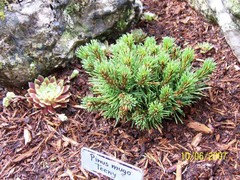
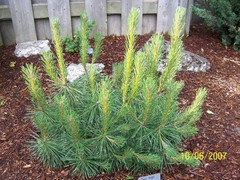
    Hmmm -- I have both 'Teeny' and 'Sherwood Compact', but I must say that 'Teeny' looks much more dwarf than 'Sherwood Compact'.
    I bought 'Teeny' this spring, and I certainly didn't suspect at all that it was the same plant as 'Sherwood Compact'.
    Something's funny here....

  • 19 years ago

    OK, here's a close-up shot of my Teeny....

    I would say that the needles are about half the length of Sherwoon Compact.

    As for how slow Mugo Pines grow, from the crazy candles I'm getting on mine this spring, it looks like it will be about 10 feet tall in 10 years...

  • 19 years ago

    I can't tell very well from your second photo, but it looks like a 5 needle pine????

  • 19 years ago

    Remember that you can cause the Mugo to grow bushy by trimming (top 1/3rd) the new candles every year - that way each candle will branch into three or four candles the following year.

  • 18 years ago

    Any idea how to trim a mature Mugo? I have two that have taken over their place in my yard. They are about 20 years old, and the one I trimmed really took off since I trimmed it.

    HELP!!

    Here's a link to a couple photos of these beasts
    http://gallery.mac.com/mjbrna#100167

    Thanks for any reply.
    mikey

    Here is a link that might be useful: My Mugo Pines