Software
Houzz Logo Print
luvngdirt

Pod vs. Pollen parent

19 years ago

I am new to the thought of pollinating daylilies...have loved them for years. Have already learned a lot about growing them from all of you by reading and lurking around here for a couple months. BUT here comes the question...What is the difference between a pod parent and a pollen parent and why would you want to choose one variety over the other for each type of parent??? Curious because I see you refer to one or the other in many of the posts.

Thank you all

And PLEASE keep all the pictures coming...how else can I enjoy all the ones I don't have

Janet

Comments (30)

  • 19 years ago

    One reason is that some Daylilies won't set pods,but the pollen is fertile,and the other way around also.Some are called"reluctant"at setting pods.Being new to this myself,I don't know the choice from the expert Hybridizer's view.Hopefully ,one of the experts will clue us in.Good question,by the way.

    Betsy

  • 19 years ago

    The pod parent is the parent ("mom") that the pod (seeds) come from and the pollen parent is the parent ("dad") that the pollen comes from. One daylily could be both the pod and pollen parent if you put the pollen on the pistil of the same daylily. Not being a hybridizer, I don't know why you'd choose one over the other (unless a daylily was only fertile one way). However, Grace Stamile told me that if you want to hybridize a variegated daylily, the seedlings will only be variegated if the pod parent is variegated. Maybe there are other traits that work this way too.

    Juliet

  • 19 years ago

    Things are controlled a lot by the ability of a flower to set pods. With tets, pod-setting is the primary controller. Most dips set pods like crazy. With tets, it can be very difficult.

    We also have our primary pollen for any certain goal. For example, with my edged pink goal, Gary Colby is my pink with the biggest edge. But it has an unclear color. Bill Robinson is a little more clear, while Princess Diana is the most clear. So, Seabiscuit will get Princess Diana and Bill Robinson pollen, since it is cream pink. Cindy Jones is a borderline clear pink so it can get any of them. But GC pollen may not yield as many clear seedlings. Shores Of Time gets nothing but GC pollen since it is perfectly clear. You won't see any Cindy Jones pollen or Shores Of Time pollen on my Gary Colby. I only put Bill Robinson and Wild Irish on it, while Princess Diana gets only Gary Colby on it.

    With a flower that is good enough to work towards a goal, but not the best pollen for the goal, it may only be used for pod setting. Many seedlings fit that category because you certainly have better pollen to dab. But if those seedlings are good at setting pods, they don't need to be as edged, or as clear, for that goal.

    Now, add in secondary goals such as a good scape, then you see where the decisions are made. Having a good crop of seedlings to set pods on is the first goal. After a number of years, your pod setters can be better for multiple goals. Ultimately, you may even consider plant habits and sun resistance.

    Now, if you are like me, factor in inbreeding verses outcrossing. That is where I begin. No inbreeding here.

  • 19 years ago

    Okay...I had to write that all out...HAHAHA.. to make sense of who went with who...But at least I see who is pod and pollen. Now two big ones...if youare putting PD pollen on Seabiscuit, why would you not put it on GC ...especially as you are using PD as the pod parent for GC pollen???

    Second big one ...Why would you pollinate a hybride daylily with itself???the seed would not be true for that variety wouild it...wouldn't it revert back to original parents?? That's a lot of inbreeding, isn't it?

    Trying to wrap my head around this one.

    Thanks for the help

    Janet

  • 19 years ago

    OK. We try to improve flowers by not crossing two which have the same fault, and using imagination combined with deductive reasoning to visualize the improvement. Finding fault is the first step. PD has few faults, but can have a bigger edge. I can use pinks with a bigger edge, or I can go to yellows which have the biggest edges. But, GC was parented by a yellow, so it needs to be crossed with clear pinks. Crossing PD with yellows such as Wonder Of It All is a good choice, but it would take more seed quantity to get clear pink.

    I put PD on Seabiscuit because PD has a great edge, but is very clear pink color. Seabiscuit is cream with some pink, but can yield pinks if crossed with a clear pink. Gary Colby needs better color, and if I use PD, I may retain the huge edge. All of these ideas relate to the physical application of pollen, and each cross can dictate which pollen is best.

    Humans are flawed much more than the flowers. We have our goals diluted by greed. To arrive at our goals...er, greed, we set aside reasonable plans and go for the gold. So, inbreeding saturates genes which eventually increase our odds of achieving results. Of course, inbreeding comes at such a cost, but that cost is not attached to us. So, greed wins out. We next manufacture scientific excuses for why inbreeding improves plant quality and outcrossing hurts our wallets. Delusions win out and truth is modified to taste.

    Without past inbreeding we have no fancy flowers, but now we have to face the truth. When we can achieve financial rewards through plant qualities instead of flower qualities then we truly improve daylilies. But we are human.

    There is no need to "self" a flower. Yes, it is still a hybrid. And it serves no purpose.

  • 19 years ago

    Both the pollen parent and the pod parent contribute DNA equally. However, only the mother contributes mitrochondrial DND. For that reason some feel the mother is more important than the father regarding vigor, size and so foth. Certainly the mother is more important in feeding the new sprout but that is obvious.


    Mitochondrial DNA (mtDNA) is the DNA located in organelles called mitochondria. Most other DNA present in eukaryotic organisms is found in the nucleus. Nuclear and mitochondrial DNA are thought to be of separate evolutionary origin, with the mtDNA being derived from the circular genomes of the bacteria that were engulfed by the early ancestors of today's eukaryotic cells. In the cells of current organisms, the vast majority of the proteins present in the mitochondria (numbering approximately 1500 different types in mammals) are coded for by nuclear DNA, but the genes for some of them, if not most, are thought to have originally been of bacterial origin, having since been transferred to the eukaryotic nucleus during evolution. In mammals, all mtDNA in a zygote is inherited solely from the mother, and this holds true for most other organisms as well.

  • 19 years ago

    You people make my poor little pea brain hurt.

    Wade your choice of user name is silly ROFL. Simplton should have been MY name. Your name should have been "Longwindedandlikestotalkandtypealot" All that you just typed/said would take me days to figure out. I just like purty stuff and taking pictures.
    He is gonna kill me now, IF he can catch me :) I just love causing trouble actually, especially when it is raining and I can't do anything else. Now look at me complaining when the rain helps everything. See I'm just a big dummy.
    Hey it must be beginners luck cause I just counted about 30 seed pods out there. Wowser!!
    BUT I am finding out that good pod parents ARE more important because there are so few of them. My heart just breaks everytime I have to gather up a tag that the flower fell off.
    By the way experts, what makes a seed pod dry up?

    Dot

  • 19 years ago

    Yes, taking my ideas and typing them displays the phrase "lost in translation". You really have to know something about the flowers I mention to make sense out of what I said. But then again, it shows how I choose my crosses.

    For those who are willing to work at it, I might provide some good info. If I make things too tedious, then it wasn't meant to be. And yes I know I beat the dead dog repeatedly, but it is a job I will take as long as no one else is doing it.

    Dot, seed pods dry up cuz there are no seeds inside. If you want to ask why there are no seeds you better be ready for more of that scientific jargon. I just say it is because it didn't work right. Tomorrow is another day.

  • 19 years ago

    Simplton, Dot is right your user name is way wrong...as you can tell mine is right on...I LOVE to play in the dirt. Thanks so much for your explanation and I really did understand it...including the DNA references...my background is in some science. Helps a little with the terminology. I'm big on knowing WHY and HOW.

    I find all this stuff just so interesting. Please teach away and it makes me look up more of the different daylilies I am unfamiliar with.....And that is alot. I do have a BIG thing for Lambertson lilies though.

    Dot, I love all your pictures...keep them coming

    Janet

  • 19 years ago

    Janet, you may find it interesting that the scientific DNA explanation came from Gary Colby. He was pollinating this post with his huge edge in scientific knowledge. Now it is up to us to set seeds and grow.

    As far as Lamberson daylilies, my newest goal is the blue eyed and edged flowers. His Awesome Artist is a new addition for me as I intend to cross it with my tet Laveneder Blue Baby progeny. I like his new intros such as Blue Hippo. Several of his new things list parents as seedlings and that worries me because I think they may be LBB kids. So, I will try to avoid inbreeding and use his older stuff.

    The blue goal makes it hard to outcross because so much is from LBB. But it can be done, at least that is what I think. I wonder what it looks like in the Lambertson garden during bloom season.

  • 19 years ago

    Can someone translate for me? I wonder if I'm the only one still confused. I'm not that good at genetics but would like to understand. Also I'm not familiar with the color quality of the particular daylilies mentioned.

    Regarding theories about mtDNA which parent seems to be able to determine whether or not the offspring is a clear color? Is it the mother(pod) since she has the mtDNA or is color clarity not part of the "vigor and size and soforth" package. What other factors would be considered in this list of things that mtDNA contributes to deciding.

    Thanks,

    Mary

  • 19 years ago

    Well alrighty then!!

  • 19 years ago

    I can't imagine any hybridizer being concerned with science when they are making their crosses. I think most people do no planning at all and cross whatever is blooming that day, or to take it one step farther, cross pretty with pretty or new with new. No science will tell you the color of the resulting seedlings.

    Neither parent determines color. It is a random combination of all the genes. If a flower has clear color, and the parents to that flower are also clear, there is a better chance of clear seedlings. But I can tell you, we need to keep things simple. The seedlings are going to be trash for the most part. It is seed quantity that gives you good seedlings, after good planning has been in place.

    Do not cross two flowers with same fault. If you want clear pink, note that Gary Colby has a yellow parent and is not clear. So cross it with a clear pink that has an edge. Even a caveman can do it.

    But, with 500 seeds from a cross, two flowers with poor color saturation may well yield a clear seedling. Cross two clear parents and you should get lots of clear seedlings. All with faults unless you hit a home run.

    Make good plans and get lots of seeds in each cross. That is a formula for success. The science is something fun to do in the winter.

  • 19 years ago

    Wade and all,

    Man, I'd sure like to climb inside your heads for a day or so..... I've always been a knowledge is power kinda guy, and this whole discussion is right up my alley. I would love to start crossing flowers, but alas, all my plants are new this year and I've read in another post that one shouldn't be setting pods on new arrivals.

    Can you possibly elaborate more on color clarity/saturation issues and possibly use some pictures to help some of us more dense people like me better understand what you are talking about?

    I am beginning to understand more about the pod/pollen donators issues but still quest for more about other issues that are bred for.

    Thanks much, and I truly do enjoy all the informative posts that you bring to the group.

    Roger

  • 19 years ago

    I work in technical support, and because we field nearly 2500 calls per month, we try to keep our answers short and as simple as we can, and still convey the message. The pod parent is the one that has been pollinated by the pollen parent. The pod parent will be the plant that the seed pod forms on and eventually will produce the seeds. The pollen parent was the one you took the pollen from to put on the pod parent. When I hybridize, I don't choose one over the other, I choose for which two will possibly produce offspring either better than themselves, different than themselves, or a cross that in a few generations might produce some altogether new color or shape, or both. As bloom season approaches I know some of the crosses I will make based on either last years' flowers or based on what I have produced in the past that I might want to repeat, maybe even on a larger scale. But then as they begin to bloom I see some flowers I hadn't planned on seeing (this is a good thing) and my creative juices hit the top of the thermometer and I must incorporate them into this years' breeding program also. Many hybridizers will not use a daylily the year it blooms because they want to analyze the plant habit first. I'm not one of those. If I see a pretty face, I go for it. (probably a result of my teen-age years.)The theory is that if you use a flower with a bad plant habit you will have a higher percentage of young ones' with bad plant habit. It makes sense if one thinks logically. But daylily hybridizing isn't all logic. I have used two daylilies with low bud count and produced daylilies with great bud count. The genetics in our plants are so diverse that once in a while you can take a chance like this. And this is where records (and memory) are important. I wouldn't want to do that for generations in a row. I will take the good one from two not so good ones and make sure I hybridize it with a good one. I hope this isn't overload, but from my experience I believe all the above to be true in Zone 5, Ohio. I do all this and stil lhave fun. I hope you do too. Bob

  • 19 years ago

    Bob, you are right on the money. How does a person discuss hybridizing in a paragraph? And if we don't, we aren't making sense.

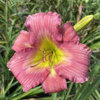
    Color clarity- a daylily is a peach base color as far as I'm concerned (I don't need science to tell me that). A pink daylily is pink onlaid peach. Just look at the backside of the petals. So, clarity is true color, and the saturation is how well it conceals the peach base. Shores Of Time has clear saturated rose color.

    Shores Of Time

    {{gwi:704701}}

    If you want an example of a lack of clarity, look at almost all of the rest. There are many flowers that are called pink but are actually a cream or peach base with a slight pink glow. A muddy color is one that has no true color, as in this seedling.

  • 19 years ago

    Been away for two days and you have all asked a lot of the questions I was going to. Thanks. I'm getting that with "500 children" you will surely have those that look nothing like the "parents"...it's just like a blonde and a brunette having a red haired child..it's in the genes somewhere. So the idea of going for say "blue" means you pick flowers that have a clear lavender or purple background??? Than there's ruffled edges and what is chicken fat. What determines an unusual form? And where did spiders come from??? I can make you crazy with questions...at least that's what DH says.

    I really find this interesting ,I am starting to wish I
    had room to play with some crosses, but alas, I only have a small area to work with....BUT, I am loading it up with as many lilies as I can. All the info makes me research more varieties so I can try to see where you going and that is fun

    Keep the pictures and info flowing...Thanks

    Janet

  • 19 years ago

    Well, I can show you "chicken fat", and you can look on the AHS website to see what the definitions of the different forms are,but as for the elusive blue? I think that's a crap-shoot,and nobody is talkin'!lol

    Betsy

    Here is a link that might be useful: Hybrizers Produce Award Winning Daylilies

  • 19 years ago

    The pollen parent is the new one with the single fan and the pod parent is the older one that is in a clump. If all of your daylilies are in clumps you should shop more.

    Edward

  • 19 years ago

    Simpleton,

    This is interesting. Please keep sharing your ideas.

    I see what you mean about pink daylilies being a peach base color and pink flowers resulting from pink inlaid on peach in a very saturated manner. Do you see clear yellows as still a peach base just well saturated with yellow or are they a different base color? How about lavender and purples?

    Mary

  • 19 years ago

    I'm glad someone is interested in things I say...but I have to add, none of these things I bring up are my ideas. I've just been around a while and spew out things that I have ingested. I am only here to accept the blame. The true villains are the many people who blazed the trails before us.

    I think the base color is cream to peach, and that may be one reason why white is not quite pure. That may not be exactly true because I never did get into the fine tuning of color. Seems like I remember there being more than one layer of base color, but the only important thing is the overall concept.

    I'm working at keeping it concise here.

  • 19 years ago

    Well Professor Wade and all others of infinite knowledge just keep spewing away please. EEEEUW...mental picture!!!

    Next question...do you need to cross spider with spider?? or were they just flukes of nature to start with and now you can cross them??

    Janet

  • 19 years ago

    Back when dinosaurs walked the earth, daylilies were orange and yellow and narrow petaled. Forty or fifty million years of breeding finally resulted in our bagels, but they are very new comparatively. It was not long ago that wide, round petals were highly sought after as breeders. So I guess spiders were flukes, but no more than fancy gold braided edges.

    Cross your spiders with spiders unless you want to venture into the unusual form category. The thing is, there are no rules because if you are lucky enough to come up with something different then you win a trophy and get to be President for a day...or sell as many as you can make. Even if it is the ugliest thing...with warts and blisters, it will sell. Be one with the flower and you shall prosper...daylilies are 99% spiritual and 1% physical. And you don't need a prescription.

  • 19 years ago

    Janet, I just bought Azure Wings which is an 11" tet true spider. I am going to cross it with the biggest edged and toothed flowers I have, hoping to get an edged spider. With no experience to back up this idea, I may be in for a surprise.

  • 19 years ago

    Well here's wishing you luck and 'May the force be with you'

    Thanks again for all your help

    Janet

  • 19 years ago

    Wade,

    I love your picture of Shores of Time. I plan on using it as a pod parent this year. It is new but the seller gave me a good clump. Other pod parents are Inherited Wealth and a white-ish seedling (Chris Salter X Micheal Miller). Pollen parents are whatever new ones are blooming. I am looking forward to using Belle Cook and JT Davis. How do you think Shores of Time X Belle Cook would turn out?

    Edward

  • 19 years ago

    Edward, I think they would be pink! Actually, I have a certain picture in my mind I guess when I plan a cross. It is based on the faults of a flower. I take it to the extreme sometimes, and I consider both SOT and BC to have the same flaw...not enough edge.

    I would cross either or both with JTD, and then add the other...(SOT x JTD)BC or (BC x JTD)SOT.

    Plus, by the time you make the second cross you might have a better eded pink to make the last cross. But if your goal is for color and not the edge, then my plan makes no sense.

    Ideally, (SOT x BC)Gary Colby would be good, but you did not gain much ground in the (SOT x BC) cross to help GC. Both have good color...so, (SOT x GC) would be better and faster (if the edge matters).

    So for me, where the edge does matter, I would make many crosses involving all three and get good seedlings to use GC on. Having a bunch of seedling pod parents is important. So, to answer your question in 1000 words or less, I would not make that cross.

  • 19 years ago

    Janet, I already have the force...smashing a square peg into a round hole kind of force. If I tilt my head to the left, maybe I can make it work!

  • 19 years ago

    Belle Cook is a northern hybridised plant and Shores of Time is a southern dormant. I think that they would be a good start for some interesting hardy daylilies. The coloured edge is not the big thing for me and I would likely cross back to Victoriam Lace to give a nice ruffle to the edge. I am also interested in raising the bud count on Belle Cook. It is a sub 20. I do like your thoughts of adding JT Davis to the mix. We shall see what is blooming at the same time.

    Edward

  • 19 years ago

    Ah yes, the dormant factor. I suggest you use all four of those mentioned and get as many seeds as you can. With 50 or more from each cross you may end up with some that have everything you want.

    Funny thing, I have not set any pods on SOT with Captain Blue pollen, but with GC pollen it has set many. If you get goos set with a certain pollen run with it.