Software
Houzz Logo Print
sequoia_stiffy

Germinating Juniper (occidentalis and communis)

18 years ago

simple in terms of just planting them and waiting or does stratification and scarification help? Any advice?

-s

Comments (11)

  • 18 years ago

    I would fall plant as soon as seed is ripe if you're collecting it. I seem to remember Dirr and Heuser Jr. indicating many junipers need warm then cold periods to overcome dormancy

  • 18 years ago

    but seriously...any advice or experience? soak in warm water for a few days/weeks?

  • 18 years ago

    I have some experience to share...but I don't think you'll like what I have to say.

    I tried to germinate Sierra Juniper seeds (Juniperus occidentalis var. australis) for several years with no success whatsoever. I collected wild seed at different times each year, from September to November, cleaned the flesh off by hand or in a blender, stratified by a number of different methods, and then planted. No luck.

    I got so desperate that I went to the academic literature, where I found this reference: Forest Science. 34(4). 1988. 1059-1066. These guys found that seeds of western and Utah juniper are "highly dormant"--the understatement of the year, IMHO. However, they finally discovered that stratification in aqueous solutions with near saturation of the solution with oxygen increased emergence to about 50%. I actually tried this, using a fish tank pump to bubble air through water in a cold room (4C) but it didn't work for me.

    I finally got discouraged and gave up! I don't know if my seed was bad, or whether Sierra juniper is perhaps even more dormant than the run-of-the-mill j. occidentalis seeds the authors were using. I know that you don't see many Sierra juniper seedlings in the wild, despite mature trees that are laden with berries.

    I'd recommend that you try the oxygenated solution approach and share your results with us.

    Shoot

  • 18 years ago

    I cleaned about an ounce of freshly collected juniper seed manually and in a yeast water mixture cold treated for 90 days and had zero germination. a small amount I didnt subject to cold storage and that batch didnt germinate either.

    That's why I said sow as soon as the seed is ripe. The seed will be warm stratified until winter, then cold stratified, then hopefully will germinate. Whatever treatment you apply may not work but if left to natural warming / and chilling cycles, some seed should germinate eventually. Might take more than a year.

  • 18 years ago

    Never tried myself, but in nature, junipers germinate after the cones have been through the digestive system of a bird. If you can find someone with a fruit-eating cagebird (e.g. a Myna), feed the cones to that, and sow the droppings. Or try to imitate the digestive process with acid (hydrochloric might be best) and a protease enzyme.

    Otherwise, the best option might be heavy abrasion of the thick seedcoat with sandpaper.

    I'd not recommend the yeast soaking, I'd think that risks killing the embryo by fungal decay.

    Resin

  • 18 years ago

    I read the same reference as treedazzled, and decided to try the alternating warm-cold, which can take several cycles. I collected seed last October from Utah juniper near Reno, NV and the White Mtns, CA; and a California juniper from Colusa Co., CA. So far I have one individual from the Reno population.

    As a generic treatment, I also soaked the berries in lemon juice overnight before extracting the seeds.

    However, realize not all junipers are alike. I'm overrun with volunteers from the Rocky Mtn. juniper under which we keep our pots in summer.

  • 18 years ago

    If anything we have too much natural regeneration of juniper here. To the point where it is a fashionable land management practice to manually remove or burn pure juniper stands to encourage more diverse plant succession. These practices are being used by city and state parks in this area, even in "natural" and "wilderness" areas.

    But that doesnt mean it's easy to grow from seed. The seedlings could be growing from seed several years old that went through several warm cold cycles. Also, as the other poster mentioned, most went through the belly of a bird.

    For a juniper species that isn't commonly cultivated you're not going to find a great answer on seed treatment in literature, and even if you did it could be affected by the provenance of your seed or chance.

    Which is why I said just fall sow fresh seed and be patient. Some will grow eventually.

    In response to pineresin's remark, I don't see how soaking the seeds in a yeast mixture overnight (which will just digest the sugars in the flesh around the seed) would subject the seed to more "fungal decay" than being naturally planted in bird manure and forest litter. Bird poop in forest litter sounds like a much better environment for fungus than my refrigerator's crisper.

  • 11 years ago

    do you think Juniperus virginiana could be different than the ones already mentioned? I've read that virginiana is somewhat easier to grow from seeds, what is you experience?

    kender

  • 11 years ago

    Hy!

    I think, juniper from seed is a question of the soil used... For example, Thuja and Chamaecyparis doesn't germinate in normal organic soil over here in germany. But if you put them in mineral substrate like quartz gravel or quartz sand, even in simple gravel with a little bit of humus, they germinate really well and in numbers...

    The same is for Pinus nigra and mugo... Normal, organic soil nearly no success, mineral (alcalic) substrate, presto... And juniper is indeed a plant of specific soil conditions - mimic them as good as possible, and success should be adjusted.

    I try this with a few J. communis seed from berrys my wife collected a few years ago. At first i stratified them, and for sowing i have mixed some ingredients for the soil.

    At first a bit of normal potting soil, some crushed mussel shell from my chickens diet, some sand, and soil from a fresh mole's hill. In the deep of the seedpots the mineralic content, above a mixture of potting soil, musselshell gravel and molehill's soil (loam), and the seeds itself are sowed in a mixture of quartz sand an a litte molesoil. I think this is the most natural close mixture possible, and time will tell, i think...

    A look at the naturally germinated seeds shows- this HAVE to work ;).


    Andreas

  • 11 years ago

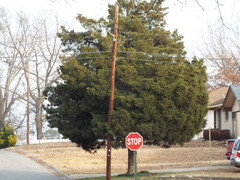
    Here''s a pic of a mature one down my street.