Software
Houzz Logo Print
auntpeach

A Mystery Pine

20 years ago

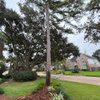
Hi everyone. I am just starting to get interested in conifers and today, saw a pine (I think) tree that was simply splendid. Trouble is, it is on a busy street corner that used to be a nursery which has long since moved away. So there's no one to ask and I don't have a digital cam with which to take a picture. Instead, I will attempt to conjure up the image with words (and hope I succeed). Any ideas will be very much appreciated.

The tree in question is shaped very much like one that's in those old picture post cards of Naples, Italy, where there's a mountain in the left foreground, the tree growing out of the mountainside, and Mt. Vesuvius in the background, puffing away. It's shape is rather like a head of broccoli (please don't laugh). The tree I saw today, which is probably about 30' tall, has a short trunk in relation to the very broad, flat top. The needles, from a distance, appear to be quite dark green and the top of the tree is very dense. At first, it reminded me of a Tanyosho pine which I had seen at a nursery, but in checking pictures, I'm not too sure that's what it is.

Oh Learned Ones, does anything sound like this tree to you? Please excuse my unenlightened description; I'm sure I would be able to give more details if I could park near the tree and take a good close look. I need to do that, I know. Any guesses will help me begin more serious research. Thanks so much to everyone.

Aunt Peach in Elgin, IL

Comments (9)

  • 20 years ago

    For the description it sound like pinus pinea (Stone Pine), but it is not hardy in zone 5, only up to 7 or so. This pine is what you will see in Italy, it is a Mediterranean Pine. Wait to see what the others have to say, they are more familiar with hardier species

    osprey

  • 20 years ago

    When I see a conifer in the shape you describe around here (I'm in the northern 'burbs), I assume that the tree has blown it's crown or been topped. I'm not an expert though.

    Judy

  • 20 years ago

    AuntPeach,

    I have no idea what it is, but what a great description. I loved the comparison to broccoli...that was worth a thousand (well, at least a hundred) pictures. :)

  • 20 years ago

    I'd agree with Osprey - it sounds like a tree that may have lost its top in a storm (or to a third-rate tree surgeon!) in the past. It needs more details for identification to species - length of the needles, how many needles per fascicle, size and shape of the cones, etc.

    Likely candidates in zone 5 would include Red Pine, Eastern White Pine, Austrian Pine, Scots Pine, Japanese Red Pine, and one or two others (that's assuming it is a pine, and not a different genus altogether, but the shape does sound more like a pine than e.g. a spruce).

    Resin

  • 20 years ago

    If not topped probably a dense-growing Austrian pine. Could have been a compact seedling variant that the nursery selected itself or purchased from another source. After many years of growth it is a 30 ft. tree, same as with a Tanyosho pine. Some conifers produce aberrant seedlings rather often when grown from seed, growers not interested in selecting variants will throw out those that do not have vigorous, normal habits creating an impression of nearly clonal uniformity being normal. You may have to visit a collection or specialist nursery to see the full range of variation in a particular species.

    Wild stands also tend to consist of trees more similar to one another than might occur in a nursery seed bed. Although these are not, of course, entirely unknown in nature aberrant habit and color forms apparently seldom survive nearly as often outside of cultivation.

    Some species give off novelties much more often than others.

  • 20 years ago

    if the foliage really is dark green,and if the bark is a dead-gray and furrowed, and the needles are 4 in. long, probably Austrian pine

    if the foliage has a bluish cast, the bark up high is orange and peeling, and the needles half that length, then likely Scots pine

    I've seen both behave the way you describe on sedate city streets

  • 20 years ago

    Hello everyone. Thank you so much for your time and for responding to my question. I took another look at the tree yesterday, took some pictures, and will be working on posting them probably tonight (if husband can make it work!). Also noticed that there are 2 trees; the largest is made up of 4 trunks and the other, just as tall, has 2 trunks. The needles are too high for me to reach and count, but I did take a shot of the closest branch I could see. Don't know if there will be enough detail to closely examine the pine cones, but both trees are loaded with them. These trees have got to be pretty hardy around here, because they are right on Ill. Route 31 where it meets Route 72 in West Dundee, Ill. This is a very busy intersection, and no doubt road salt gets splashed up into the ground during the winter. So they must be able to withstand some pretty brutal conditions. In looking up into the tree yesterday, it appears that the undergrowth browns out, and the new growth which faces outward is nicely green. I took some closeups of the bark, so if anyone is knowledgeable enough to ID a tree by its bark, maybe we can get closer. I'd bet these trees have been there 30-40 years, the trunks are probably close to 18" in diameter (not circumference). I did not see any evidence of either up-limbing or top trimming; the trunks just naturally branch widely into a beautiful flat canopy.

    Thanks for giving me some possibilities; I'll search for some photos and see what I can find. Maybe I can get to the nursery that used to have that corner, which moved a few towns west, and find someone who knows something ... but from what I see at that store, most of the kids probably weren't even born when the nursery moved!

    So the search continues -- but again, many thanks to you all for your responses.
    Aunt Peach in Elgin, Ill.

  • 20 years ago

    If you are able to go there easily, as apparently you are since you went right back look for cones on the ground. Bring a few in comparatively good condition back and post photos of those, as well as the shots of the bark and the overall appearance of the trees if you can. Another thing that you can do is pick up dead needles and post pictures of those, preferably with a ruler for scale. They will have all the feaatures of the live needles except the green color.

    If there are somehow no cones on the ground get a shot of them on the branches that shows how abundant they are and how they are arranged, with some pines this is fairly distinctive. A picture showing a silhouette (outline) of the cones dispersed along one of the branches might be adequate.

  • 20 years ago

    Thanks to everyone once more for your ideas. As luck would have it, I was able to locate a guy at the nursery's new location who knew a little about the pines. He said his great grandfather planted them at least 100 years ago, and really lavished care on them over the years, as did his descendants who were subsequent owners of the nursery. He told me they are Tanyosho pines, also known as table top pines. This very helpful man and I discussed their similarity to the Italian Stone pine (the one in the Naples, Italy post cards), and was very happy to find someone interested in his g-g'father's handiwork. So the mystery is now solved, and when I do find a local source for a Tanyosho and bring it home, I hope to call up all the patience in the world while it's growing. We are still planning on posting some pix so all of you can see these 100+ year old trees. Thank you again.
    Aunt Peach in Elgin, IL

Sponsored
Peabody Landscape Group
Average rating: 3.5 out of 5 stars8 Reviews
Columbus' Reliable Landscape Design & Contracting