Software
Houzz Logo Print
nippersdad

Forsythia on bank

18 years ago

Carroll County gave me the most wonderful ditch a couple years ago and I have been trying to think of things which could be planted on the bank which could survive. The ditch/bank in question is about sixty or seventy feet long and ten feet tall with approximately a 45 degree slope of pure Georgia red clay. The top of the bank is planted in holly, oak, cedar, redbud and crape myrtle which will block the western sun. It has an eastern exposure and is about six hundred feet from the nearest spicket.

I would love to plant azaleas or some other evergreen flowering shrubs, but fear that they would not get the kind of water necessary to keep them alive. I know that forsythia is not an evergreen, but it is easy to propagate, well nigh impossible to kill and is pretty in the spring. Does anyone have any better suggestions? Perhaps something that would feed/give cover for the birds?

Comments (9)

  • 18 years ago

    Is the area wet at all or just average? Does the area get plenty of morning sun?

    If it is wet, then something like the native Clethra 'Hummingbird' (which flowers in the summer) is a good spreader.

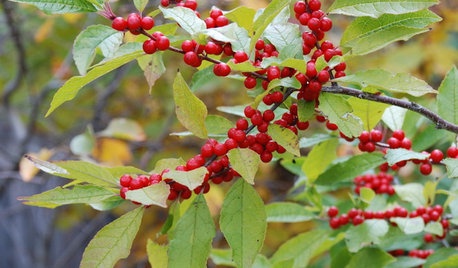
    An evergreen native shrub that is not used a lot is Florida Anise (Illicium floridanum). Inkberry holly is another one.

    Using native shrubs will attract native insects that birds feed on (but not an excessive amount - it's hard to say 'attracts insects' and have it be taken in a positive way!).

    Anything you plant will need some supplemental watering the first year, as I'm sure you realize.

  • 18 years ago

    Hello Esh:

    Thanks for the suggestions! I cannot use the bottom of the ditch because of litter buildup and the County bush hogging the ditches, so I am limited to the bank itself. Anything planted on the bank will have to be pretty drought resistant which leaves out the clethra. They will have to be planted on terraces carved out of the bank and mulched, mulched, mulched! On the plus side, it has an unobstructed eastern exposure; unfortunately this would cause winterburn in the Florida Anise.

    The inkberry holly would fit in nicely with the tapestry hedge that I have growing on the top of the bank. What might be a couple of other natives which could coordinate well with the holly? Beautyberry, blueberry?

  • 18 years ago

    Clethra tolerates wet, but could do ok in regular conditions. So keep it in mind if you come across it.

    Beautyberry is good and has nice fall interest with the berries. Blueberry is fine and can have really spectacular fall color. Another nice shrub now that you are considering deciduous is Mapleleaf Viburnum. Nice flowers, berries and the fall color can be almost fluorescent. Beautyberry fall color is yellow so it could be a nice combination.

    If you're going to shop for natives, I do recommend Nearly Native Nursery in Fayetteville. I hope that would be convenient for a day trip from Carroll County.

    Here is a link that might be useful: Nearly Native Nursery

  • 18 years ago

    Thanks for the recommendations, those colors sound like they would be great in combination! I have heard of Nearly Native Nursery, even talked to the owner a couple of years ago, but have yet to get out there. This probably would be a good time to go. Thanks for reminding me about them!

    I have some of the Clethra Alnifolia near my patio and it smells wonderful when in bloom. I have yet to put out the shorter, white variant that I found last spring (drought!). If I can ever get the soil conditions just right, I hear that it spreads. I would love for it to naturalize in amongst the azaleas, Daphne and sweetshrub. I have never seen anything which brings in the native pollinators like that stuff!

  • 18 years ago

    How about Rosemary? Heat and drought tolerant. You can buy small ones for about a buck apiece. Space them 2 to 3 feet on center. Water twice a week for a month, once a week for a month, then once every two weeks for the 3rd month. Then, never water them again!

  • 18 years ago

    A friend has a large forsythia hedge, and it's very nice. I have a bank like yours and, inspired by hers, planted a section with forsythia, which was itself doing very nice in heat and drought until the County came and nuked it with spray. This with plastic streamers on to let them know the bank was planted. I'll be replanting forsythias eventually.

    I planted a WEST-facing bank--right by the house where I knew they'd always have domestic-garden watering--with a dozen healthy 3-gallon inkberry hollies, setting them into well-prepared soil like babies in the spring and keeping them watered well until I had to cut back (kept watering them even as I cut the rest of the garden off). Most of them are dead now. I was shocked at how vulnerable my young plants were. In a normal year, two- and 3-gallon forsythias got dumped in holes far from watering and took care of themselves. Maybe the inkberries could handle west heat once maturely established, and maybe they would do okay with an east exposure (?), but I'd try out just a couple first.

    Both our native mockoranges and their cultivated relatives are drought-tolerant and have a dense branching habit that still makes a decent screen in winter.

  • 18 years ago

    Hello Alex and Rosie:

    Alex: I love the idea of Rosemary on a bank, so Mediterranean! But I worry that it would be overtaken by larger, faster growing weeds planted by the birds. Poke salad is one of their favorites! We have it in every nook and cranny and I never seem able to get all of the roots out.

    Rosie: What is it with the Counties and their sprays and bushhogs? I fought ours for ten years until I finally gave up. Transplanted everything fifteen feet in and donated a verge to them (hence, the eastern grand canyon). I can finally sleep in mornings without being thrown out of bed at the first sound of a work crew at dawn! I would understand if there were some possibility of plantings invading the road, but that is never the case.

    Those west facing banks are really hard to deal with, I commiserate. That sun is like battery acid. I planted our western property line in Mary Nell and Nellie R. Stevens Hollies mixed with Leyland Cypress and dogwood. They seem to take the sun well as long as they are mulched and now give grateful shade and wind protection behind the hedge. Those Nellie R. Stevens seem well nigh indestructible; I find that I use them in all of my troublesome spots. Later, they prune up to make nice small trees too, if you wish to underplant them. I wonder if they would not make a good mixture with the forsythia in your application?

    Thanks for the warning on drought tolerance of newly planted Inkberries. With our current weather patterns, that is really good advice.

  • 18 years ago

    Nippersbad, a wince and wry smile at the reminder of what it's like to jerk alert, hair standing on end, at the sound of, oh, no, is that a work crew.

    Nellie sounds like a great companion for forsythia's relaxed arching charcter and is a nice green, too. I like that idea.

    In another area I have one lone dwarf Burford and have come to like it a lot and will be putting in more where I can't use more height. I'd still like something with a more relaxed branching for that west bank, though, and had thought he tinkberries would be perfect, with berries for the birds, also. Parney cotoneaster has berries and an arched habit, but I prefer its lighter grayer green as an accent rather than the main mass.

  • 18 years ago

    I'd be hesitant to plant a rosemary hedge. I've seen them around the Bay Area (CA), where they look great, but not around here. They seem to up and die now and then. We lost one one winter and it wasn't that cold. A friend of ours lost one, too (a different year). Ours now has some sort of scale that I don't know how to get rid of. I'm not going to put a systemic in my herb garden. I'll replace it eventually and plant the new one somewhere on the other side of the lawn.

    I wonder if anything will keep out poke weed. It grows in the leyland cypress border (50' l and 30' h x 15' w) that came with the house. Admittedly it's hard to see it in there.

    Mike

Sponsored