Software
Houzz Logo Print
jjj111q

identifying basil damage (small circles)? *PHOTOS*

17 years ago

Hi everyone,

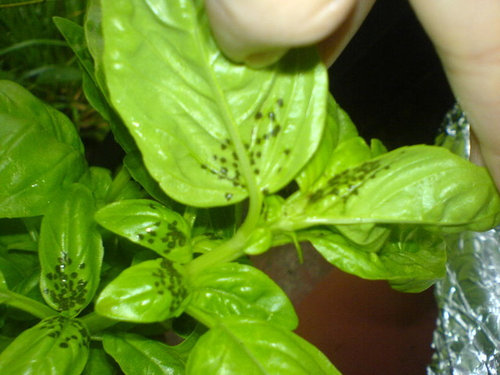
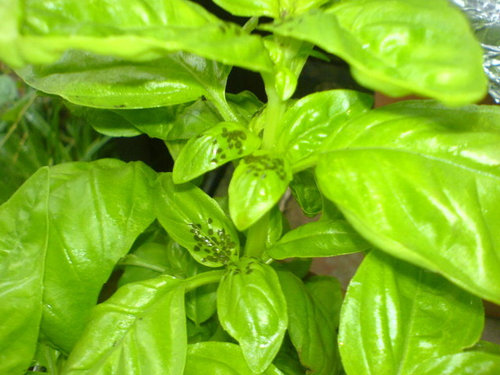
I accidentally chose a basil seedling that had a little damage on 2 of its leaves, but it seemed old so I wasn't worried. It's now spread to some other leaves, and I can't tell if it's an insect or a disease-- any help on identifying what is causing the damage, and how to deal with it? There are clusters of small dark circles (about 2 mm in diameter) that are visible on both the top and bottoms of the leaves. The old damage that I hadn't noticed is light gray/golden in color, but the new damage (pictured) is almost black. (You can click on the photos for larger versions).

I can't rub any of this off, and the circles themselves seem thinner than the leaf, though I'm not positive. SHould I remove all the damaged leaves or leave them on? I really don't want this to spread to the rest of my plant! Thank you so much for your help!


J

Comments (14)

  • 17 years ago

    On another forum that pattern of thinned foliage with black spots that eventually turn into holes was identified as "four lined plant bug" damage.

    That's the common name, needless to say!

    I have the same thing on a number of plants and have killed a number of the red/black nymphs when I've seen them but haven't "caught" them actually on the plants yet.

    Could be a possibility. Others said they hadn't seen damage from this "bug" for a number of years but prolonged cool/wet weather may have contributed to that situation

    Photo in link shows damage I saw on my plants including Basil which looks very much like yours.

    They say it's limited to May/June but any damage bothers me...LOL.

    Here is a link that might be useful: Four Lined Plant Bug

  • 17 years ago

    I had these bugs decimate some catnip a few years back. I thought they were cucumber beetles before I could get a proper ID.

    Here is a link that might be useful: four-lined plant bug

  • 17 years ago

    A lot of people mistake the 4LPB for cuke beetles. But even without being able to tell a beetle from a 'true-bug', that damage is a terrific clue, isn't it?

    J, there is no reason to remove the leaves of your basil. Just keep your eye out for the adults, nymphs, and eggs. Remove them when you find them.

  • 17 years ago

    Thanks everyone! On one hand, I'm relieved that it's a bug and not an infection of some sort. On the other hand, I feel terrible that I've introduced a bug from the nursery into my garden. Just seeing that damage made my skin crawl! Hopefully I can see the nymphs/bugs/eggs and get rid of them before they decimate all herbs...

  • 17 years ago

    Spray with neem as mentioned in another thread. Its the best treatment used for edible leaf plants.

  • 17 years ago

    I have the same damage on my oregano, but I haven't seen any bugs. And what is neem and where can I get it?

  • 17 years ago

    Ever use the internet to do a search?? Its found in many places on line, as well as Home Depot and Lowes. Safer is one brand thats organic, as are most other neem based products. Neem is from a seed that comes from India and is prized for its abilities to protect many plants agaist some diseases and insects along with other uses. It can even be used as an insect repellent. If you need an actual source, for it, I suggest that you simply type in the word 'neem' in the search window here at the top or bottom of the forum and it will bring up literally hundreds of threads that contain every single bit of info about it. There is even a company selling a highly concentrated product and its mixed with castle soap to act as an emulsifier to be mixed with water. Gardens Alive also sells the product as do many nurseries and other sources for plant supplies. If the holes in leaves are large, it could be due to slugs. My brussels sprouut leaves are badly damaged by slugs that feed at night. Its been extremely wet around here and thats increased sulg populaton. Yesterday, I put down a barrier of Surround, a white powdery clay and it irritates slugs, as does diatomatious earth (swimming pool filter medium), which should prevent the slugs from damaging the sprout leaves further. Here, I also saw many lady bugs, as I used to release them every year. I found many of their larve browsing my sunflower leaves as well a crawling all over my dill. Lady bug large love aphids and I never see aphids anymore.

  • 17 years ago

    Can't use swimming filter DE as a pest control, krogers. NOT!

    Not only does it contain much more of the very dangerous silica (compare about 70% to 3%, respectively), but it is processed in such a way that renders it nearly useless in the physical abrasion required to kill insects and other arthropods. I surely hope that you are not using pool filter DE in your garden. Look for food/horticultural grade DE in the garden centers or in any good agricultural supply store.

  • 17 years ago

    Rhizo-
    Apparently your not aware that the DT IS organic and can be used for crawling pest control. I am not saying the swimming pool filter type EXACTLY, nor did I imply that, but here in the link below is a 50 pound bag being sold by a company that ONLY sells ORGANIC products for the garden. Most suppliers for the pool filter product do not mix the earth with anything else either, and I have even used it for filtration for tropical fish tanks. Guess you don't know everything? They also have one thats mixed with pyrethrins as a spray.

    Here is a link that might be useful: ORGANIC DIATOMATEOUS EARTH

  • 17 years ago

    You referred to 'swimming pool filter medium'. I felt it very necessary to explain to others that they must NOT use pool filter DE, but to look for food/horticultural grade DE.

    It appears that you don't understand what DE is comprised of. It is a natural product (except for the heat/chemical treated pool filter DE), consisting mostly of silicon and several other minerals. As with any product containing crystalline silica, it's imperative that one avoids the inhalation of the air-borne dust. It can cause silicosis.

    Pool filter DE can contain as much as 70% crystalline silica, which is one reason I felt the need to clarify your statement. Food/horticultural grade DE typically contains a mere 3%, or less. But you will still find a warning about inhalation on the label, krogers. Including the product you linked us to.

    Again, krogers, you are implying that organic products are perfectly safe. They aren't. However, if we educate ourselves about the products we choose to use and use them wisely and with care, 'organic' products can be reasonably safe for us, for non-target organisms, and for Earth.

    The chemical make-up of natural DE, by the way, is perfectly safe and has long been given approval by the FDA as an additive. If you eat anything with grains or nuts, you are likely ingesting a daily dose of DE. It's also fed to livestock and poultry and pets. But you just can't inhale the stuff, or apply it in a location that is visited by bees and other beneficial insects.

  • 17 years ago

    Rhizo,
    You must get some kind of sick pleasure and enjoy trying to undermine my writings. I only stated that the pool filter medium is made from the same DE. I deal with the USDA not FDA. You simply read in too much and assume the worst, then post your assumptions. As in the past, you also seem to have a small followng with a vile attitude as well, so just drop the issue and carry on with your rants elsewhere.

  • 17 years ago

    I never try to undermine your posts. I just try to clarify some issues, always for safety's sake.

    Why don't you share your experiences with Surround? I've been hearing a lot about it but have not tried it as yet. What plants did you use it on, and to protect against which pests?

  • 17 years ago

    Rhizo_1: I, for one, appreciate the clarifications.

    Don't really care for the hostile responses to the clarifications though.

    F.DeBaggio

  • 17 years ago

    why bother, you or others will just attack me all the time.