Software
Houzz Logo Print
hzdeleted_21887604

Tree Ideas - Front Yard Grouping

18 years ago

I have three diseased trees that will be removed this spring - the gardens beneath are shade beds and I would like to keep them that way. Do you have any suggestions for a tree that would look good if 3-5 (most likely 3) were planted as a group? Any experience? I welcome any suggestions.

P.S. You can see the area in the 3rd row of pictures on my member page.

Comments (19)

  • 18 years ago

    Love the idea of maintaining a grove of one kind of tree. The Polly Hill Arboretum has some really nice groupings of Stewartia pseudocamellia, and there are more narrow varieties that would also work well. It's a really lovely tree; mine are all in full sun and doing well, although I've read that they prefer some afternoon shade.

    If you have less room between them than Stewartia would require - can't tell from the photo how large this area is - and if you don't need *too much* height, then Heptacodium miconioides (Seven Sons Flower) might be a good choice. It grows really quickly, so you can get inexpensive, small plants (i.e. from Bluestone) and have a grove of flowering trees in short order.

  • 18 years ago

    hostabuff - what kind of trees are those growing there at the moment? Looks like oak and/or hickory? What kind of exposure and terrain is your front yard...ie which direction does it face, is it dry soil, irrigated, how well drained is it? All those would influence the choice of tree that would do well there. What disease is causing problems with the existing trees?

  • 18 years ago

    Diggingthedirt, thank you for some suggestions. I will definitely look into these varieties.

    Ellen, this was farm land about 30 years ago. When the property was no longer farmed, a lot of different trees seeded - therefore most of the trees are about 20 years old. This grove of locust and one elm were left in front of the house and the locust are the trees I want to remove (this locust tree is considered a junk tree and seeds easily along our highways). The tree's very brittle limbs drop with the slightest wind and recently large limbs have come down in storms. An arborist was consulted and suggested I remove them within the year. Two of the three have very large scars - I'm not sure what caused them, however the most damaged is definitely loaded with carpenter ants. I plan on leaving the elm, however I am not sure if this is the right decision (considering Dutch Elm disease and the cost of a separate removal).

    This is the north side of my property and the area gets a strong northeast wind in winter. A large maple to the east of this area casts a fair amount of shade until mid day. The soil throughout my yard is dry; however this area is well amended and includes drip hoses for my Hosta collection.

    I have been spending some time with Dirr's Hardy Trees and one option I wanted to explore is Okame Cherry. Dirr notes that the upright habit lends to a group planting. It also blooms before the hosta leaf out (the locust tree flowers are pretty and smell wonderful, however the flower petals can stick on the hosta leaves if it rains and create rot spots if I don't clean them off). Okame Cherry is also a fast grower - up to 2 ft per year...

    I hope to have a few options, because I may not be that successful finding the one I want...I welcome more suggestions.

  • 18 years ago

    Reading Dirr is always time well spent! There are some great cherries - I have a little cornus mas, which has nice tiny yellow flowers in very early spring, before the leaves appear, but it would probably be too small for you in this spot. There are a couple more I've always wanted to try ... I'll have to google Okame.

  • 18 years ago

    How about a grouping of paper birch? Or a Paperbark Maple (Acer griseum) with its interesting exfoliating bark. I would have suggested River Birch with its nice peeling bark but it tends to prefer moist areas.

  • 18 years ago

    Ellen - Birch was my original choice, however I thought I read somewhere (hosta forum) that it is hard to grow hosta under birch. I need to follow up on this and find out what type of root system the birch have (I won't grow anything that has lots of tiny surface roots like maples). In addition to the nice glow of the white bark, I think the bark would be a nice contrast against my grey house. Thanks for another great suggestion.

  • 18 years ago

    This is a somewhat smaller tree than a large locust or elm, but one of my favorite trees is Cornus alternifolia (pagoda dogwood.) Around here it grows well in full sun or full shade, though it is thicker in full sun. It tends to be a multiple trunked tree and has interest all year - flowers (like elder/Sambucus flowers), berries (and therefore birds) and nice winter branch structure. You might want to limb it up some to allow your hosta enough light. You can find cultivars with chartreusy-gold and green leaves ('golden shadows' AKA 'Wstackman') or white and green leaves('argentea'.) I live in a valley that often channels wind, and even the one with total exposure in the field does fine.

  • 18 years ago

    Hostabuff - just a few questions - will the Elm and Maple stay as canopy trees? What kind of Maple is it? Are you looking for trees that grow large and become part of the canopy or small-medium sized trees that will be understory trees?

  • 18 years ago

    The maple will stay; just because I don't want to loose the shade (all other maples have been removed). Even with new plantings, I won't have the amount of shade I have now with my canopy trees - even canopy trees with sparse limbs. I believe the maple is a silver maple (it does not get the great fall color of a sugar maple). The maple is on my property line vs. the island I want to plant in.

    The elm is in question. If I bring in heavy equipment to remove the other trees and then this tree becomes diseased, a removal at a later date would be much more costly and risk the new plantings. Plus, if I really want the plantings to look nice and take advantage of a grouping - one tall canopy tree in the group may look odd.

    I am thinking that under story trees would be better with the size of my home. However I can make an argument of canopy trees so you simply view the home through the trunks as you do now. I don't know what a recommended rule of thumb is for plantings in front of a home (if there is such a thing in the landscape world). I'm open to your thoughts.

  • 18 years ago

    If you remove the Elm as well as the Locusts, won't that also remove a lot of the shade? Unless you purchase large specimens when you replant, it will be some years before they provide enough shade for a shade garden. Unless that maple casts a lot of shade. But then, you wouldn't want a Maple too close to the garden anyway, because they have thirsty roots that are impossible to compete with. (Btw, if there's any chance it's a Norway maple, they are a scourge, terribly invasive and should be shot on sight! hehe.)

    I keep envisioning Cornus florida - Flowering Dogwood - to replace the locusts. For multiple season interest, wildlife value, and beauty, you can't beat them. You irrigate the area which will be to their favor as would the partial shade. You could choose one of the new cultivars, maybe use both pink and white flowering Dogwoods.

    I also like Cornus alternifolia, and have 8 small trees growing in my nursery area. Cornus kousa is really nice too.

  • 18 years ago

    Second Cornus alternifolia as well as Cornus kousa choices.

  • 18 years ago

    Terrene,
    Thanks for the suggestion on the white and pink dogwood. This is a combination that my husband has always wanted and he might just get his way this year!

  • 18 years ago

    Btw Hostabuff - Locust is reputed to have some of hardest, most rot resistent wood in the tree world. If you are at all interested in doing anything with the wood, you should try to save the trunks. People make natural fenceposts with Locust that last for decades, no pressure-treatment required!

    I've had major tree work done to remove large Norway maples, and removed nearly a hundred smaller trees and saplings between 1-9" diameter with the help of a friend. I've saved smaller logs, tops of large branches, and long straight thin trunks from Norway maples. I plan to build trellises, bird perches, rustic deer fencing, and whatever else inspires me with the leftover wood. I only wish I had Locust!

  • 18 years ago

    My first thought was also Cornus florida, and I would also look at Cornus alternifolia. I would hate to cut down a healthy elm, but maybe you should pop over to the tree forum to see what their advice is about that.

    Beautiful gardens, hostabuff!

  • 18 years ago

    Beautiful bark, hostabuff. I take it the flowers will be early enough to not drop petals on the hosta leaves?

    The only other thing I would worry about is winter moths, if you have them in your area. I have some kwanzan cherries planted by the previous owner, and these are a favorite food of winter moths and/or other kinds of caterpillars. While I don't really care too much about the damage to the trees' leaves, the droppings on the perennials below causes a really nasty mess - easily as bad as flower petal drop.

  • 18 years ago

    Before it's too late...
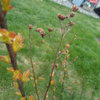
    Beside being somewhat prone to aphids, scales and borers, Prunus maackii is very famous for its girdling roots (you could see them on your own picture) and I have a very high doubts that your hosta collection will stand a chance to survive, forget about prospering there.

    Beside that....Amur Chokecherry is a gorgeous tree, especialy if proper pruning for maintaining the shape of the three is done every 3-4 years.
    Sorry for raining on your parade.

  • 18 years ago

    Ego45...That's the kind of information I need to hear. I read about girdling roots, however I was so excited about the tree's four season interest that I lost sight of my original objective. I was a little concerned if they would produce the amount of shade I was look for. Back to the drawing board.

  • 18 years ago

    I forgot what is the sun conditions there and don't want to go thru all posts, but just from a memory here are several trees that will be hospitable to hostas and will look attractive if planted as a small grove
    -red oak,
    -all malus family (crabapple etc),
    -all fraxinus family (f. iodocarpa has a very attractive red berries),
    -phellodendron (would be one of my first choices as a hosta's 'cover')

    Good luck in your search :-))

Sponsored
Haus Studio
Average rating: 4.8 out of 5 stars28 Reviews
Franklin County's Preferred Custom Cabinetry & Design Studio