Software
Houzz Logo Print
sedum_gal

Moving a mature Magnolia....?

17 years ago

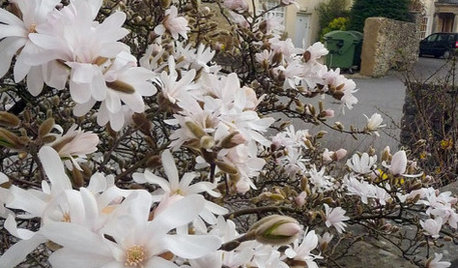
Hi, I'm doing some gardening for a friend who wants to relocate a lovely little M. stellata, about 7'x7'. I am hesitant, remembering Magnolias resent root disturbance and all.

Can this be successfully moved? If so, can someone give me particulars on how to go about it?

Also, he's convinced his soil is poor and wants to have it hauled away and replaced (!) with an amended 3-way mix or something similar. I'm finding his soil is not that bad (free draining, sandy loam) and would rather see him spend the money on compost and other soil building components.

What are the pitfalls to bringing in new soil, and if I can't convince him otherwise, what kind of mix would be preferable?

Thanks for any counsel---

~Lisa

Comments (6)

  • 17 years ago

    It's not that they resent root disturbance, it's that they tend to have very widely spreading roots given their size so a significant portion tends to be lost at transplanting. Fall is realy the ideal time, as it gives the roots a better chance to regenerate. If you can't wait, do it soon, before the tree breaks dormancy, which tends to be early in these parts:-) And take the largest rootball you can manage. 7'x7' is about half size or less for a stellata, but I'd still expect it to have a significantly wide root system.....and a LOT of surface roots.

    As to the soil.....if it drains well, then forget about the effort and expense of removing and replacing. That is really unnecessary! Adding a good amount of organic matter will go a long way in improving virtually any soil situation and is all that is necessary in most soils. Check out Cedar Grove Compost or Bailey's (in Snohomish) or look at other bulk providers like Sky Nursery in Shoreline or Pacific Topsoils. And just go with the compost product of your choice.

  • 17 years ago

    Being a deciduous magnolia it may, in fact die if a quite generous soil ball is not gotten. Mix organic amendments into the entire potential rooting area or use them as mulch over unamended planting hole backfill instead. Do not amend the planting hole only, this is counterproductive.

  • 17 years ago

    Thank you both for the good advice---
    I think the Magnolia would be fine where it is, and my friend is willing to consider designing around it.
    He wants to bring in a large quantity of compost, however, and rototill the entire bed in which it sits. Is this going to cause any problems?
    We will try to avoid the Magnolia's root zone with the rototiller.
    Also, is 6" of compost too much? Not enough?
    Thanks again for any further comments...

    ~Lisa

  • 17 years ago

    Don't till its roots. This are likely to extend well beyond its branches.

    "Â Ideal soils, from a fertility standpoint, are generally defined as containing no more than 5% OM
    by weight or 10% by volume
    Â Before you add organic amendments to your garden, have your soil tested to determine its OM
    content and nutrient levels
    Â Be conservative with organic amendments; add only what is necessary to correct deficiencies and
    maintain OM at ideal levels
    Â Do not incorporate organic amendments into landscapes destined for permanent installations;
    topdress with mulch instead
    Â Abnormally high levels of nutrients can have negative effects on plant and soil health
    Â Any nutrients not immediately utilized by microbes or plants contribute to non-point source
    pollution"

    Here is a link that might be useful: Compost overdose.pdf

  • 17 years ago

    Gosh...once again Linda makes statements that are just not supported by scientific evidence. And you'll notice she never bothers to provide any of her own :-)

    4-6 inches of compost or other organic matter tilled into infertile or otherwise deficient soils is not going to cause any problems. If spread over a reasonably wide area, it's certainly not going to account for anywhere near 10% of total volume. And compost has a very low nutrient content, so there is very little likelihood of "high levels of nutrients" having a "negative effect on soils or plant health". This is most often the complaint used against synthetic fertilizers, not compost or other organic matter or even organic fertilizers. And since what nutrients ARE present in compost or other OM are in an insoluble form and must be digested by soil organisms before being accessed by plants, the chances of them leaching into groundwater or streams or contributing to pollution is virtually nil.

    Compost or other organic matter added to soils (not individual planting holes but entire planting areas) that are not routinely mulched (lacking in organic matter) or evidence extremes in drainage (too slow or too fast) improves soil texture and tilth and helps to retain moisture while at the same time benefitting drainage. It also encourages increased populations of beneficial soil organisms which improve plant health and offer increased disease suppression.

    I think Linda needs to take a class in basic Soils Science :-)

    But I wouldn't till around the magnolia, either. Apply the compost as a mulch in this location but feel free to work it into the soil a sufficient distance from the roots.

  • 17 years ago

    Thanks, Gardengal...
    I appreciate your input. I find some of Dr. Chalker-Scott's assertions contradicting to what I was taught in soils class a few years ago.
    My friend's soil is on the sandy side, and has not been top-dressed or amended much at all, so we're proceeding with the 4" of Cedar Grove, tilled in, avoiding the magnolia.
    Thanks again for the advice!

    ~Lisa